Are Whirlpools Dangerous? Can You Survive One?
Most natural whirlpools are smaller than their reputation. The ones that kill people are usually made by dams and spillways. Here is what is dangerous, what to do if you are caught, and how to stay away.
On this page
Most whirlpools are smaller and less dramatic than their reputation. A natural whirlpool in a river or lake can still tip a small boat or tumble a swimmer, and strong ones have currents below the surface that pull objects down. The deadliest ones are often made by humans: low-head dams, spillway intakes and the churning water below larger dams. The Association of State Dam Safety Officials ties low-head dam hydraulics alone to dozens of deaths a year on U.S. waterways.
This guide separates those two cases, explains what to do if you are caught, and covers the avoidance habits that matter more than any survival technique. For where whirlpools form on a map, see whirlpools in lakes and rivers. For the physics, see what causes whirlpools in water.
The short answer#
- Natural whirlpools call for a life jacket, a calm head and a swim toward the outer edge, not the center. Cold water is often the bigger danger.
- Low-head dams are far more lethal. Officials call them “drowning machines” because the recirculating water below the dam can trap boats and people.
- Spillways and dam outlets pull water at speed. Stay out of the marked zones.
- We could not find a national count of deaths caused by whirlpools themselves, so treat any precise statistic you see online with caution.
What a whirlpool actually is#
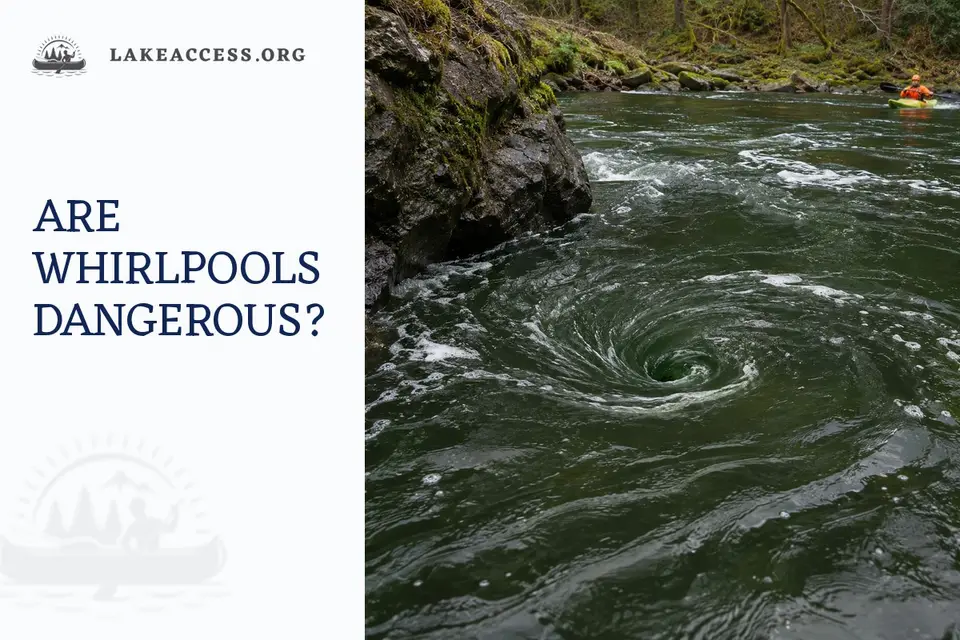
A whirlpool is a body of rotating water produced by opposing currents or by a current running into an obstacle. Small ones appear at river rapids and downstream of weirs and dams. NOAA describes a maelstrom as a strong whirlpool that forms when opposing currents meet, and notes it can be dangerous because of powerful currents beneath the surface that can pull surrounding objects into its vortex.
Fiction exaggerates this. The Moskstraumen off Norway is the one Edgar Allan Poe wrote about in his 1841 story. Descriptions of it as a gigantic funnel that reaches the seabed are wrong; it is actually a system of currents and crosscurrents. Large whirlpools can still be a real hazard to small craft, but ships being swallowed whole is a story, not a fact.
Where the real danger is#
Low-head dams#
A low-head dam is a manufactured structure that runs across a river from bank to bank. Water flows over the crest continuously. The Ohio Department of Natural Resources says these dams range from a drop of about six inches to 25 feet, and that a two- or three-foot dam face with moderate flow can be as dangerous as a big one.
The danger is the hydraulic below the dam. Water that falls over the crest forms a hole at the base and a recirculating current that carries a victim underwater, pushes them away from the dam, brings them to the surface, and draws them back against the base again. The Association of State Dam Safety Officials (ASDSO) says the roller circulates people and boats “for an extended amount of time,” and that churned, aerated water can be up to a third less buoyant than still water, so even a life jacket is not a guarantee. The surface can look calm while this happens below.
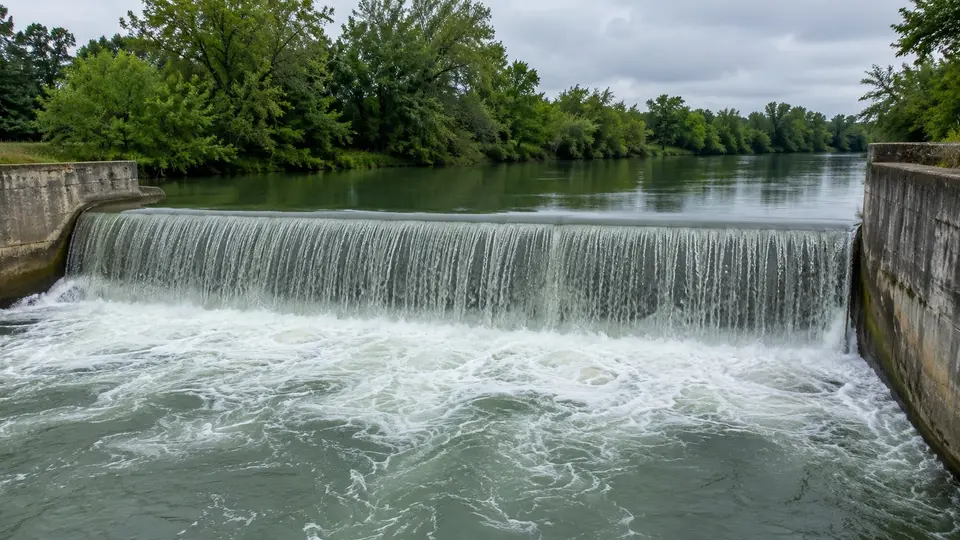
Ohio DNR adds that dams can be hard to spot from upstream and are often unmarked, that the concrete side walls block escape routes, and that rescues are dangerous and often unsuccessful.
Spillways and intakes#
A bell-mouth spillway, also called a morning glory or glory hole, is shaped like an inverted bell so water enters around the entire perimeter. At Lake Berryessa in California, the Monticello Dam spillway has a 72-foot-diameter entrance narrowing to a 28-foot exit pipe and drops more than 200 feet. It is protected by barriers and a buoy line, and it spills only when the lake is very high. A woman died there in 1997 after swimming out to the spillway and gripping its edge; the local irrigation district said at the time that no one else had been documented falling through. In February 2025 the Bureau of Reclamation issued a safety advisory when the lake reached the spillway again.
Below dams#
The U.S. Army Corps of Engineers’ Walla Walla District restricts access to hazardous water immediately upstream and downstream of its dams. It explains that turbulent boils and powerful currents can swamp, capsize and trap boats and people, that flows can increase within seconds, and that hydropower, spilling and lock operations often begin with little or no notice. In that district’s restricted areas, boating, swimming and wading are all prohibited.
Cold water#
The National Weather Service says cold shock can be as severe in 50-60°F water as in 35°F water, and that gasping can be triggered by water as warm as 77°F. The gasping and rapid breathing of cold shock occur during the first two to three minutes or more. A whirlpool that would be a nuisance in warm water can drown you in cold water.
What to do if you are caught#
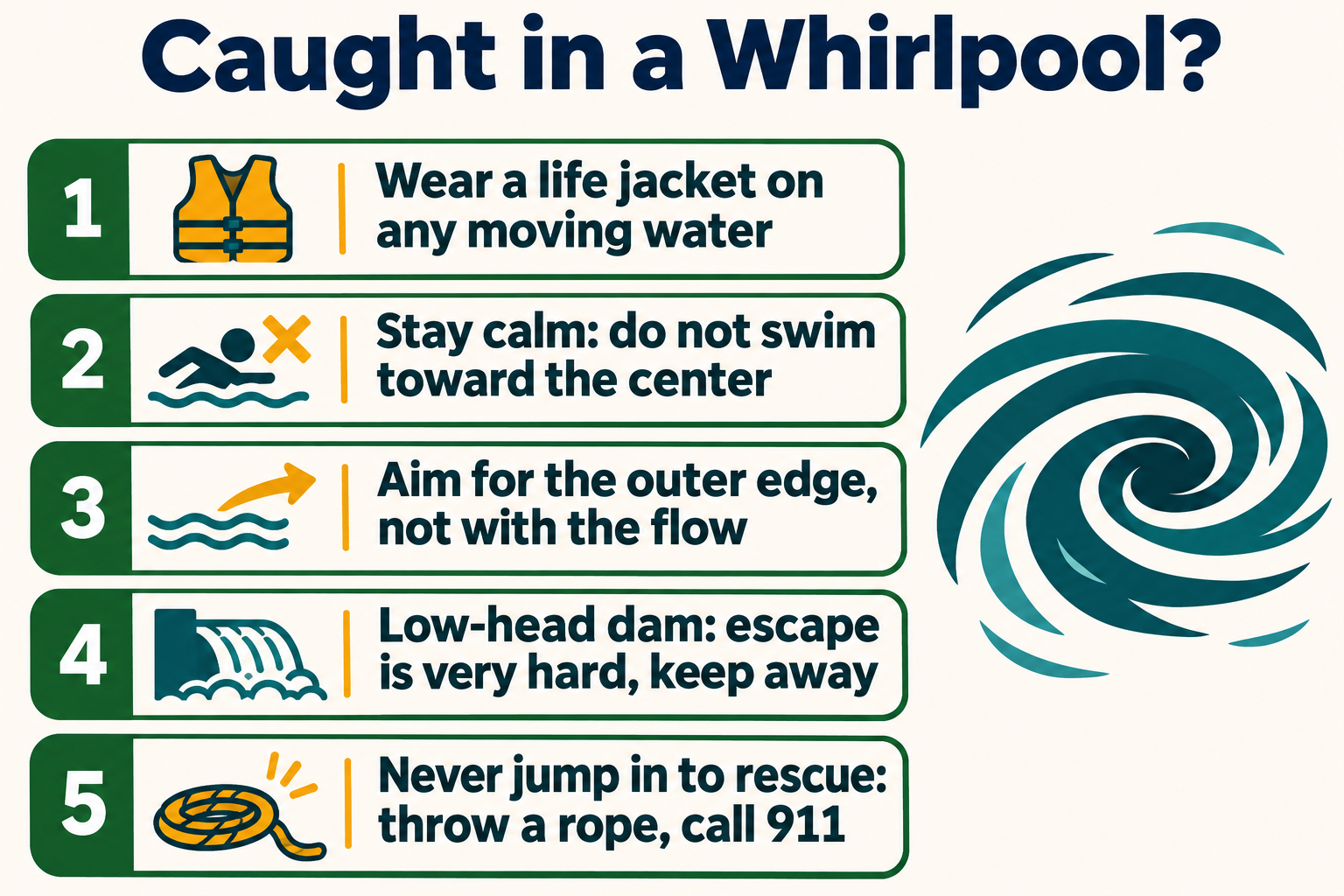
In a natural whirlpool. Live Science, citing champion kayaker Ken Whiting, advises wearing a life vest and helmet on moving water, and not entering water at all if you see signs of whirlpools. If you are in one, aim for the outer edge rather than the center. In a boat or kayak, try to keep the boat from filling with water. In some cases the whirlpool throws you back out.
Below a low-head dam. Advice varies, which says something about how hard this situation is. Ohio DNR calls it nearly impossible to escape the hydraulic and recommends tucking your chin down and drawing your knees to your chest with your arms around them, in the hope that the current carries you along the riverbed and out past the boil line. Paddling instructors quoted by Paddling Magazine teach swimming for the side or swimming for the bottom, and ASDSO describes washing out along the bottom of the hydraulic, which it admits can mean the counterintuitive step of removing your life jacket. None of this is reliable. Treat it as a last resort and avoid getting there.
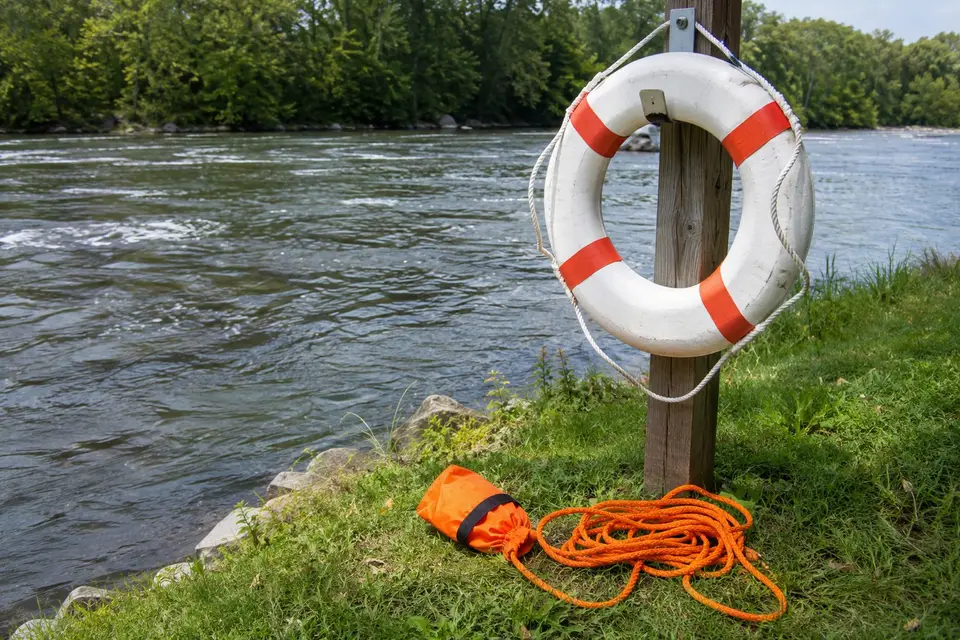
Rescuing someone else. Do not go in. Ohio DNR says to throw a line from shore, wear a life jacket if you do anything, call for help, and never approach the hydraulic in a boat unless trained. ASDSO says rescues at these dams often result in multiple deaths, including well-meaning bystanders.
How to avoid them#
- Learn the water. Scout the river and ask local boaters where hazards are. Ohio DNR recommends boating with experienced people.
- Look for the signs. A smooth horizon line across a river where the stream meets the sky can mean a dam. Concrete retaining walls on the banks are another clue.
- Portage. Carry your boat around all dams, and re-enter the river well downstream of the boil.
- Respect buoys and signs. Marked zones near spillways and dams exist because people have died there.
- Wear the life jacket. In the Coast Guard’s 2024 boating statistics, drowning caused about three-quarters of deaths and 87% of the drowning victims did not wear a life jacket. Our lake boating safety guide has the basics.
- Know the cold. Dress for the water temperature, not the air.
A reminder that lakes can drain, too#
In November 1980, a drilling rig on Lake Peigneur in Louisiana pierced a salt mine under the lake. A vortex drained the lake into the mine, swallowing the rig, eleven barges, a tugboat and 65 acres of surrounding land. No people died, though three dogs did, and all 55 miners escaped. A fisherman piloted his small boat to shore. It is a rare, human-made event, but it shows what water does when it has somewhere to go. For more on how lakes drain, see how they drain lakes.
Frequently asked questions#
Can a whirlpool pull you under?
A natural eddy or small whirlpool can spin a swimmer or small boat and push them under briefly, and NOAA notes that strong whirlpools have powerful currents below the surface. The most dangerous cases are hydraulic rollers below low-head dams, where water recirculates and can hold a person against the dam face.
Can you swim out of a whirlpool?
In a natural whirlpool, the advice is to wear a life jacket, stay calm, and aim for the outer edge rather than the center. Below a low-head dam, officials say it is nearly impossible to escape the hydraulic by swimming, which is why avoiding the dam is the real answer.
Are whirlpools like the ones in movies real?
Not as portrayed. The famous Moskstraumen off Norway, the model for fictional maelstroms, is a system of tidal currents and crosscurrents, not a funnel that reaches the seabed. Whirlpools are still dangerous to people and small boats.
Do lakes have whirlpools?
Natural lakes rarely do, because still water lacks strong opposing currents. Swirling water in lakes is usually near outlets, intakes and spillways, or on reservoirs behind dams.
What should I do if someone is caught in a whirlpool or below a low-head dam?
Call 911. Throw a rope or float from shore. Do not go in, and never approach the dam in a boat unless you are trained. Rescue attempts at hydraulics often kill the rescuers too.
Sources#
- Whirlpool, Wikipedia
- Weird Ocean Phenomena (Maelstrom), NOAA National Ocean Service
- Whirlpools: Facts, formation and survival tips, Live Science
- Lowhead Dam Safety, Ohio Department of Natural Resources
- Public Safety Hazards, Association of State Dam Safety Officials
- Avoid the Drowning Machine: Low Head Dam Awareness Month, National Weather Service
- How To Escape A Hydraulic, Paddling Magazine
- Restricted Areas Around Dams, U.S. Army Corps of Engineers Walla Walla District
- Cold Water Hazards and Safety, National Weather Service
- Visitors urged to use caution in the Lake Berryessa Recreation Area, Bureau of Reclamation
- Is Glory Hole Dangerous?, Lake Berryessa News
- Lake Peigneur, Wikipedia
- Coast Guard reports fewest boating fatalities in more than 50 years, U.S. Coast Guard
Written by
We started this blog as a place to go to when we had questions about buying our first home on the lake. There was a lot of information on the internet, but we always spent hours...