Whirlpools in Lakes and Rivers: Where They Form and How to Stay Safe
Calm lakes rarely have whirlpools. They form where water is forced to turn: at dams, spillways, river bends, confluences and obstacles. Here is where to look and how to stay clear.
On this page
A whirlpool needs a reason to turn. Wikipedia defines it as a body of rotating water produced by opposing currents or by a current running into an obstacle. That one sentence explains the map. A calm lake with no strong currents rarely has a whirlpool of any size, while rivers, outlets, dams and spillways make them regularly.
This guide covers where whirlpools form on lakes and rivers and how to stay clear of the ones that matter. If you want the survival side first, read are whirlpools dangerous. For the physics, see what causes whirlpools in water.
Where to look#
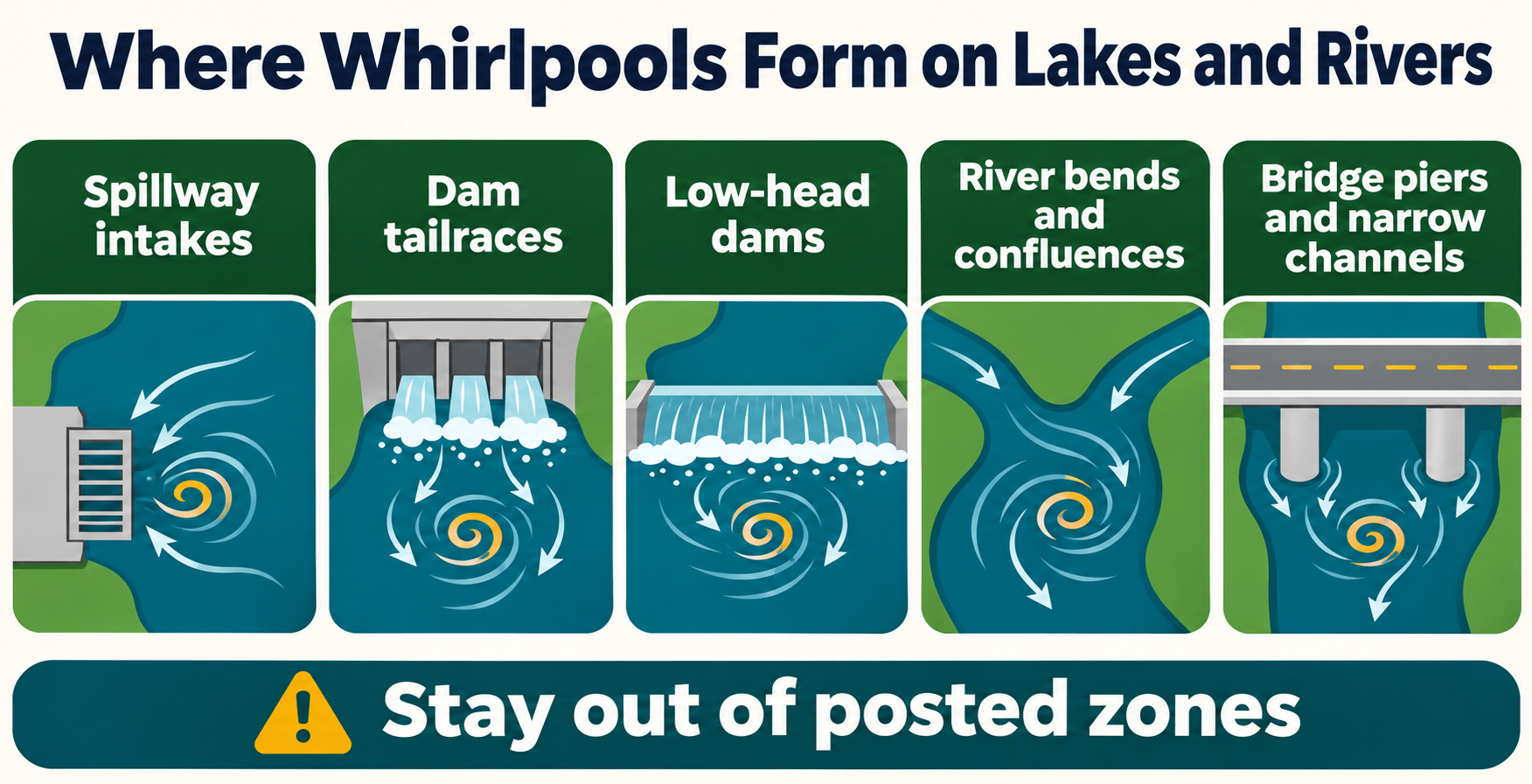
Spillway intakes#
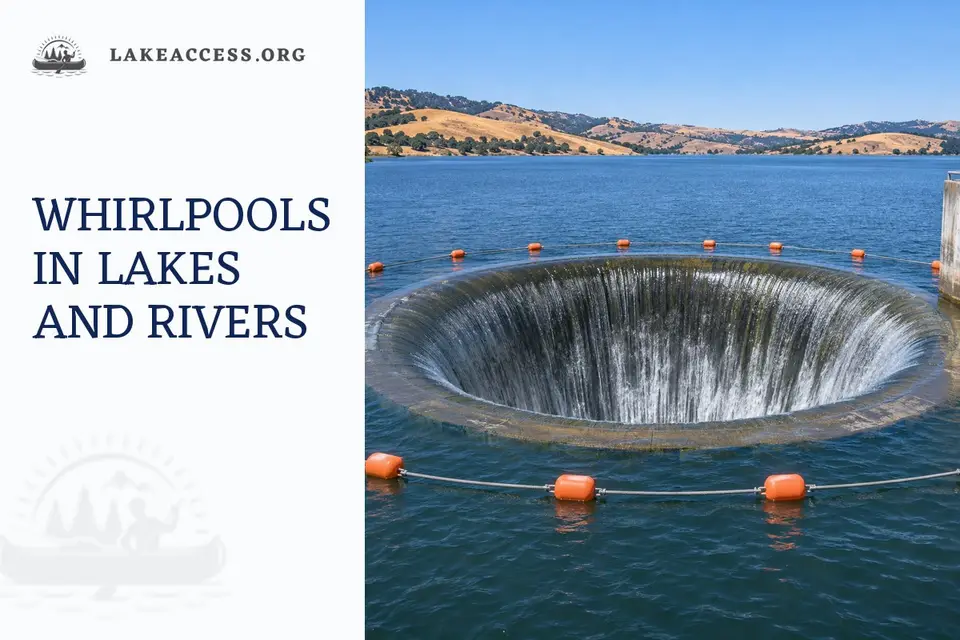
A bell-mouth spillway, also called a morning glory, glory hole or shaft spillway, is shaped like an inverted bell so water can enter around its whole perimeter. It carries a reservoir’s overflow down a shaft and out through a pipe. The one at Lake Berryessa in California has a 72-foot-diameter entrance, narrows to a 28-foot exit pipe and drops more than 200 feet. It is fenced off with barriers and a buoy line and, as of 2019, had spilled only 25 times in 60 years, but when it does, water pours over the rim from every side. A 2019 local report described it flowing about four feet over the edge.
If you boat or swim on a reservoir, learn where the intake is and keep well outside the buoy line. Our guide to why Lake Mead is so dangerous covers another big reservoir with its own hazards.
Dam tailraces#
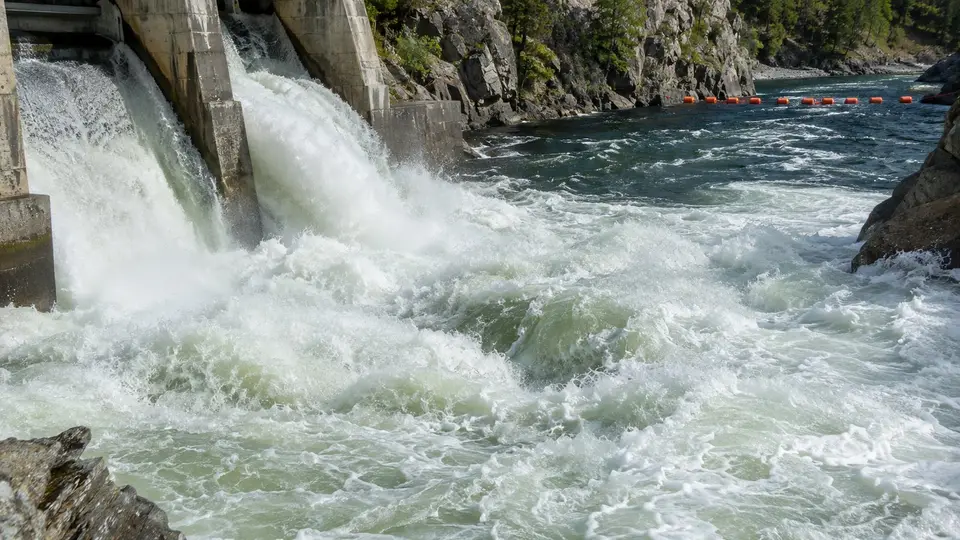
The water below a dam can be more dangerous than the water above it. The U.S. Army Corps of Engineers’ Walla Walla District says hazardous conditions below dams come from multiple discharge sources, large releases, rapidly changing conditions, highly turbulent water and cold water. Flows can rise within seconds, turbine discharges can create turbulence and undertows, and boils and upwellings can swamp, capsize or trap boats and people. The district prohibits boating, swimming and wading inside its restricted zones.
Low-head dams#
A low-head dam runs bank to bank across a river, and water flows over the crest all the time. The hydraulic it creates at the base can recirculate a boat or a swimmer for a long time. Ohio’s natural resources agency says the drop can be anywhere from 25 feet to about six inches and that two or three feet at moderate flow can be as dangerous as a tall one. Dams are hard to see from upstream and often unmarked.
River bends and confluences#
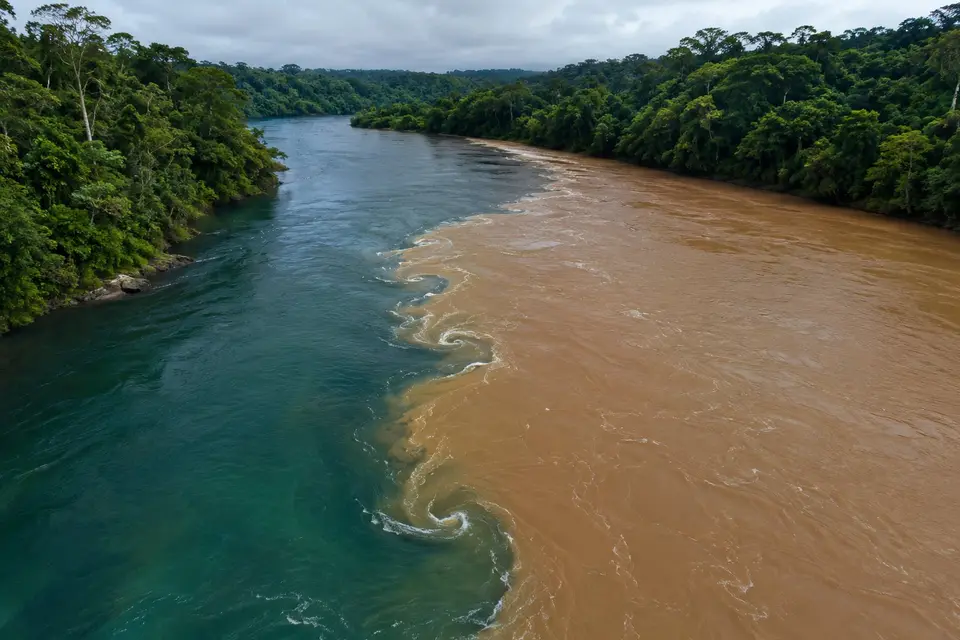
Where two currents meet at an angle, they cannot pass straight through each other, so they turn and swirl. Live Science describes whirlpools as forming when water moving in different directions meets and interacts. On a river this shows up as eddy lines and small, short-lived whirlpools along the seam where two flows join, and on the inside and outside of sharp bends where the current changes direction.
Bridge piers and narrow channels#
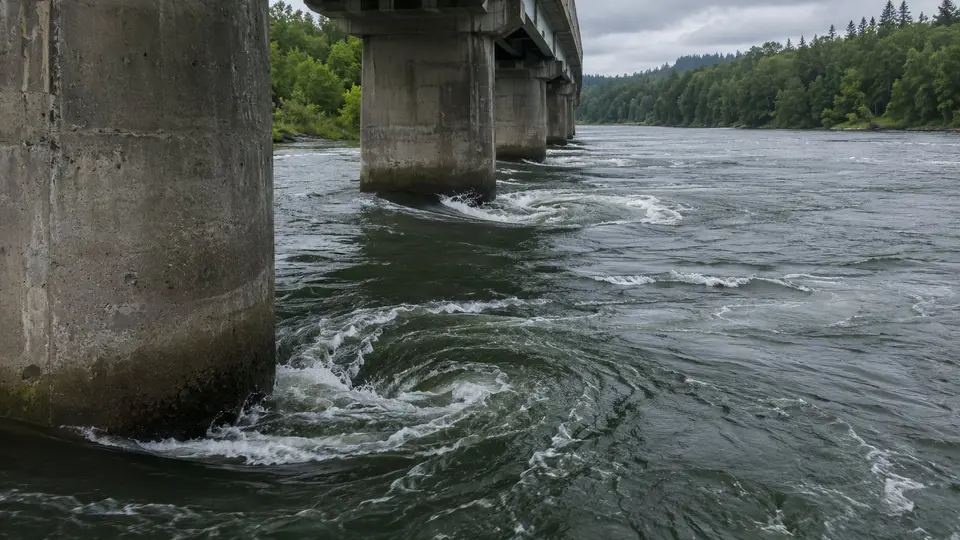
Any obstacle in a current can shed eddies. A bridge pier, a rock or a channel constriction forces the flow around it and leaves swirling water behind. This follows from the standard definition of a whirlpool as a current running into an obstacle, and it is why the water downstream of piers often swirls. Most of these are small eddies, not dangerous vortices, but they can spin a kayak or a small boat sideways, especially in high water.
Lakes versus rivers#
Lakes. With little current, lakes mostly lack the opposing flows that make whirlpools. The exceptions are at the edges of the lake system: where streams enter, where the lake drains, and around dams, intakes and outlet structures. On a reservoir, the main risk is near the dam.
Rivers. Every river has a current, so whirlpools and eddies are routine. Most are small. The concern is the combination of a strong current and a structure.
Both. Water temperature matters as much as the swirl. The National Weather Service says cold shock can be as severe at 50-60°F as at 35°F, and that gasping can be triggered by water as warm as 77°F. A small eddy that tips a boat into cold water becomes a drowning risk quickly.
A human-made exception#
Whirlpools in lakes are usually tied to structures, and in one famous case, to a drilling accident. In 1980, a rig on Lake Peigneur in Louisiana pierced a salt mine beneath the lake, and a vortex drained the lake into the mine. Nobody died, but it swallowed the rig and eleven barges. It is the exception that proves the rule: where whirlpools form in lakes, people usually built something there. For routine drainage, see how they drain lakes.
Staying safe: a checklist#
Before you launch
- Check a map or a local source for dams, weirs, spillways and intakes on your route.
- Read posted signs and learn where buoy lines and restricted zones are.
- Check the flow. Releases from dams can change quickly.
- Dress for the water, not the air, and wear a life jacket.
On the water
- Watch for a smooth horizon line across a river where the stream meets the sky, and for concrete retaining walls. Both can signal a dam.
- Stay outside barriers and buoy lines around spillways and dams.
- Portage around dams and re-enter well downstream of the boil.
- Treat eddy lines and the water downstream of piers with respect, especially in a kayak. Our list of the best lake and river kayaks can help you choose a stable boat.
If someone is in trouble
- Call 911.
- Throw a rope or float from shore. Do not go in, and do not approach a hydraulic by boat unless you are trained.
For general boat safety, see our lake boating safety guide. For hazards beyond whirlpools, see do lakes have rip currents and how to know if a lake is safe to swim in.
Frequently asked questions#
Do lakes have whirlpools?
Natural lakes rarely do, because a whirlpool needs opposing currents or a current running into an obstacle, and still water has few of either. Swirling water in lakes is most likely near inlets, outlets, spillway intakes and other structures, especially on reservoirs behind dams.
Where do whirlpools form in rivers?
Wherever moving water is forced to turn or meets an obstacle: below weirs and dams, at rapids, where two currents meet, and downstream of bridge piers or rocks. Wikipedia notes that small whirlpools appear at river rapids and downstream of weirs and dams.
Can a spillway pull a boat in?
It can if the boat is too close. The Association of State Dam Safety Officials warns that if a spillway crest is unmarked and unprotected, boaters in the reservoir can be drawn over it. Barriers and buoy lines exist to keep you out of that zone, so stay outside them.
Are whirlpools below dams dangerous?
Yes. The U.S. Army Corps of Engineers’ Walla Walla District restricts boating, swimming and wading in hazardous water immediately upstream and downstream of its dams, because flows can change within seconds and turbulent boils can swamp, capsize and trap boats and people.
Can I tell a low-head dam from upstream?
Sometimes. Ohio DNR advises watching for a smooth horizon line where the river meets the sky, and for concrete retaining walls at the banks. Dams are often unmarked, so scouting and local knowledge matter.
Sources#
- Whirlpool, Wikipedia
- Spillway, Wikipedia
- Whirlpools: Facts, formation and survival tips, Live Science
- Restricted Areas Around Dams, U.S. Army Corps of Engineers Walla Walla District
- Public Safety Hazards, Association of State Dam Safety Officials
- Lowhead Dam Safety, Ohio Department of Natural Resources
- Is Glory Hole Dangerous?, Lake Berryessa News
- Visitors urged to use caution in the Lake Berryessa Recreation Area, Bureau of Reclamation
- Cold Water Hazards and Safety, National Weather Service
- Lake Peigneur, Wikipedia
Written by
We started this blog as a place to go to when we had questions about buying our first home on the lake. There was a lot of information on the internet, but we always spent hours...