

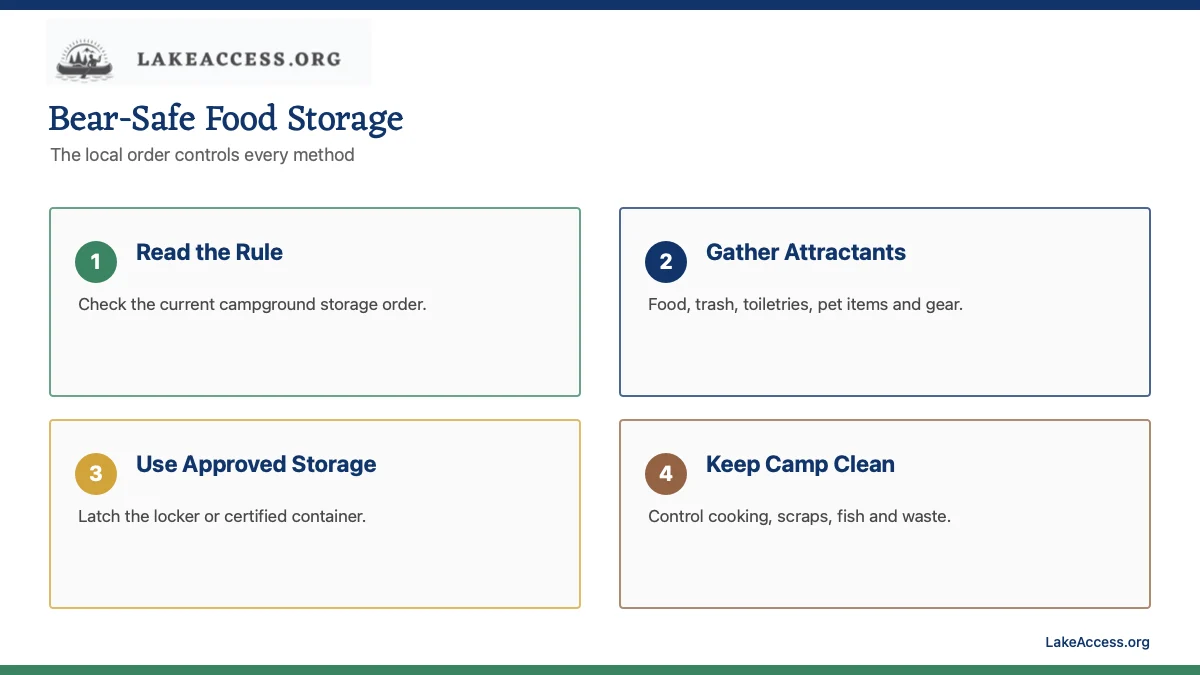
Quick answer: Follow the exact food-storage order for the campground. Put food, trash, toiletries, coolers, pet food, cooking gear and every scented item in the required locker, approved bear-resistant container or vehicle method whenever they are not under immediate control. Never keep attractants in a tent, soft-sided shelter or open truck bed, and do not assume a hang or vehicle is legal everywhere.
Decision table
| Decision point | Evidence to collect | Do not assume | Safe next step |
|---|---|---|---|
| A locker is provided | Current campground rule, locker dimensions and working latch | That the locker is reserved or large enough | Pack to fit and keep it closed and latched |
| A vehicle is available | Local day/night vehicle rule and vehicle type | That every park permits overnight vehicle storage | Use only the method the managing agency authorizes |
| Backcountry canister required | Approved-product list, capacity and itinerary | That any hard container or hang qualifies | Carry the approved canister and keep it locked |
| Fish are cleaned or trash accumulates | Cleaning-area rule and bear-resistant disposal schedule | That burning or burying removes odor | Use designated facilities and remove waste promptly |
Define food as the agency defines it
Yosemite treats any scented item as food for storage purposes, including drinks, trash, toiletries, sunscreen, soap and empty coolers. Other parks publish their own list, but the principle is consistent: packaging and human perception do not determine whether an item attracts wildlife. Collect attractants into a controlled system before arriving.
Include pet bowls and food, dishwater equipment, grills, stoves, fishing bait and clothes or packs contaminated with food. Do not leave a closed cooler on a table and do not count a zipper, tent vestibule or pickup bed as bear-resistant.
Use lockers and canisters correctly
A steel locker protects food only when completely closed and latched. Measure bulky coolers before the trip and keep the locker available rather than filling it with non-scented equipment. Shared lockers cannot be privately locked unless the operator expressly permits it.
Approved bear canisters must be on the current local list, fully closed and placed according to the agency's instructions. Yosemite requires canisters in its wilderness and prohibits food hangs there, while another jurisdiction may publish a different permitted method. Generic hanging diagrams must never override a current order.
Do not generalize vehicle storage
Some parks permit specified vehicle storage while others restrict it by time, vehicle construction or bear activity. Yosemite, for example, limits ordinary car storage and directs campers to lockers after dark. A hard-sided RV may be treated differently from a soft pop-up.
Read the exact campground rule every trip. Close windows, vents and doors as required, remove visible attractants and crumbs and never store food in an open bed or strapped outside. If the rule is unclear, use the most protective available approved method and ask a ranger.
Keep cooking, fish and waste controlled
Prepare only the food needed, keep attractants within reach while actively cooking and return them to storage immediately. Clean the table and ground, strain dishwater only where directed and use bear-resistant trash or recycling containers. Never burn food or scented packaging unless the agency explicitly allows it.
Fish remains and bait can attract wildlife. Use designated fish-cleaning stations and disposal instructions; do not leave remains at shore, bury them beside camp or throw them into shallow water. Report a bear that obtains food or repeatedly enters camp to campground staff.
Build one current conditions packet
A reservation confirmation is not a conditions report. Save the managing agency’s alert page, campground page, road status, weather forecast, water conditions and emergency contacts shortly before departure. Note the page timestamp and the time you checked it. Social posts can reveal questions, but an order, warning or closure must come from the agency that has authority for the campground, road, water or incident.
Conditions at home, in the nearest town and at a lake campsite can differ sharply because of elevation, terrain, wind exposure and distance from a weather station. Search the exact campground, access road and lake rather than relying on a broad county forecast. Download critical pages and a map for offline use, but recheck live information whenever service returns.
Confirm the operator’s current rules
Food storage, fires, generators, shoreline use, vehicles, pets, quiet hours and emergency procedures vary by jurisdiction and may change under temporary orders. Read the current campground rules and alerts, then call the ranger station or operator when wording is unclear. Advice that is acceptable in one park can be illegal or unsafe in another.
Ask whether potable water, restrooms, dump stations, docks, gates and emergency phones are operating on the actual dates. A campground shown as open may have reduced services, and a road shown on a general map may be seasonal, gated or unsuitable for the vehicle and trailer.
Choose a safe route to shelter and exit
Before unloading, walk the designated site and look up, down and toward the water. Check for damaged branches, leaning trees, unstable slopes, drainage channels, low ground, erosion, sharp drop-offs and a blocked vehicle path. Do not move barriers, create a new pad or camp outside the assigned boundary to improve the view.
Identify the substantial building or enclosed hard-topped vehicle you will use for severe weather, and time the route in ordinary conditions. Keep keys, shoes, medications, headlamps and essential layers accessible. Every adult should know the campground address or coordinates, the exit direction and where the group will reunite if cell service fails.
Treat the lake as a separate environment
Warm air does not prove warm water. The National Weather Service warns that sudden immersion can trigger involuntary gasping, rapid breathing and loss of useful movement before classic hypothermia develops. Check water temperature as well as air temperature, wear an appropriate life jacket around docks and boats, and keep children and pets within active reach near the shoreline.
Wind over open water can rise quickly and make paddling, docking and tent management harder than conditions in a sheltered parking area suggest. Use the relevant National Weather Service forecast and local marine or lake products when available. Return to shore early; a campsite reservation is never a reason to launch or remain on the water in deteriorating conditions.
Pack dry layers and a no-cook backup
Bring a waterproof outer layer, insulating midlayer, dry sleep clothes, warm hat, spare socks and a protected set of critical clothing for each person. Store bedding and emergency layers in waterproof containers until shelter is secured, and keep a dry change available rather than wearing every layer at once.
Plan meals and water that do not depend on a campfire, open kitchen or operating campground utility. Fire restrictions, wind, wildlife activity or a closure can make the original cooking plan unusable. A stove may also be restricted by a temporary order, so verify the current rule and carry food that can be eaten without cooking.
Use explicit leave-now triggers
Write down the events that end an activity or the stay: an evacuation order, closure, thunder, smoke beyond the group’s plan, rising water, falling branches, unsafe wind, loss of the only exit, cold-stress signs or failure of essential shelter. Decide before the trip who monitors alerts and who has authority to call the stop.
Leaving early is risk control, not a failed trip. Do not wait for every camper to agree once an official order or a defined trigger occurs. Pack the vehicle so departure essentials are reachable, keep enough fuel for a detour and avoid parking where another vehicle or falling limb could trap the route.
Make the communication plan work without one phone
Share the campground name, site number, access road, vehicle description, group roster and expected return with a trusted person who is not on the trip. Give that person the managing agency’s contact and a clear time for escalation. Do not promise routine check-ins when the destination has unreliable coverage; explain the communications gap and the action to take only after the agreed deadline.
Carry the tools appropriate to the location, which may include a charged phone, power bank, battery weather radio, whistle and a satellite messenger with an active plan. Test equipment before departure and understand what it can and cannot do. A message shown as sent is not proof that emergency help received it, and a map app does not replace directions downloaded for offline use.
Set up for a clean departure
Keep the parking spur, road and turnaround clear. Store footwear, keys, headlamps, outer layers and essential personal items in known places after each use. Avoid a camp layout that requires dismantling a kitchen, moving a boat trailer or searching through several bins before anyone can leave. The safest arrangement remains within the designated site and respects campground traffic rules.
At night, secure gear against ordinary wind and wildlife without creating trip hazards. Keep guy lines visible, maintain a lighted route to the vehicle and restroom, and do not run cords or loose equipment across another person’s exit path. Close fuel containers and follow fire, stove and generator rules; convenience never overrides a temporary restriction or manufacturer instruction.
Plan for the people in the group
Build the plan around the least mobile person and anyone with health needs, not the fastest adult. Record allergies, essential medications and emergency contacts in the form the group can access, while protecting private information. Bring normal personal medication and supplies with an appropriate reserve, and know the location and realistic travel time to urgent or emergency care.
Assign active supervision for children and pets near water, roads, fires and wildlife. A verbal rule such as stay close is not a control by itself. Use a specific boundary, direct handoff between supervising adults and a count before every departure. If smoke, cold, wind or another condition affects one group member more quickly, use that person’s limit for the whole activity.
Use a written go, change or cancel decision
At the final check, write one of three decisions: go under the current plan, change the destination or activity, or cancel. List the official evidence and the time it was checked. A change may mean selecting an inland campsite, removing boating from the itinerary, arriving earlier, carrying water because a system is shut down or moving to a campground outside an affected area.
Do not weaken a threshold because gear is packed, money was spent or friends are already driving. Reopen the decision whenever an alert, operator message, forecast or group condition changes. The record is not paperwork for its own sake; it prevents the group from forgetting why a limit was chosen when the trip becomes emotionally or financially difficult to abandon.
Repeat the check on arrival and each morning
At check-in, ask the host or ranger about new alerts, wildlife activity, water changes, fire restrictions, forecast hazards and the location of the nearest safe shelter. If the assigned site has a hazard, stop setup and request direction rather than improvising a new campsite.
Repeat the check each morning and before a water activity. Weather, smoke, closures and shoreline conditions can change during a multi-day stay. Keep the plan simple enough that another adult can run it when the person who made the reservation is unavailable.
Camp checklist
- Read the current local food-storage order.
- Pack all food, trash, toiletries and pet items to fit.
- Use only locally approved lockers, canisters or vehicles.
- Keep the storage device closed whenever items are not in use.
- Report bear conflicts and never feed or approach wildlife.
Related LakeAccess guides
- Beginner's guide to lake camping safety
- Camping food without refrigeration
- Choosing a waterfront campsite
- Lake Kachess camping
Sources
Standards, agency procedures and product requirements can change. These official or high-trust sources were checked July 21, 2026; confirm the current rules and exact equipment before building, modifying or operating a vessel.
- NPS camping in bear country (checked July 21, 2026)
- Yosemite bears and food storage (checked July 21, 2026)
- Yosemite bear canisters (checked July 21, 2026)
- Yosemite food lockers (checked July 21, 2026)
- NPS camping safety basics (checked July 21, 2026)
- NPS bear safety and food storage (checked July 21, 2026)