How to Keep RV Pipes from Freezing While Camping
Exposed lines, hoses, valves and drain pipes are where RV plumbing freezes first. Here is what RVIA, Winnebago, Jayco, CPSC, the Red Cross and Utah State University Extension say about preventing and thawing frozen RV pipes.
On this page
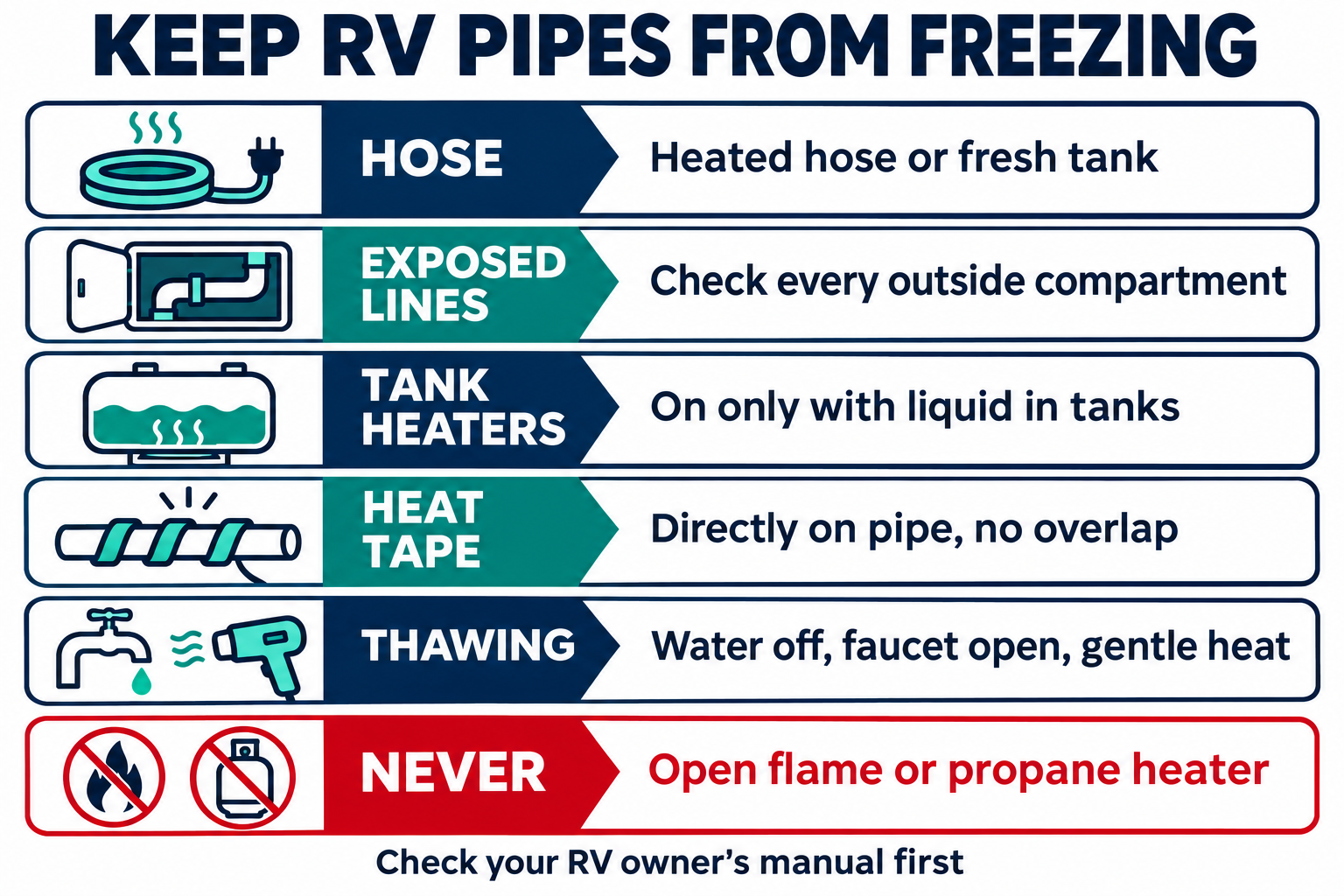
Quick answer: Keep RV pipes from freezing by protecting the parts the furnace cannot reach: the fresh-water hose and its spigot, lines in outside compartments, and the short drain pipes and valves under the holding tanks. Use a heated hose or your fresh tank, insulate and skirt the underside, run tank heaters only as your manual describes, install heat tape exactly to its instructions, and thaw a frozen line gently, never with a flame. Read your owner’s manual first: RVIA calls its own winter advice general and says the details differ by RV.
What this guide replaces#
An earlier version of this page suggested a propane heater for thawing, a “drip between 0 and 32°F” rule, and parking in the sun as a fix. We found no source for the last two, and the first is unsafe: the Red Cross and Utah State University Extension both say not to thaw pipes with an open flame or propane heater. Everything below comes from pages we read and list at the end, checked November 2026.
Why RV plumbing freezes#
Utah State University Extension puts it simply: when unprotected waterlines sit at freezing temperatures for several hours, the water freezes, expands and can crack or split the pipe. The leak shows up later, when the line thaws.
An RV has more exposed plumbing than a house. Winnebago published an owner account of a coach whose dealer said the plumbing was inside and safe as long as the coach was heated. The lines still froze, because a section ran behind an uninsulated water fill compartment. In the owners’ words, the exposed part of the lines can freeze even when the RV is heated.
The same pattern shows up under the tanks. Their tank heaters kept the tanks liquid, but the short pipe leaving the tank and the valves froze anyway.
So the first job is to find your weak spots. Open the water bay, the utility compartment and any access panels, and note every line, valve and fitting that sits outside the heated space. Your owner’s manual should show where the low point drains and water lines run.
Protect the water supply#
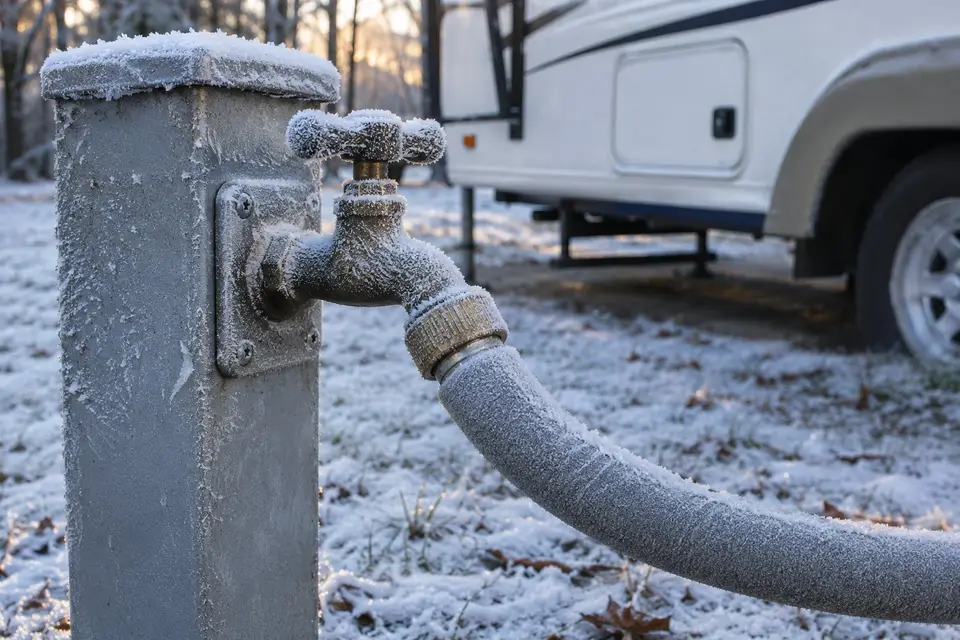
The hose. Winnebago’s owners woke up to a frozen fresh-water hose after leaving a regular hose connected overnight. Their fix: use a heated hose or rely on the fresh tank. RVIA also recommends a heated hose for a fresh-water hookup and says to keep all hoses and cables off the ground and out of the snow.
The spigot. A heated hose does not heat the campground’s standpipe. Winnebago notes that you may also need to protect or insulate the box or pipe at the water’s source, and that parks in places where freezing is common have often dealt with this already. Ask the campground when you book; our lake camping reservation guide covers what to confirm before you go.
The fresh tank option. Winnebago’s owners chose to fill the tank and disconnect. Their tank sat in a slide, so it stayed liquid as long as the RV was heated. That depends on where your tank is, so check before you copy it.
Insulate and skirt the underside#
- Foam board. RVIA suggests cutting insulated foam boards to fit between the RV frame and its base. It says this creates a barrier that helps insulate the tanks, water lines and floor and keeps cold air out.
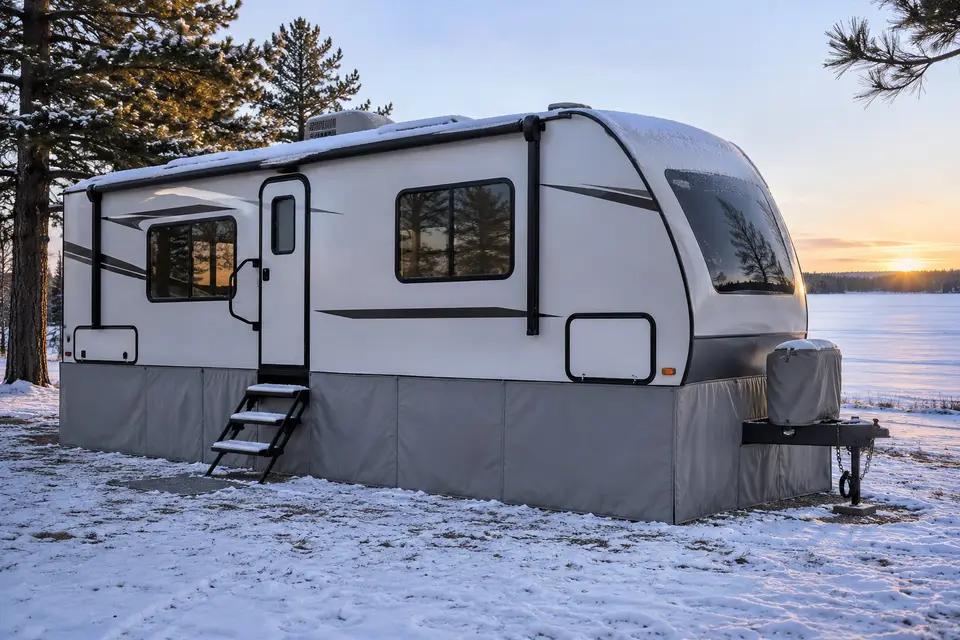
- Skirts. RVIA says RV skirts can help, though they don’t provide as much insulation. Winnebago’s owners skirted only the back end of their RV with insulation boards to protect the dump valves.
- Pipe insulation. USU says insulation has to cover pipes, fittings and fixtures completely, fit snugly and be taped. Check for leaks first, since wet insulation stops working.
- Know the limit. USU also says insulation will not protect pipes from prolonged freezing temperatures unless there is some source of heat or periodic water flow. Insulation slows freezing; it does not stop it.
Holding tanks and drain lines#
RVIA’s advice runs against summer habits: in colder months, wait to empty the tanks until you are ready to leave, and empty the black and gray tanks before the trip. It recommends adding about a quart of RV antifreeze to each tank to protect the dump valves, insulating the pipes that drain into the tanks, and wrapping the sewer hose in insulation or heat tape to help prevent ice dams.
Jayco’s 2020 Redhawk owner’s manual adds that free draining is never recommended, especially in cold weather. If you are on a sewer hookup, keep the valves closed and dump in batches.
Antifreeze type matters. RVIA says to use RV-specific antifreeze, not the kind used in cars. Jayco’s manual says automotive antifreeze and windshield washer antifreeze are poisonous and should never go in the fresh water system.
Tank heaters and heat tape#
Tank heaters. Many RVs have them as an option. In the Jayco 2020 Redhawk manual, the heaters prevent freezing in the tanks and lines down to -11°F, contingent on how the RV is set up. The thermostat-controlled tank pads turn on at 44°F and off at 64°F, while the 12-volt line heaters stay on constantly. Jayco says to switch them on when there is liquid in the tanks and it is 35°F or colder, and off when the tanks are empty. Those numbers are for that model. Yours may differ, so use your manual.
Heat tape and pipe heaters. RVIA suggests electric pipe heaters for extended camping below freezing, but only with an electric hookup or generator. Without power, they do nothing.
The CPSC safety rules for heat tape date from 1989 but still describe the basic risks:
- Inspect it before winter. Replace tape with a damaged or cracked covering, bare wires or charring.
- Buy tape sized by the maker for the pipe’s diameter and length.
- Wrap it directly on the pipe, never on top of insulation, and do not overlap it unless the instructions allow it.
- Cover it only if the maker says so, only with a nonflammable material, and never with more insulation than recommended. The CPSC says over-insulation can cause a fire.
The Red Cross suggests UL-listed heat tape or heat cable for exposed pipes.
Heat inside the RV, and its costs#
The furnace keeps interior lines warm, but Jayco warns that running it more often will substantially increase battery draw and propane use. RVIA says propane is likely to last only a few days in extremely cold weather and suggests finding a refill station before you go.
Do not swap the furnace for a camping heater at night. The CPSC says never to use fuel-burning portable heaters or lanterns while sleeping in tents, campers and vehicles. CDC says people who are sleeping can die from carbon monoxide before they have symptoms. Electric space heaters carry their own fire risk: NFPA says space heaters and heating stoves caused 73% of home heating equipment fire deaths in its 2020-2024 averages.
Winnebago’s owners kept their fill compartment from freezing with a 150-watt heat lamp. That is one owner’s setup, not a tested recommendation. Ask your RV maker before you put any heat source in an enclosed compartment.
Jayco also notes that cold-weather use can need ventilation or a dehumidifier to control condensation. If smoke or other closures change your plans, see our note on wildfire smoke and campground closures.
Dripping a faucet#
The Red Cross says running water through a pipe, even at a trickle, helps prevent freezing. USU agrees it works but says it wastes water and should only be used when more permanent methods cannot. USU also points out that hot lines freeze too. On a fresh tank, a drip drains your supply and fills the gray tank.
If a line freezes#
The Red Cross says that if you open a faucet and only a trickle comes out, suspect a frozen pipe. Then:
- Shut off the water supply and open the faucet on the frozen line. USU says to begin thawing at the faucet.
- Raise the temperature gradually. USU lists a hair dryer, heat lamp, heat tape, space heater or towels soaked in hot water, and warns to be cautious with electrical appliances in wet locations. RVIA lists a blow dryer for defrosting pipes and tanks in its winter kit.
- Never use an open flame or boiling water. The Red Cross also rules out kerosene and propane heaters.
- Keep the faucet open until full pressure returns, and keep a bucket nearby.
- Check the other faucets. The Red Cross says that if one pipe freezes, others may too.
- If you cannot find or reach the frozen section, the Red Cross says to call a licensed plumber.
Jayco’s manual says repairs due to freezing are not covered by its warranty, so it pays to find leaks before you refill the system.
What the sources do not cover#
We found no official source that gives a single “pipes freeze at X degrees” number for RVs, or that tests which skirting, heated hose or heat tape brand works best. Most of the RV-specific guidance here comes from one industry association, one owner account and one model’s manual. Your own manual outranks all of them.
For planning around cold, short days, read our shoulder season lake camping guide and how to plan a lake camping trip.
Sources#
Checked November 2026: RVIA winter tips, Winnebago winter RVing, Jayco 2020 Redhawk owner’s manual, CPSC heat tapes, CPSC heaters and camping equipment, Utah State University Extension, American Red Cross frozen pipes, CDC carbon monoxide, NFPA heating safety.
Frequently asked questions#
At what temperature do RV pipes freeze?
No source we found gives a single temperature for every RV. Utah State University Extension says unprotected waterlines freeze when they sit at freezing temperatures for several hours, and wind, exposure and your RV’s layout all change that. Jayco’s 2020 Redhawk manual says to winterize when the motorhome will be exposed to temperatures at or below 32°F, so check the manual for your own model.
Can I leave my fresh water hose connected in freezing weather?
Not a regular hose. Winnebago says to use a heated hose or rely on your freshwater tank, and adds that the box or pipe at the water source may also need protection. RVIA also recommends a heated hose for a fresh-water hookup and says to keep hoses and cables off the ground and out of the snow.
Will running the furnace keep my RV pipes from freezing?
Not always. Winnebago describes lines in an uninsulated fill compartment that froze even though the coach was heated. Jayco also warns that running the furnace more often will substantially increase battery draw and propane use, and RVIA says propane is likely to last only a few days in extremely cold weather.
Should I let a faucet drip to stop RV pipes from freezing?
It can help, but it is a fallback. The Red Cross says running water through a pipe, even at a trickle, helps prevent freezing. Utah State University Extension says the technique works but wastes water and should only be used when more permanent methods cannot. In an RV running on its fresh tank, a drip also fills the gray tank.
How do I thaw a frozen RV water line safely?
Utah State University Extension says to shut off the supply, open the faucet on the frozen line and warm the pipe gradually, starting at the faucet, with a hair dryer, heat tape, heat lamp, space heater or hot towels. Be careful with electrical appliances in wet locations. Both USU and the Red Cross say never to use an open flame. If you cannot find or reach the frozen section, the Red Cross says to call a licensed plumber.
Can I use car antifreeze in RV plumbing?
No. RVIA says to use RV-specific antifreeze and not the kind used in cars, and Jayco’s manual says automotive antifreeze and windshield washer antifreeze are poisonous and should never go in the fresh water system. See our beginner lake camping gear guide for other cold-trip basics.
Written by
We started this blog as a place to go to when we had questions about buying our first home on the lake. There was a lot of information on the internet, but we always spent hours...