
Quick answer: Plan spring and fall lake camping around the coldest credible night, current water temperature, wind and daylight, not the warmest afternoon forecast. Confirm seasonal road and campground services, carry dry layered clothing and lighting, wear a life jacket around cold water and set an early turnaround time. Leave when shelter, access or a group member's condition falls outside the plan.
Decision table
| Decision point | Evidence to collect | Do not assume | Safe next step |
|---|---|---|---|
| Warm afternoon, cold lake | Current water temperature and immersion plan | That warm air makes paddling or swimming low-risk | Dress for water temperature and wear a life jacket |
| Campground remains open | Water, restroom, gate and road service dates | That open means full summer services | Confirm each service and carry an independent backup |
| Sunset is earlier | Civil twilight, route time and headlamp capacity | That the summer activity schedule still fits | Set a daylight turnaround and carry redundant light |
| Wind rises overnight | Site exposure, gust forecast and tent limits | That a sheltered forecast point describes the shore | Use a protected legal site or leave before limits are exceeded |
Compare spring and fall honestly
Spring often combines longer days with snowmelt, cold water, mud and roads or services that have not opened. Fall can bring shorter days, rapid temperature drops, active wildlife and facilities closing before the campground itself. NPS advises checking opening dates and reduced services during shoulder seasons.
Build two separate trip plans rather than treating both seasons as simply less-crowded summer. Confirm gate times, potable water, restroom status, trash, fuel, nearby services and the last safe arrival time.
Dress for water and wind
NWS warns that warm air can create a false sense of security around cold lakes and that involuntary gasping and rapid breathing can begin immediately after immersion. Wear a properly fitted life jacket for docks, boats and paddling, check water temperature and avoid an activity when protection and rescue resources do not match conditions.
On land, use a wicking base, insulating layer and wind or rain shell, with dry sleep clothing protected from the day's moisture. Change wet layers promptly. Do not use alcohol, exercise or a campfire as a warming plan.
Recognize cold stress and act
Federal health and park guidance lists shivering, exhaustion, confusion, fumbling hands, memory loss, slurred speech and drowsiness among adult hypothermia warning signs. Hypothermia can develop after exposure to rain, sweat or cold-water immersion. This article does not replace medical advice.
Stop exposure, call emergency services for suspected hypothermia and follow dispatcher or trained medical guidance. Do not wait for a thermometer reading or assume a person who says they are fine can assess themselves accurately when confusion is present.
Protect the short-day schedule
Check sunset and civil twilight for the exact date, then work backward from the slowest person's pace, camp tasks and weather margin. Set headlamps and spare power where they can be reached before dark. A phone flashlight is not the only lighting plan. Account for the time needed to cook, secure food, collect water and prepare dry bedding before the temperature falls.
Finish water activities and exposed hikes early enough to return before cooling, fog or darkness complicates navigation. If road conditions, a late start or a closure consumes the margin, shorten the activity rather than moving the risk into the night. Put the next morning's critical gear under cover before bed so frost, condensation or overnight rain cannot disable the departure plan. Confirm the alarm and departure time before everyone sleeps.
Build one current conditions packet
A reservation confirmation is not a conditions report. Save the managing agency’s alert page, campground page, road status, weather forecast, water conditions and emergency contacts shortly before departure. Note the page timestamp and the time you checked it. Social posts can reveal questions, but an order, warning or closure must come from the agency that has authority for the campground, road, water or incident.
Conditions at home, in the nearest town and at a lake campsite can differ sharply because of elevation, terrain, wind exposure and distance from a weather station. Search the exact campground, access road and lake rather than relying on a broad county forecast. Download critical pages and a map for offline use, but recheck live information whenever service returns.
Confirm the operator’s current rules
Food storage, fires, generators, shoreline use, vehicles, pets, quiet hours and emergency procedures vary by jurisdiction and may change under temporary orders. Read the current campground rules and alerts, then call the ranger station or operator when wording is unclear. Advice that is acceptable in one park can be illegal or unsafe in another.
Ask whether potable water, restrooms, dump stations, docks, gates and emergency phones are operating on the actual dates. A campground shown as open may have reduced services, and a road shown on a general map may be seasonal, gated or unsuitable for the vehicle and trailer.
Choose a safe route to shelter and exit
Before unloading, walk the designated site and look up, down and toward the water. Check for damaged branches, leaning trees, unstable slopes, drainage channels, low ground, erosion, sharp drop-offs and a blocked vehicle path. Do not move barriers, create a new pad or camp outside the assigned boundary to improve the view.
Identify the substantial building or enclosed hard-topped vehicle you will use for severe weather, and time the route in ordinary conditions. Keep keys, shoes, medications, headlamps and essential layers accessible. Every adult should know the campground address or coordinates, the exit direction and where the group will reunite if cell service fails.
Treat the lake as a separate environment
Warm air does not prove warm water. The National Weather Service warns that sudden immersion can trigger involuntary gasping, rapid breathing and loss of useful movement before classic hypothermia develops. Check water temperature as well as air temperature, wear an appropriate life jacket around docks and boats, and keep children and pets within active reach near the shoreline.
Wind over open water can rise quickly and make paddling, docking and tent management harder than conditions in a sheltered parking area suggest. Use the relevant National Weather Service forecast and local marine or lake products when available. Return to shore early; a campsite reservation is never a reason to launch or remain on the water in deteriorating conditions.
Pack dry layers and a no-cook backup
Bring a waterproof outer layer, insulating midlayer, dry sleep clothes, warm hat, spare socks and a protected set of critical clothing for each person. Store bedding and emergency layers in waterproof containers until shelter is secured, and keep a dry change available rather than wearing every layer at once.
Plan meals and water that do not depend on a campfire, open kitchen or operating campground utility. Fire restrictions, wind, wildlife activity or a closure can make the original cooking plan unusable. A stove may also be restricted by a temporary order, so verify the current rule and carry food that can be eaten without cooking.
Use explicit leave-now triggers
Write down the events that end an activity or the stay: an evacuation order, closure, thunder, smoke beyond the group’s plan, rising water, falling branches, unsafe wind, loss of the only exit, cold-stress signs or failure of essential shelter. Decide before the trip who monitors alerts and who has authority to call the stop.
Leaving early is risk control, not a failed trip. Do not wait for every camper to agree once an official order or a defined trigger occurs. Pack the vehicle so departure essentials are reachable, keep enough fuel for a detour and avoid parking where another vehicle or falling limb could trap the route.
Make the communication plan work without one phone
Share the campground name, site number, access road, vehicle description, group roster and expected return with a trusted person who is not on the trip. Give that person the managing agency’s contact and a clear time for escalation. Do not promise routine check-ins when the destination has unreliable coverage; explain the communications gap and the action to take only after the agreed deadline.
Carry the tools appropriate to the location, which may include a charged phone, power bank, battery weather radio, whistle and a satellite messenger with an active plan. Test equipment before departure and understand what it can and cannot do. A message shown as sent is not proof that emergency help received it, and a map app does not replace directions downloaded for offline use.
Set up for a clean departure
Keep the parking spur, road and turnaround clear. Store footwear, keys, headlamps, outer layers and essential personal items in known places after each use. Avoid a camp layout that requires dismantling a kitchen, moving a boat trailer or searching through several bins before anyone can leave. The safest arrangement remains within the designated site and respects campground traffic rules.
At night, secure gear against ordinary wind and wildlife without creating trip hazards. Keep guy lines visible, maintain a lighted route to the vehicle and restroom, and do not run cords or loose equipment across another person’s exit path. Close fuel containers and follow fire, stove and generator rules; convenience never overrides a temporary restriction or manufacturer instruction.
Plan for the people in the group
Build the plan around the least mobile person and anyone with health needs, not the fastest adult. Record allergies, essential medications and emergency contacts in the form the group can access, while protecting private information. Bring normal personal medication and supplies with an appropriate reserve, and know the location and realistic travel time to urgent or emergency care.
Assign active supervision for children and pets near water, roads, fires and wildlife. A verbal rule such as stay close is not a control by itself. Use a specific boundary, direct handoff between supervising adults and a count before every departure. If smoke, cold, wind or another condition affects one group member more quickly, use that person’s limit for the whole activity.
Use a written go, change or cancel decision
At the final check, write one of three decisions: go under the current plan, change the destination or activity, or cancel. List the official evidence and the time it was checked. A change may mean selecting an inland campsite, removing boating from the itinerary, arriving earlier, carrying water because a system is shut down or moving to a campground outside an affected area.
Do not weaken a threshold because gear is packed, money was spent or friends are already driving. Reopen the decision whenever an alert, operator message, forecast or group condition changes. The record is not paperwork for its own sake; it prevents the group from forgetting why a limit was chosen when the trip becomes emotionally or financially difficult to abandon.
Repeat the check on arrival and each morning
At check-in, ask the host or ranger about new alerts, wildlife activity, water changes, fire restrictions, forecast hazards and the location of the nearest safe shelter. If the assigned site has a hazard, stop setup and request direction rather than improvising a new campsite.
Repeat the check each morning and before a water activity. Weather, smoke, closures and shoreline conditions can change during a multi-day stay. Keep the plan simple enough that another adult can run it when the person who made the reservation is unavailable.
Camp checklist
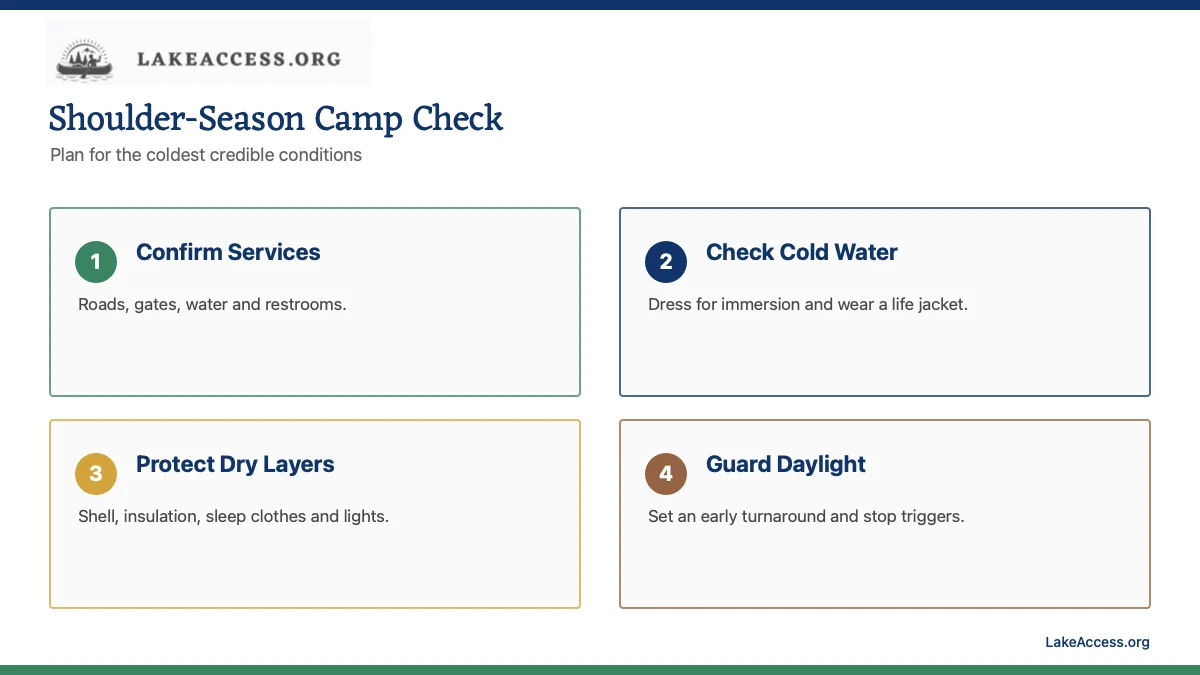
- Confirm seasonal roads, water, restrooms and gate hours.
- Check both air and water temperature.
- Pack protected dry layers and redundant lighting.
- Set daylight, wind and cold-stress stop triggers.
- Share the route and expected return with a trusted contact.
Related LakeAccess guides
- Must-have lake camping kit
- Lake camping reservation guide
- How to know if a lake is safe to swim in
- Wildfire smoke and closure checks
Sources
Standards, agency procedures and product requirements can change. These official or high-trust sources were checked July 21, 2026; confirm the current rules and exact equipment before building, modifying or operating a vessel.
- NPS when can I camp (checked July 21, 2026)
- National Weather Service cold water hazards (checked July 21, 2026)
- NPS hypothermia guidance (checked July 21, 2026)
- MedlinePlus hypothermia overview (checked July 21, 2026)
- National Weather Service cold safety (checked July 21, 2026)
- NPS camping conditions and alerts (checked July 21, 2026)