How Wide a Boat Can You Trailer Without a Permit?
There is no single national answer. Most states start at 102 inches, some at 96, and your boat's advertised beam is not the width that counts. Here is how to check.
On this page
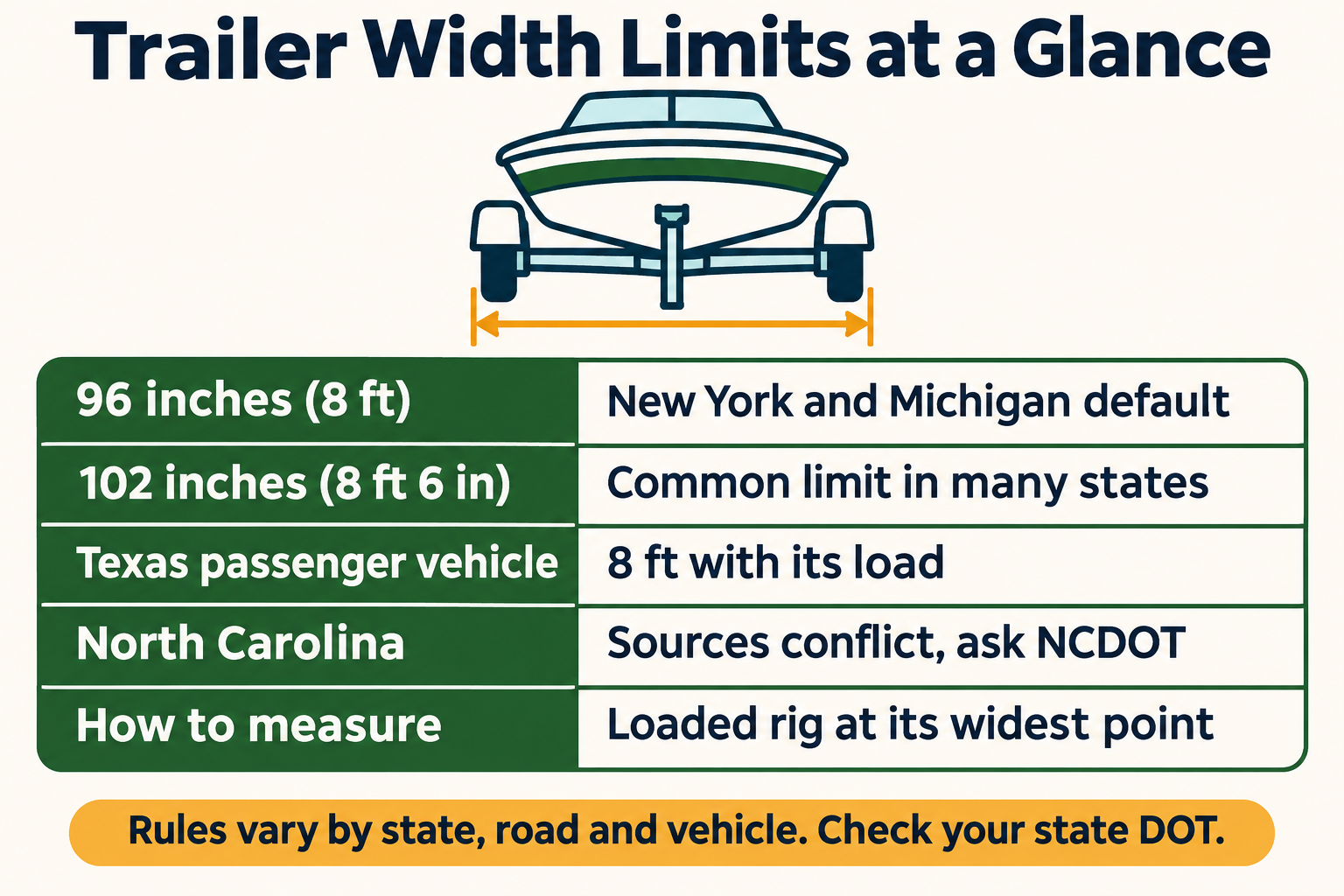
There is no single national number. For most private rigs, 8 feet 6 inches (102 inches) is the common ceiling, but New York and Michigan start at 96 inches on some roads, Texas has an 8-foot category for passenger vehicles, and North Carolina’s own sources disagree. The width that counts is also not the beam in your boat’s brochure. It is the widest point of the whole loaded rig as it sits on the road.
This guide gathers what state legislatures and transportation departments publish. It is not legal advice. The controlling answer depends on the exact state, road, tow vehicle, boat, trailer and route, and a local authority can add its own rules. If your rig is close to a limit, call the state agency before you tow. For the basics of choosing a trailer, see our boat trailer dimensions guide.
Width limits at a glance#
What the federal rule does and does not say#
Federal regulation says no state may impose a width limit of more or less than 102 inches on a vehicle operating on the National Network, with an exception for Hawaii. A state may still grant special permits for vehicles that exceed 102 inches. But the Federal Highway Administration’s FAQ says the federal 102-inch minimum and maximum apply only to commercial motor vehicles. For a private pickup towing a boat, the state’s own law is what you have to read.
State limits#
These are the rules as the states publish them. A permit threshold means the first width above the no-permit width for the road category cited, and route-specific restrictions can make the practical limit narrower.
| State | Width without a permit | What to watch |
|---|---|---|
| Texas | TxDMV’s general table lists 8 ft for a passenger vehicle and its load, and 8 ft 6 in for all other vehicles and loads | A passenger vehicle’s load may not extend more than 3 inches beyond the left fender line or 6 inches beyond the right. Check how your tow vehicle is classified. |
| Florida | 102 in for the total outside width of the vehicle or load, excluding safety devices the state determines are necessary | Roads without a through lane of 12 feet or more, and roads deemed unsafe, may restrict vehicles over 96 in. |
| Minnesota | 102 in, with listed exclusions for rearview mirrors and some load securement devices not exceeding 3 in per side | A MnDOT permit is not valid on county, municipal, township or other local roads. |
| Michigan | 96 in is the general rule. The same statute allows 102 in for a trailer. MDOT lists 96 in on non-designated highways and 102 in on designated highways | Do not assume one Michigan number. |
| Wisconsin | 8 ft 6 in | A vehicle wider than that needs a permit unless an exception applies. |
| Ohio | 102 in including load for all other vehicles | Side mirrors, turn signal lamps, marker lamps, flexible fender extensions and mud flaps are excluded. |
| Pennsylvania | 8 ft 6 in including any load | Mirrors may extend 6 in on each side beyond the width of the vehicle, trailer or load, whichever is greater. |
| New York | 96 in plus safety devices, and 102 in plus safety devices on any qualifying or access highway | The limit depends on the road. |
| Georgia | GDOT treats width greater than 8 ft 6 in as an oversize condition | Its permit page lists 8 ft 6 in (or 102 in) on roads with 12-foot travel lanes. |
| Tennessee | 8 ft 6 in | TDOT’s noncommercial boat permit fees start at 8 ft 7 in. |
| California | 102 in statewide | A city or county may prohibit combinations over 96 in on its own highways once signs are up. |
| Washington | 8.5 ft | An externally mounted rear vision mirror may extend beyond the body. |
The figures for North Carolina are covered separately below.
North Carolina: the sources disagree#
North Carolina’s current statute, G.S. 20-116, states a general limit of 102 inches for the total outside width of a vehicle or load. It also says a boat or boat trailer with an outside width of less than 120 inches may be towed without a permit, with amber lamps required once the width passes 102 inches. The NCDOT handout posted for boat transportation, however, says that 10 feet wide and greater requires a permit, and it lists 8 feet 7 inches to 9 feet 6 inches as no permit required.
We could not reconcile those two, and a boat at the edge of either band is exactly where a mistake gets expensive. If you tow in North Carolina with a wide boat, ask NCDOT directly and keep the answer in writing.
How to measure your rig#
A boat’s advertised beam is a design figure. The Coast Guard’s calculation beam excludes rub rails, fenders and other extensions, and its safe-loading guide says not to consider rub rails or hardware when establishing beam and length. That is a boat-design definition. It is not a road rule, and the state sources we reviewed do not carry it over. See our guides on how to measure the beam of a boat and how wide a pontoon boat is for the boat-side numbers.
Highway width is measured differently:
- TxDMV says width is measured from the outside points of the widest extremities, excluding safety devices.
- Caltrans tells permit applicants to enter the widest dimension of the vehicle or load, whichever is greater.
- Pennsylvania’s statute counts the width of the vehicle including any load.
Our recommendation, which is ours and not a statute, is this sequence:
- Write down the state and the type of road you will use first.
- With the boat on the trailer, measure the loaded rig at its actual widest horizontal point. Include a swim platform, brackets, rails, fenders and trailer parts unless your state’s written guidance excludes them. We found no primary source that excludes swim platforms everywhere, so treat that as a gap and not a given.
- Measure height from the road surface and length separately, using the endpoints your state specifies.
- Compare the widest number with the state’s limit and the road category.
A boat that sits wrong on its trailer can also push the width out, so check how a boat should sit on a trailer and, for a pontoon, our pontoon boat trailer sizing guide.
If your rig is over the limit: applying for a permit#
Each state runs its own permits, but the steps look similar in the official pages we read.
- Measure the actual loaded rig. TxDMV says you must know the exact dimensions and weight of your vehicle and load before applying.
- Check whether the load is divisible. Washington says permits are only issued to transport loads that cannot be divided, and that a load which can reasonably be reduced must be reduced.
- Find the road authority. Florida and Wisconsin both assign permits by jurisdiction: the state transportation department for its highways and local authorities for theirs. A MnDOT permit is not valid on local roads.
- Submit the vehicle, load and route. Georgia asks for tractor and trailer details including length, width, height and weights, origin and destination, routes and dates.
- Use the state channel. Examples include Texas TxPROS, Michigan MiTRIP, Georgia GAPROS, Caltrans CTPS and Wisconsin’s online, mail or drop-box options.
- Carry the permit. Florida requires every special permit to be carried in the vehicle or combination to which it refers.
Costs vary. Official pages list $12 per dimension over the legal limit in North Carolina, $30 for a Georgia standard single, $40 for a New York single trip, and $40 for a Tennessee noncommercial boat from 8 feet 7 inches to 14 feet wide.
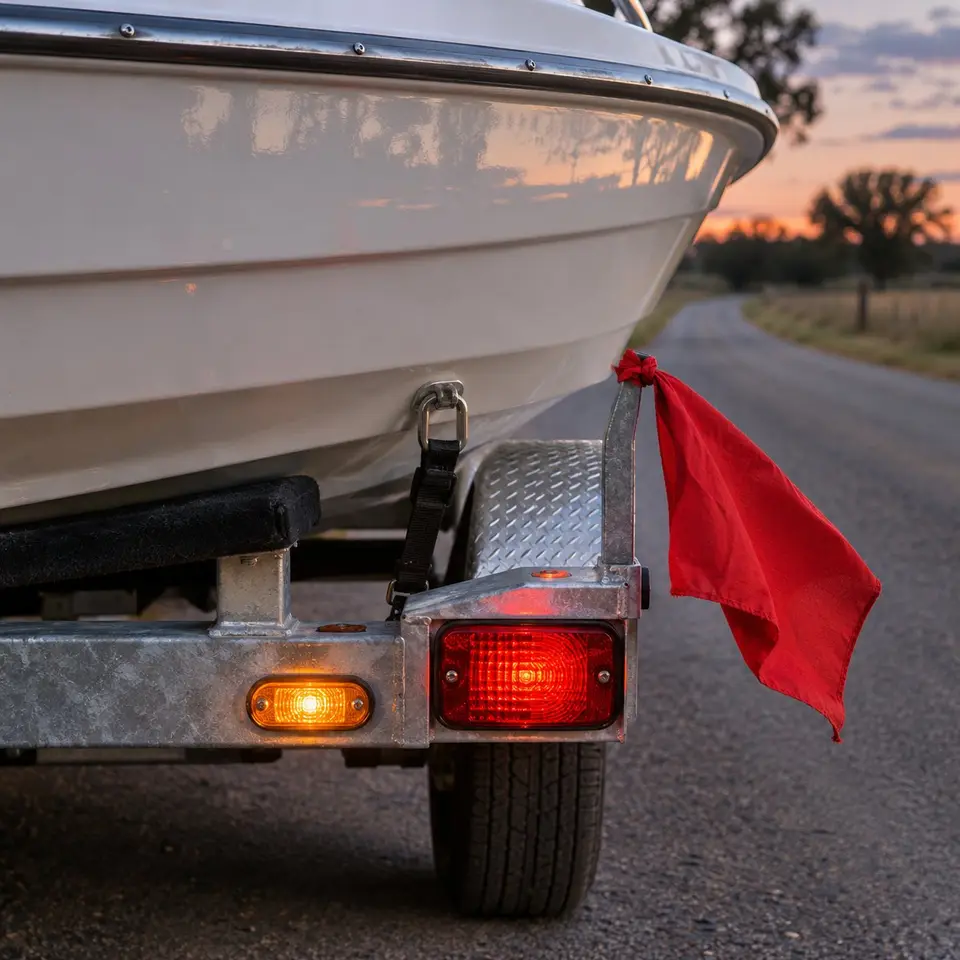
Flags, lights and escorts. These are set by the permit and the state, not by the 102-inch line alone. Wisconsin requires flags that are solid red or orange and not less than 18 inches square at the corners of an overwidth load. New York’s permit information says vehicles over 8 feet 6 inches shall display 18-inch red flags front and rear on the left side unless other warning devices or escorts are required. Texas begins width escorts above 14 feet, and Georgia requires a front escort above 12 feet on two-lane roads and two escorts above 16 feet. Our guide to boat trailer light troubleshooting covers the lighting side of a legal tow.
Before you tow#
- Check the destination state and every state on the route. Limits change at the border.
- Check local roads. California cities and counties can restrict combinations over 96 inches, and Minnesota’s state permit does not cover local roads.
- Weigh it too. Width is only one dimension. Our guides on tongue weight and boat trailer dimensions cover the rest.
- Keep the answer in writing. If you phone a state agency, note the date and the person.
Frequently asked questions#
How wide can a boat trailer be without a permit?
It depends on the state and the road. 8 feet 6 inches (102 inches) is the common baseline, for example in Pennsylvania, Wisconsin, Tennessee, Georgia and Washington. New York starts at 96 inches except on qualifying and access highways, and Michigan has both 96-inch and 102-inch categories. Check the state where you will drive.
Does the federal 102-inch limit apply to my pickup and boat trailer?
Probably not directly. Federal rules stop states from setting a limit above or below 102 inches on the National Network, but the Federal Highway Administration’s FAQ says the federal minimum and maximum apply only to commercial motor vehicles. For a private pickup and boat, state law decides.
Do tow mirrors and lights count toward the width?
It depends on the state. Pennsylvania allows mirrors to extend 6 inches on each side beyond the width of the vehicle, trailer or load. California allows required lights, mirrors or devices to extend up to 10 inches on each side. Washington allows an externally mounted rear vision mirror to extend beyond the body, and Ohio excludes side mirrors and marker lamps from its width calculation.
Does a swim platform or rub rail count?
We found no primary source that excludes swim platforms or rub rails from highway width everywhere. The Coast Guard excludes rub rails and hardware from its boat-design beam, but that is not a road rule. Measure the loaded rig at its widest point, including those parts, unless your state’s written guidance says otherwise.
How much does an oversize permit for a boat cost?
It is set by the state. Examples from official pages: North Carolina charges $12 per dimension over the legal limit for a single-trip nondivisible permit, Georgia lists $30 for a standard single, New York lists $40 for a single trip, and Tennessee lists $40 for a noncommercial boat from 8 feet 7 inches to 14 feet wide.
Sources#
- 23 CFR 658.15, Width, eCFR
- 23 CFR 658.16, Measurement, eCFR
- 23 CFR 658.19, Reasonable access, eCFR
- Freight size and weight FAQ, FHWA
- Texas size and weight limits, TxDMV
- Oversize and overweight permits, TxDMV
- Texas Transportation Code 621.201
- Florida Statutes 316.515
- Florida Statutes 316.550
- Minnesota Statutes 169.80
- Determining if you need a permit, MnDOT
- Michigan Vehicle Code 257.717
- Oversize and overweight permits, MDOT
- Wisconsin Statutes chapter 348
- Oversize and overweight permit requirements, WisDOT
- Oversize and overweight requirements, WisDOT
- Ohio Revised Code 5577.05
- Permits, Ohio Department of Transportation
- Pennsylvania Vehicle Code, Title 75 Chapter 49 Subchapter B
- New York Vehicle and Traffic Law 385
- Vehicle dimension sheet MV-519, New York DMV
- Special hauling permits, NYSDOT
- Georgia oversize and overweight permits, GDOT
- Oversize and overweight permits FAQ, TDOT
- Single trip and annual permit fees, TDOT
- California Vehicle Code 35100
- Vehicle widths, Caltrans
- Auto and boat transporter exemption, Caltrans
- Revised Code of Washington 46.44.010
- Commercial vehicle permits, WSDOT
- North Carolina G.S. 20-116
- Boat transportation handout, NCDOT
- Safe loading guide, US Coast Guard boating safety
Written by
We started this blog as a place to go to when we had questions about buying our first home on the lake. There was a lot of information on the internet, but we always spent hours...