Lake Tahoe Fishing Guide: Rules, Species and Boat Inspections
Lake Tahoe fishing runs under two states' rules, from licenses and limits to a mandatory boat inspection. Here is what California, Nevada and TRPA pages say, checked November 2026.
On this page
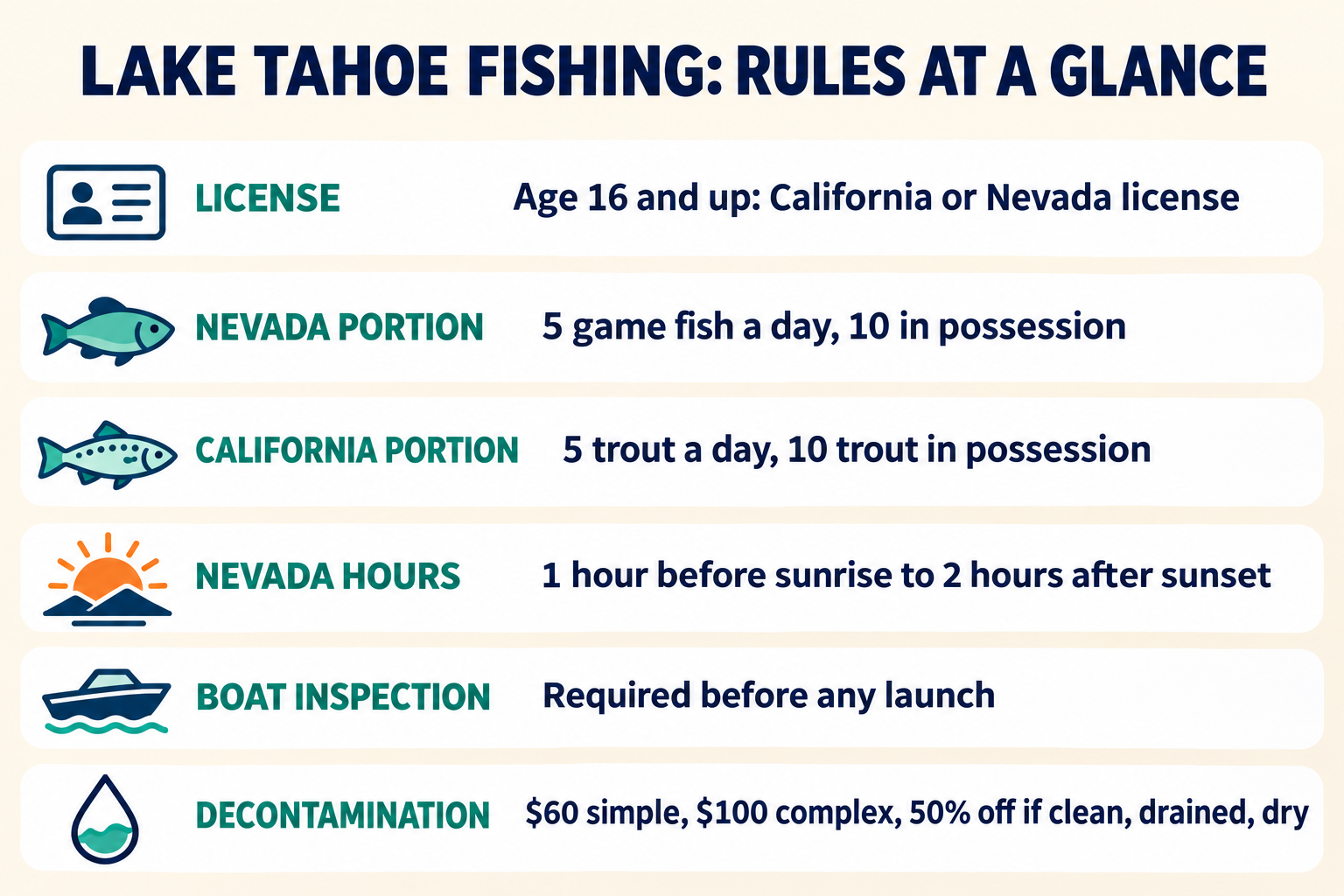
Quick answer: If you are 16 or older you need a California or Nevada fishing license, and either one is valid around the whole shore. The daily limit is five trout on the California side and five game fish on the Nevada side, which are two different rules. Mackinaw (lake trout) dominate the catch, rainbows are the shore fish, and a boat needs a Tahoe inspection before it launches. This guide uses state, federal and TRPA pages we read on November 7 and 11, 2026.
Two states, two sets of rules#
Lake Tahoe covers 192 square miles and reaches 1,646 feet deep, according to the Nevada Department of Wildlife (NDOW) angler guide. NDOW manages it as a put-and-take fishery. Rules differ on each side of the state line:
| California side | Nevada side | |
|---|---|---|
| Daily limit | 5 trout | 5 game fish |
| Possession limit | 10 trout | 10 game fish |
| Hours | Closed from 2 hours after sunset to 1 hour before sunrise | 1 hour before sunrise to 2 hours after sunset |
| Closed or restricted | Within 300 feet of tributary mouths until September 30 | 200 yards around the mouths of Third, Incline and Wood Creeks; 500 yards around the Sand Harbor boat ramp; inside the Cave Rock ramp jetty |
California’s numbers come from the CDFW 2026 freshwater regulations (updated July 10, 2026), and Nevada’s from Commission Regulation 25-16, which covers 2026 and 2027. Nevada defines the possession limit as twice the daily limit. Both states let you fish year-round.
On the California side, CDFW’s table allows only artificial lures with barbless hooks within 300 feet of a tributary mouth from the Saturday before Memorial Day through September 30, with a zero-trout limit. The Forest Service calls the same zone closed to fishing. Treat it as off limits.
We did not find a source that explains how to tell which state’s water you are on. If you fish near the border, ask an agency.
Licenses and bait#
- Age 16 and up: the Forest Service and CDFW both say a California or Nevada license is valid anywhere on the lake. Nevada’s code also recognizes an Interstate Boundary Waters license, which NDOW lists at $30.00 a year.
- Under 16: NAC 502.286 says anglers under 16 need no license or permit at Tahoe. NDOW’s general license page says anyone 12 or older must carry one. We follow the lake-specific rule, but confirm with NDOW if your child is 12 to 15.
- California prices (2026): CDFW lists an annual license at $64.54 for residents and $174.14 for nonresidents, and a one-day license at $21.09.
- Nevada prices: NDOW lists an annual adult license at $40.00 for residents and $80.00 for nonresidents, and one-day permits at $9.00 and $18.00.
- Trout stamp: CDFW’s booklet says Nevada also requires a trout stamp. NDOW’s Tahoe guide does not mention one, so ask when you buy.
Live bait fish are limited to species native to the lake. NDOW’s list is Lahontan redside, tui chub, Tahoe sucker, mountain sucker, Paiute sculpin and speckled dace, taken from Lake Tahoe. That rule is about bait fish; the Forest Service still recommends nightcrawlers for brown trout.
What you can catch#
NDOW says the introduced sport fish include lake trout, rainbow trout, brown trout and kokanee, with largemouth bass, crappie and bullhead catfish to a lesser extent.
- Mackinaw (lake trout): NDOW calls them the most caught and popular species, generally 16 to 25 inches, and says they account for 50-90% of angler catch because of the number of boats and charters. Troll or jig from a boat. The Forest Service suggests deep-line trolling at least 80 feet with large flashers and says mackinaw are caught year-round. Our lake trout seasonal depth guide goes deeper on depth.
- Rainbow trout: the predominant shore catch, usually 10 to 14 inches, and 16% of angler catch. NDOW stocked 10,876 in 2025. Use small lures when toplining, says the Forest Service.
- Brown trout: all wild, under 3% of the catch, but they grow to trophy size. The Forest Service suggests nightcrawlers or lures at the west end, along piers and over rocky bottoms, in early summer and just before dusk. NDOW lists a 15-pound, 15-ounce brown among record fish. An older version of this article claimed 20-pound browns, and no source we found backs that.
- Kokanee: 25% of angler catch. Troll small to medium spinners or lures; they average 12 to 20 inches and are good to keep for the table. The Forest Service says most are in the southwest corner and that catching them from shore is highly unlikely, which contradicts our old claim that they are easy from shore. For another lake with a kokanee fishery, see Lake Kachess fishing.
- Lahontan cutthroat: Tahoe’s native trout, listed as threatened under the Endangered Species Act. NDOW reports 48,947 stocked in Nevada in 2025, and its 2026 forecast said 100,000 more would be stocked in the lake. It says stocking generally happens in June, July and September, but that is a forecast, not a schedule.
- Warmwater fish: NDOW names largemouth and smallmouth bass, crappie and bullhead catfish, caught from a boat in shallow, structured water from spring to fall.
The old draft also listed yellow perch, bluegill and sunfish, and treated brook trout as a lake fish. NDOW’s species list does not include them, so we removed them. The Forest Service says brook trout are most commonly found in higher-elevation lakes and streams.
When and how to fish it#
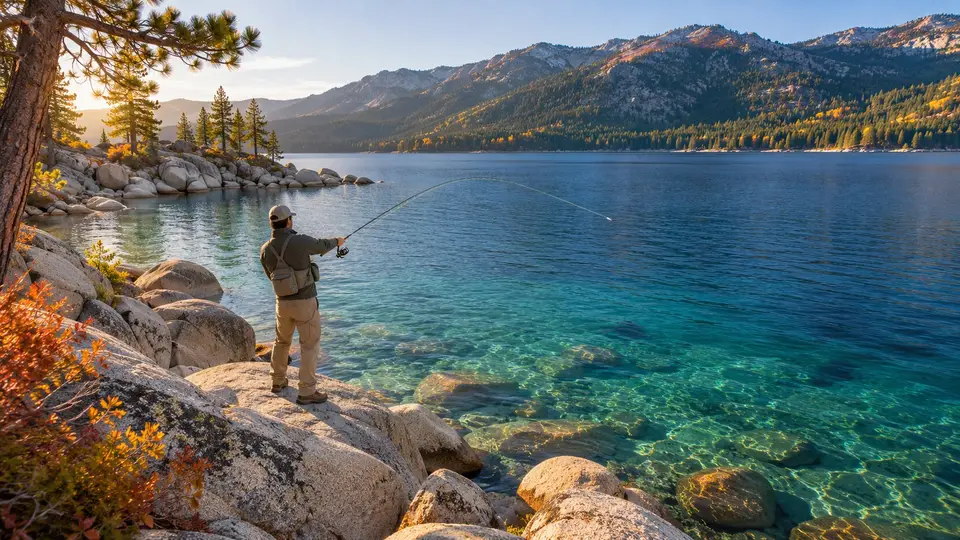
NDOW says fishing from shore or by top-lining and deep-lining from a boat is most productive in July and August. The Forest Service gives other windows: September to November and May for rainbows, early summer for browns, and early spring and late summer for kokanee. Pick the species first.
Tahoe’s clear water shapes tactics. The Forest Service says to avoid mirror-calm conditions unless you are fishing deep for mackinaw, use a light monofilament line, and make very long casts from shore or let out a long trolling line. For shore trout, NDOW suggests shoreline drop-offs with kastmasters, panther martins, balanced leeches or midge flies. For general technique, read how to fish for trout, and compare Tahoe with the best fishing lakes in California.
Fishing from shore#
NDOW says shore access is limited around most of the lake by private property and limited parking. Its pick for small stocked rainbows is Cave Rock and Sand Harbor (Nevada State Parks). The Forest Service adds Rubicon Point on the west shore and Cave Rock on the east shore, with a day-use fee at both.
At Cave Rock, a steep shoreline and rocky shoals make for good fishing, but fishing is not allowed on the beach or in the boat-ramp area. Nevada State Parks lists a $10.00 day-use fee per vehicle ($15.00 for non-Nevada vehicles) and a $20.00 boat launch ($25.00 non-Nevada). California State Parks lists Camp Richardson Marina in South Lake Tahoe as a public marina and launch.
Fishing is only part of a Tahoe trip. See our guides to things to do at Lake Tahoe in summer and dog-friendly beaches.
Boat inspections#
NDOW’s guide says mandatory inspections are required before launching any boat into Lake Tahoe. TRPA says the program calls for inspection and decontamination of all motorized watercraft, and that in March 2025 mandatory decontamination was added for visiting motorized watercraft, because golden mussels were found in California’s Delta in 2024. The program’s 2026 season report says inspectors intercepted 10 boats carrying golden mussels during 5,200 inspections.
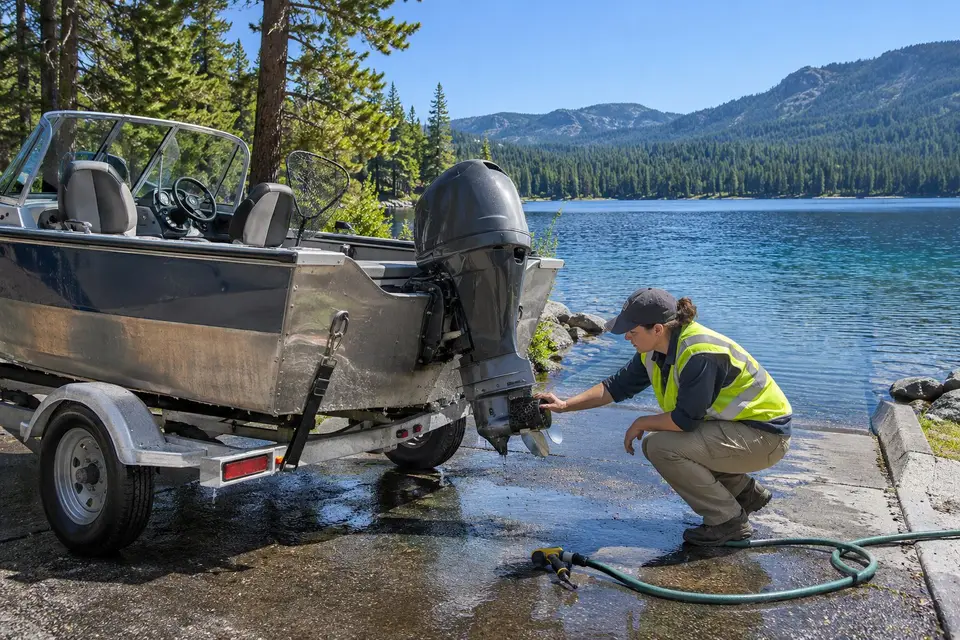
A trailered boat with an intact seal from its last haul-out at Tahoe can skip a new inspection, according to the program. Otherwise expect both steps. The 2026 fees are:
- Tahoe In and Out sticker: $70 for personal watercraft and vessels up to 17 feet, $115 for longer vessels.
- Tahoe Only sticker: $50, for sealed boats from earlier seasons that will stay on Tahoe, Fallen Leaf and Echo lakes.
- Single inspection pass: $65 or $95 by length, good for one inspection and seven consecutive days of sealing.
- Decontamination: $60 for one or two water intake systems, $100 for three or more, and $350 if mussels are attached. Arriving clean, drained and dry saves 50%, except on the mussel fee.
TRPA’s fee schedule covers February to December 2026, so check before the 2027 season. In winter, the Meyers station opens select Wednesdays from October 14 through March 2027 by appointment, booked 48 hours ahead with a refundable $30 deposit. The program’s October 29 news release says appointments run from October through April, so confirm the end date before you plan a spring launch.
Two more points from the program’s preparation page. TRPA prohibits the launch and use of most carbureted two-stroke engines, and kayaks with trolling motors count as motorized and need an inspection.
Before you go#
- Buy a California or Nevada license, and ask about the Nevada trout stamp.
- Know your side’s limit: five trout in California, five game fish in Nevada.
- Book a Tahoe inspection and arrive clean, drained and dry.
- Pick your species, then your season and depth.
- Check closed areas near creek mouths, Sand Harbor and the Cave Rock ramp.
Sources#
Checked on November 7 and 11, 2026: NDOW Lake Tahoe angler guide, Nevada Commission Regulation 25-16, Nevada NAC 502, NDOW fishing licenses, CDFW freshwater regulations, CDFW license fees, CDFW Tahoe cutthroat release, Forest Service fishing page, TRPA aquatic invasive species, TRPA 2026 fee schedule, Tahoe Boat Inspections fees, Tahoe Boat Inspections locations, Tahoe Boat Inspections preparation, Tahoe Boat Inspections 2026 report, Nevada State Parks Cave Rock, Nevada State Parks fees, California State Parks boating facilities.
Frequently asked questions#
Do I need a fishing license for Lake Tahoe?
Yes, if you are 16 or older. The Forest Service says anyone 16 or older needs a valid California or Nevada sport fishing license to fish in Lake Tahoe, and CDFW says either state’s license is valid around the entire shore. Nevada’s code says anglers under 16 need no license or permit at Tahoe. Nevada’s general license page says anyone 12 or older must carry one, so if your child is 12 to 15, confirm with the Nevada Department of Wildlife before relying on the lake-specific rule.
What is the daily limit at Lake Tahoe?
It depends on the state. CDFW’s 2026 booklet gives California inland lakes a five-trout daily limit and 10 in possession. Nevada’s regulation lists Lake Tahoe at five game fish a day and 10 in possession, and defines the possession limit as twice the daily limit. The pages we read do not explain how to tell which side of the state line you are on, so ask the agencies if you fish near the border.
What fish do people catch most at Lake Tahoe?
Lake trout, also called mackinaw. NDOW says they account for 50-90% of angler catch because so many boats and charters target them, with kokanee at 25% and rainbow trout at 16%. For tactics, see our lake trout seasonal depth guide.
Can you fish Lake Tahoe from shore?
Yes, mostly for rainbow trout. NDOW says rainbows make up the predominant shore catch and that Cave Rock and Sand Harbor produce the best catches of small stocked rainbows. It also warns that shore access is limited by private property and parking. The Forest Service says kokanee are highly unlikely from shore.
Do I need a boat inspection to fish Lake Tahoe from a boat?
Yes. NDOW’s guide says mandatory inspections are required before launching any boat into Lake Tahoe, and TRPA says all motorized watercraft are inspected and decontaminated. A trailered boat with an intact seal from its last haul-out at Tahoe can go straight to a ramp, according to the inspection program. Hand-launched non-motorized craft such as kayaks are inspected and decontaminated for free.
How much does a Lake Tahoe boat inspection cost?
For 2026, the program lists a Tahoe In and Out sticker at $70 for personal watercraft and vessels up to 17 feet, and $115 for longer vessels. A Tahoe Only sticker is $50, and a single inspection pass is $65 or $95. Decontamination is $60 for simple and $100 for complex boats, with 50% off if you arrive clean, drained and dry. Fees are set yearly, so check the program’s fee page before you launch.
Written by
We started this blog as a place to go to when we had questions about buying our first home on the lake. There was a lot of information on the internet, but we always spent hours...