
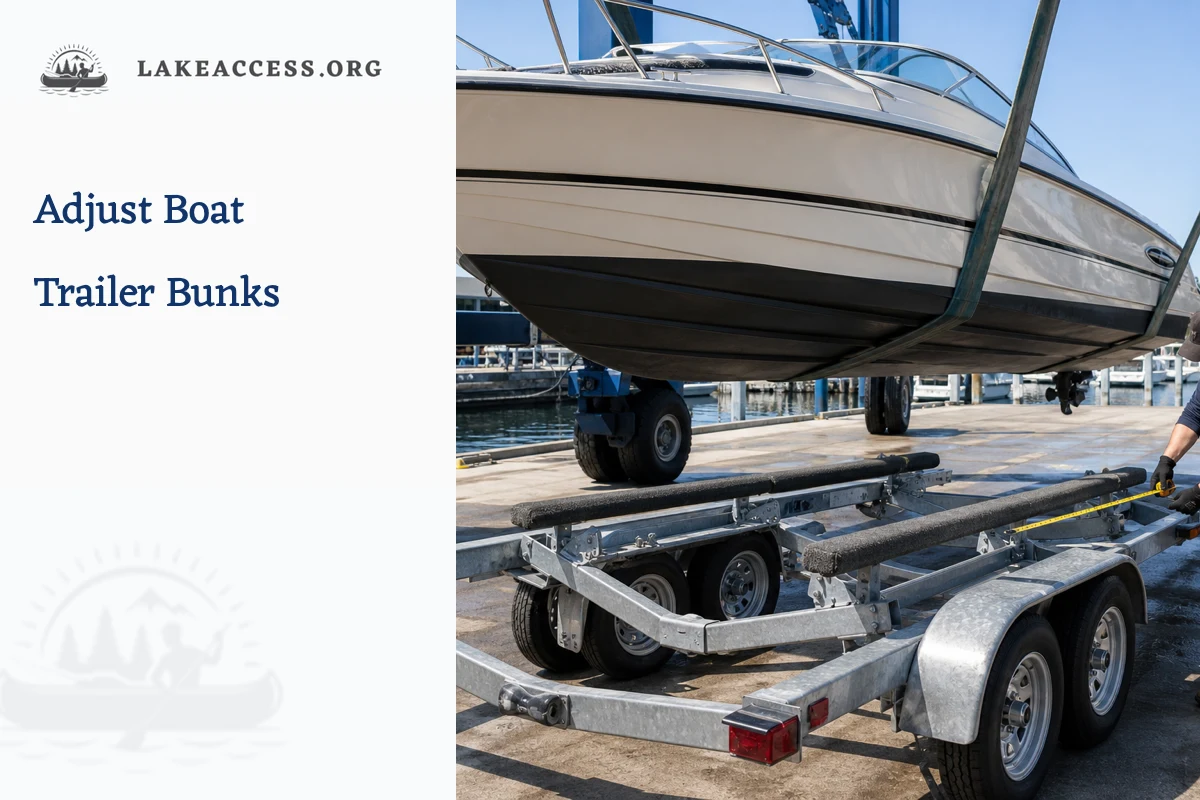
Quick answer: Get the boat and trailer makers' model-specific support and adjustment instructions before loosening anything. Have a marina lift or another approved method fully support and remove the boat from the trailer, mark the existing bunk and hardware locations, then position the main bunks for continuous contact in permitted hull zones while avoiding strakes, chines, fittings and unsupported transom load. Tighten every fastener to its documented specification, reload, inspect contact and verify tongue weight and road fit. Never loosen a load-bearing bunk while the hull rests on it, and never use trailer hardware as an undocumented lifting point.
Diagnostic decision table
| Finding | What it suggests | Do not assume | Next safe check |
|---|---|---|---|
| Gap between hull and a main bunk | Bunk height, angle, twist or trailer fit may be wrong | That raising the nearest bracket alone preserves load distribution | Unload boat; compare all supports with boat and trailer fit instructions |
| Bunk crosses a strake, chine or fitting | The support location may damage hull or prevent full contact | That carpet makes the contact harmless | Move only within approved zones and confirm with hull manufacturer |
| Transom extends beyond intended support | Heavy engine load may not be transferred where the trailer maker designed | That bow-stop position can compensate safely | Verify boat position, bunk length, winch stand and trailer model fit |
| Boat loads crooked or shifts after retrieval | Ramp depth, guides, bunk symmetry, winch alignment or hull fit may contribute | That tightening the bow eye forces correct support | Inspect unloaded geometry and obtain professional setup when repeatability fails |
Map the hull support zones before moving hardware
Find the hull owner manual, trailer setup sheet and model fit chart. Identify main load-bearing bunks versus target, keel or centering supports. Mark strakes, chines, transducers, drains, speed sensors, steps and through-hull fittings that cannot carry load. Record the transom and bow-stop relationship and photograph every bracket before disassembly.
A fiberglass monohull, aluminum hull, pontoon and personal watercraft use different support patterns. Do not infer lift points or bunk positions from a different model. If damage, a repaired laminate, unusual hull shape or missing fit data makes the load path uncertain, ask the boat manufacturer or qualified dealer before proceeding.
Remove the boat from the trailer for adjustment
Load Rite instructs users to remove the boat while adjustments are performed. A professional marina travel lift or other boat-maker-approved support keeps the hull independent of loose bunks. Keep personnel outside suspended-load zones and let trained operators control lifting. The empty trailer must be chocked on level ground.
Mark bracket height, angle and fore-aft position, then loosen only the hardware needed for one controlled change. Inspect bunks for rot, crushed carpet, exposed staples, split wood, corrosion and bent brackets. Replace damaged parts with components specified for the load rather than shimming around them.
Set main bunks for broad continuous contact
Place the main load-bearing bunks as the fit guide directs, generally maximizing stable contact while clearing strakes and fittings. Adjust paired brackets evenly so the bunk follows the hull rather than creating isolated hard points. Keep bunks parallel or angled only as specified. Target or keel supports should not accidentally take the main load.
Support the transom and engine mass in the intended zone. Verify the bow eye aligns with the winch and bow stop without pulling the hull down to reach. Check propeller, skeg, trim tabs and drain clearance. The trailer suspension and frame should sit square before final measurements.
Tighten, reload and verify under real weight
Use new approved hardware where required and torque U-bolts, pivots and bracket fasteners to the current component specification. Do not guess from bolt diameter alone; material, coating, thread and reuse rules matter. Mark completed fasteners for inspection, remove all tools and slowly position the empty trailer for reloading.
Lower or retrieve the boat while observing contact from safe positions. Never place a hand between hull and bunk. After the hull is fully supported, inspect every bunk end, bracket and clearance. Recheck bow stop, winch, stern tie-downs, overall dimensions and tongue weight. If the hull rocks, gaps remain or load is concentrated, unload and correct it rather than towing.
Build the answer from the exact labels and manuals
A boat trailer is a system, not a collection of interchangeable rules of thumb. Start with the certification label, trailer owner manual, axle or hub manual, tire markings, coupler and jack ratings, tow-vehicle owner manual and hitch documentation. Record the trailer VIN, model, gross vehicle weight rating, axle ratings, tire size and the boat’s loaded condition. If a label is missing or unreadable, ask the trailer manufacturer or a qualified dealer to identify the equipment before changing or loading it.
Use the most restrictive applicable limit. A higher tire rating does not raise an axle, wheel, hub, trailer, hitch or vehicle rating. A strong hitch does not create payload in the tow vehicle. Hardware that looks similar can require a different torque, lubricant, adjustment or replacement part. This article offers a diagnostic workflow, not model-specific authorization, so confirm every numeric setting in documentation for the exact equipment.
Inspect the complete loaded combination
Evaluate the trailer as it actually travels: boat, engine, batteries, fuel, water, anchor, fishing equipment, safety gear and removable cargo aboard; covers, coolers and accessories secured; spare tire and carrier included. Weighing only the empty trailer or using a boat brochure’s dry weight can miss installed and variable loads. A public scale or qualified marine service facility can provide the evidence needed for axle, tire and tongue-load decisions.
Record what was aboard when the measurement was taken. Moving a battery, full fuel tank, anchor or heavy gear changes load distribution. Loading should also be repeatable, with the boat at its intended winch-post position and bow and stern restraints installed. Do not solve one rating problem by shifting weight until another component, axle or tow-vehicle limit is exceeded.
Work on level ground with redundant support
Chock the wheels, keep the tow vehicle secured when the procedure requires it, and use lifting and support points approved by the trailer or axle manufacturer. A tongue jack stabilizes or raises the tongue; it is not automatically a service stand. Never work under a boat or trailer supported only by a hydraulic jack, travel lift sling or improvised cribbing. Rated jack stands must be placed where the manufacturer permits.
Unload or professionally support the boat before adjustments that release bunks or structural hardware. Disconnect the trailer electrical plug before resistance or continuity testing, and isolate batteries when the equipment manual requires it. Keep ignition, flames and sparks away from fuel. If corrosion, seized fasteners, damaged structure or uncertain support makes a step unsafe, stop and use a qualified trailer or marine technician.
Separate an observation from a diagnosis
Sway, heat, tire wear, a dim lamp, a noisy hub or a hull contact mark is evidence, not a complete diagnosis. Several faults can produce the same symptom. Begin with a visual inspection and the least invasive measurements, then isolate one part of the system at a time. Compare left and right sides only when the components and loading are meant to match; symmetry does not prove that either side meets specification.
Do not road-test a known unsafe combination. A trailer that sways, has a hot or loose hub, damaged tire, nonworking required lamp, insecure boat or suspect structural support should remain parked until corrected. A short drive to see whether a problem gets worse adds heat, speed and public-road exposure. Arrange mobile service or transport when the safe condition cannot be restored where the trailer sits.
Recheck after immersion and after service
Boat trailers repeatedly move between highway heat and water. Inspect connectors, grounds, brakes, hubs, seals, fasteners, straps and corrosion after launch use according to their manuals. Fresh water can still enter a damaged seal or connector, while salt water accelerates corrosion. Rinsing does not replace inspection, lubrication or scheduled service, and adding grease does not prove that a bearing or seal is healthy.
After any adjustment, verify fastener torque by the component maker’s procedure, reload the boat, repeat the relevant measurements, reconnect and test every lighting function, and complete a stationary pre-trip inspection. Recheck newly serviced hardware after the interval specified by its maker. Save the date, measured values, parts and lubricant used, torque source and technician so the next inspection starts with evidence.
Check law and route requirements separately
Federal equipment standards, state vehicle codes and local operating rules answer different questions. Required lamps, brakes, width equipment, safety chains, inspections and speed restrictions can depend on the trailer, load and jurisdiction. Confirm the rules for every state on the route through the state motor-vehicle or transportation agency; do not treat a retailer chart or another state’s threshold as legal advice.
Legal minimum equipment is not a substitute for manufacturer maintenance. A light can satisfy the required function yet still have corrosion that will soon fail. A combination can be below a posted weight threshold but outside a component rating. Use both checks: comply with current law and follow the service, loading and fit instructions for the exact boat, trailer and tow vehicle.
Create a repeatable inspection record
Use one dated worksheet for the trailer VIN, boat model, tow vehicle, loaded scale tickets, tongue-weight measurement, tire pressures, hub observations, lighting test and bunk contact. Photograph certification labels and the finished travel load. Record the ambient condition and whether tires were cold, because a value without its measurement condition is easy to misuse later. Keep receipts and part numbers with the record instead of relying on memory at the next season.
A record makes changes visible. Compare like with like: the same loading plan, gauge, scale arrangement and inspection point. A meaningful change in tongue load, tire pressure loss, hub behavior, lamp brightness or hull contact deserves investigation before departure. Do not normalize a worsening trend because the trailer completed its last trip; road shock, storage and immersion can turn a marginal condition into a failure.
Know when the job needs a qualified technician
Professional help is appropriate when identification is uncertain, labels are missing, ratings conflict, structure or welds are damaged, a spindle or bearing surface is scored, brakes are contaminated, wiring enters a vehicle control module, or the hull lacks documented support zones. A marina lift operator, trailer dealer, tire specialist, axle service center or tow-vehicle dealer solves a different part of the system, so choose the provider that owns the uncertain component.
Give the technician the measurements, photos, model numbers and failure pattern rather than only a requested part. Ask for the controlling specification and the completed test result. After service, repeat the owner-level pre-trip inspection and verify that no new interference, loose wiring or load shift was introduced. Outsourcing a repair does not remove the need to confirm the trailer is ready before entering a ramp or public road.
Before the first trip after repair or adjustment, perform a stationary function check and a low-speed check only where the equipment documentation and local rules permit it. Stop immediately for unusual noise, movement, odor, heat, warning messages or changed handling. Return to the inspection point and resolve the cause; do not continue toward the lake merely because a reservation, launch slot or travel schedule is waiting.
Pre-trip checklist
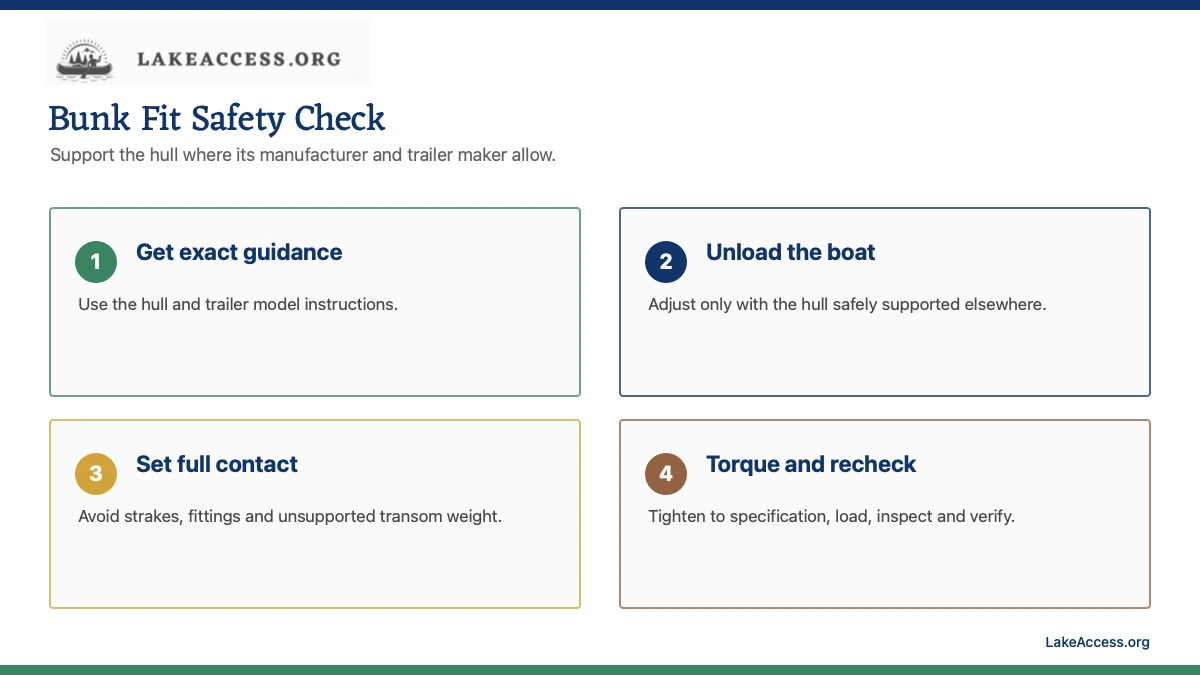
- Obtain exact hull and trailer model fit and support instructions.
- Photograph and mark original bunk, bracket, bow-stop and transom positions.
- Remove and support the boat by an approved professional method.
- Set continuous main-bunk contact away from strakes, fittings and damage.
- Torque to specification, reload slowly, inspect contact and recheck tongue weight.
Related LakeAccess guides
- How a boat should sit on a trailer
- Boat trailer dimensions
- Pontoon boat trailer sizing
- Boat trailer tongue weight
Sources
Specifications and legal requirements can change. These official or high-trust sources were checked July 19, 2026; use the current manual and rules for the exact equipment and route.
- Load Rite trailer operator manual and bunk setup (checked July 19, 2026)
- Current Load Rite operator manual (checked July 19, 2026)
- ShoreLand'r owner resources (checked July 19, 2026)
- Karavan owner support (checked July 19, 2026)
- NHTSA secure-your-load guidance (checked July 19, 2026)
- Dexter light-duty service manual for support precautions (checked July 19, 2026)