150 HP Outboards Compared: Yamaha, Mercury, Honda, Suzuki, Tohatsu
Five brands sell a 150 hp four-stroke outboard in the US. Here are their published weight, displacement, alternator output, gearing and prices, side by side.
On this page
Five makers sell a 150 hp four-stroke outboard in the US: Yamaha, Mercury, Honda, Suzuki and Tohatsu. All five are in-line four-cylinder engines with the same headline rating, so the choice comes down to weight, electrical output, gearing, price and who can service the motor near your lake. This guide puts the published numbers side by side. It does not crown a winner, because the right motor depends on your boat.
We did not test these engines. The figures come from the makers’ own pages, a Yamaha price list, dealer listings and a boat-test database, and each source is listed at the end.
The short version#
| Engine | Displacement | Dry weight | Alternator | Gear ratio |
|---|---|---|---|---|
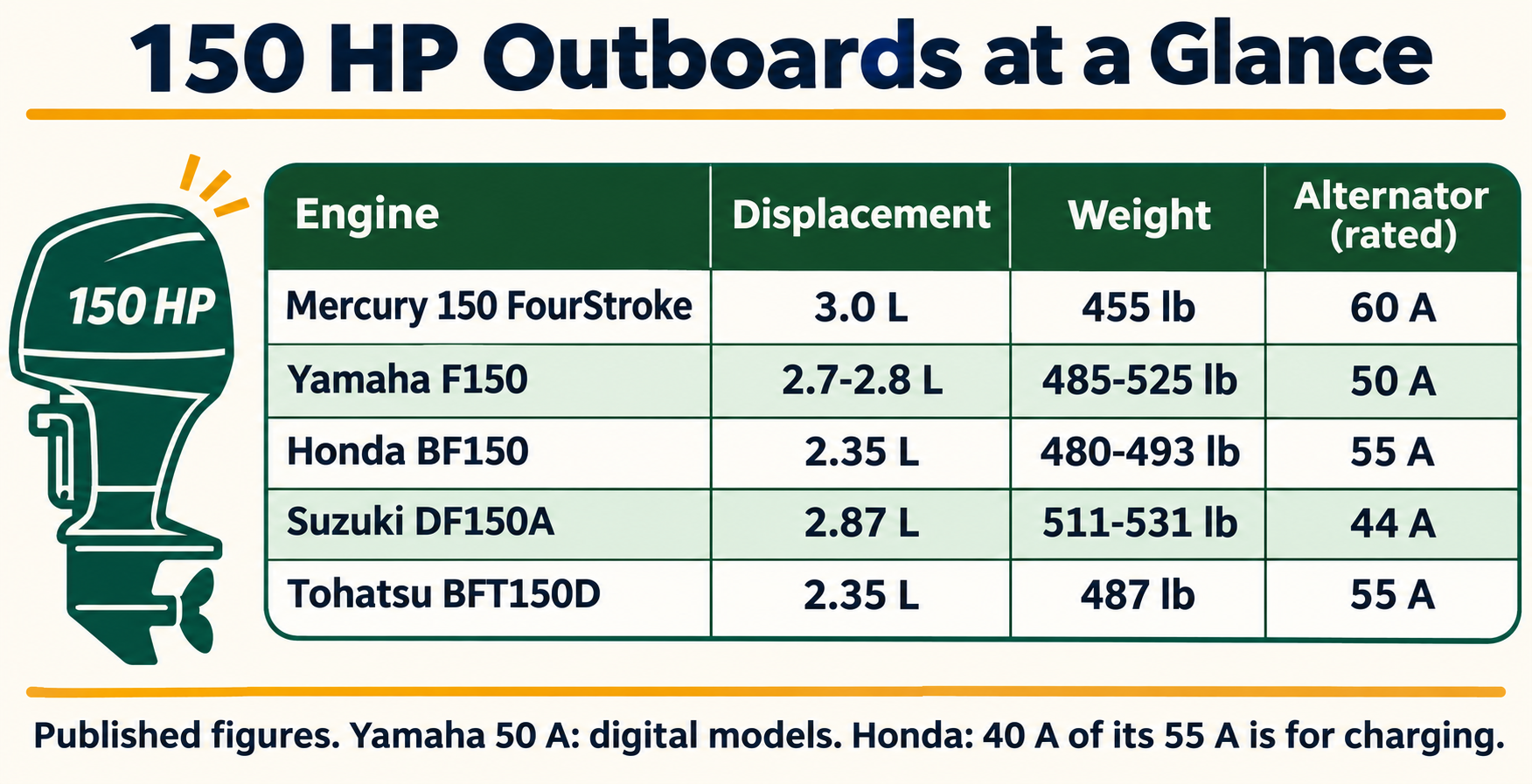
| Mercury 150 FourStroke | 183 cu in (3.0 L) | 455 lb | 60 A | not listed in our sources |
| Yamaha F150 | 2.7 L mechanical, 2.8 L digital | 485 to 525 lb | 50 A (digital models) | 2.00:1 |
| Honda BF150 | 2,354 cc (2.35 L) | 480 to 493 lb | 55 A total, 40 A for charging | 2.14:1 |
| Suzuki DF150A | 2,867 cc (2.87 L) | 511 to 531 lb | 44 A | 2.50:1 |
| Tohatsu BFT150D | 2,354 cc (2.35 L) | 487 lb | 55 A | 2.14:1 |
Honda, Suzuki and Tohatsu list a full-throttle range of 5,000 to 6,000 rpm, and Yamaha lists the same band for its F150. Honda and Tohatsu publish identical displacement, bore and stroke (87 x 99 mm), so on paper those two are close to twins. Where a cell says “not listed in our sources”, we could not find the figure on the maker or test pages we used.
Weight: Mercury is lightest, Suzuki heaviest#
Mercury lists the 150 FourStroke at 455 lb, and the boat-test database BoatTEST calls it the lightest outboard in its class. Suzuki lists 511 lb for the mechanical long-shaft model and up to 531 lb for the drive-by-wire extra-long shaft. Mercury’s lightest figure and Suzuki’s heaviest are 76 lb apart, which is worth checking against the maximum engine weight your transom can carry.
Treat small gaps with caution. Yamaha says its weights are measured without engine oil, gearcase oil and propeller, and Honda says a propeller adds 6.6 to 13.2 lb depending on model. Yamaha’s own numbers also shift by model: its 2017 sheet lists 485 to 487 lb, while its integrated-steering sheet lists 509 to 525 lb for the non-jet 150 models.
Electrical output: the difference that shows up on the water#
Rated alternator output runs from 44 A on the Suzuki to 60 A on the Mercury. Honda counts 55 A in total but says 40 A of it is battery charging power. If you run a livewell pump, a fishfinder, a chartplotter and lights, this number matters more than a few pounds of weight.
It also matters when the engine is not at full throttle. Ratings are normally quoted near wide-open throttle, and boats spend a lot of time idling or trolling. Tohatsu is one of the few makers to give a number below full speed: its 150 produces 30 A at 1,000 rpm and 40 A at 2,000 rpm and above. Mercury says the 150 has idle charge battery-management technology that automatically raises idle rpm to boost alternator output and recharge low batteries. We explain how stators and alternators behave at low speed in do outboard motors charge the battery.
Gearing and propellers#
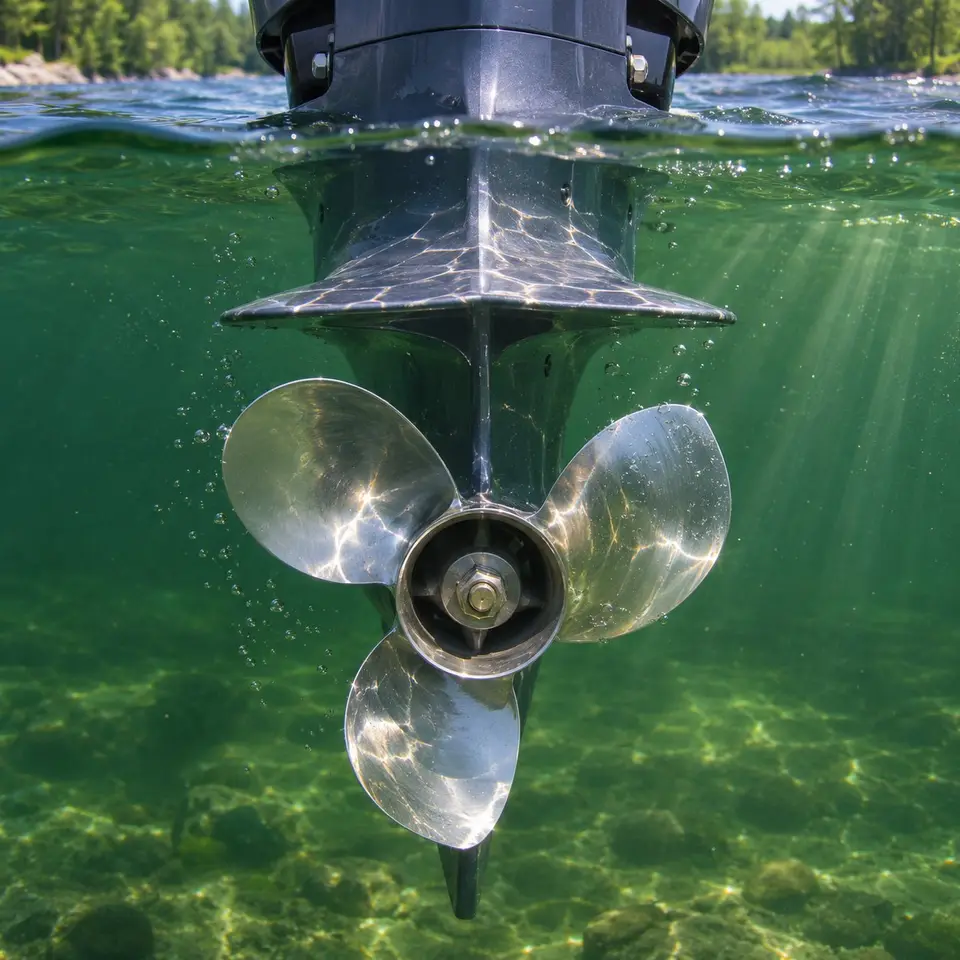
The gear ratio sets how fast the propeller turns for a given engine speed. Yamaha lists 2.00:1, Honda and Tohatsu 2.14:1, and Suzuki 2.50:1. A higher ratio turns the prop more slowly, so it works with a different prop than a lower one. Suzuki’s page lists a propeller selection of 17 to 19.
The effect is easy to see in pontoon speed math. PontoonHQ works out that each inch of prop pitch is worth about 1.78 to 2.41 mph on a Yamaha F150 and about 1.42 to 1.93 mph on a Suzuki DF150A once the engine reaches its rated band and prop slip is counted. The right prop is the one that lets the engine reach full-throttle rpm inside its rated range with your normal load, and a dealer should confirm that on your boat. For what that means for speed, see pontoon speed by horsepower.
Prices: what listings showed in November 2026#
Prices change by model year, shaft length, steering and controls, and rigging is extra. These are the numbers we found, with the exact model each applies to, so they are not an apples-to-apples ranking.
- Yamaha, January 2026 price list: F150LD (2.7 L, mechanical, 20 in shaft) at $17,900 and F150XD (25 in shaft) at $18,175. The digital 2.8 L models start at $20,725 for the F150XSA and reach $22,320 for counter-rotation versions.
- Mercury 150L: MSRP $16,190, with a dealer price of $14,895 on the listing.
- Honda BF150DK1XDA: MSRP $17,599, with a dealer price of $16,051.
- Suzuki DF150AP (2025): MSRP $17,889 and a base price of $13,100 on one dealer’s listing.
- Tohatsu MFS150AETL: MSRP $15,201, with a dealer price of $13,073. This is a Tohatsu 150 model number from a dealer listing, not necessarily the BFT150D in the table above.
For context, a boat marketplace’s cost guide says a new Yamaha 150 generally lands between $15,000 and $18,500 before installation, and that rigging, controls, props and labor can add $2,000 to $8,000 to a repower. The same guide cites NMMA data putting the average new outboard sold in the US in 2025 at about $13,081 across all sizes.
Fuel, warranty and support#
Fuel. Mercury and Tohatsu list 87 octane, and Honda lists 86. Yamaha’s 2017 sheet for its digital models lists a minimum pump octane of 89, while a newer third-party listing says 87, so check the manual for your engine.
Warranty. Tohatsu advertises a five-year limited warranty. Honda calls its coverage the True 5 Warranty and describes it as transferable and non-declining. BoatTEST lists a three-year corrosion warranty for the Mercury. Yamaha’s 2017 sheet listed three years for pleasure use and one year for commercial use, so confirm current terms. We did not find a Suzuki figure. Terms change, so read the current warranty for the year you buy.
Support. A warranty is only useful if a dealer can service the motor. If one brand has a shop ten minutes from your launch and another is two hours away, that can matter more than any spec in this article.
How to choose#
- You run a lot of electronics or a trolling battery. Compare the alternator numbers, especially below full throttle, and read our guide on charging a boat battery on the water.
- Your transom or boat is weight-sensitive. Check the maximum engine weight for your boat. Mercury lists the lightest 150.
- You want digital controls. Yamaha’s 2.8 L models and Suzuki’s drive-by-wire model are digital, and Honda’s listing shows Intelligent Shift and Throttle. On Yamaha’s price list, the mechanical 2.7 L models cost less than the digital 2.8 L ones.
- You are rigging twins. Yamaha lists counter-rotation F150 models, and Tohatsu says its 150 comes with standard or counter rotation.
- You tow, fish or cruise a pontoon. Match the engine to the boat and the load, not to the brochure. Our fishing boat speed guide and pontoon motor horsepower guide help narrow the choice.
Before you buy#
If your boat has a capacity plate, read it and keep the horsepower at or below the maximum shown. Ask the dealer to quote the exact model number, shaft length, controls and prop, because the prices above move with each of those. Ask for the current warranty terms in writing, and for what rigging will cost on your boat.
Frequently asked questions#
Which 150 hp outboard is the lightest?
On published numbers, the Mercury 150 FourStroke, at 455 lb. Tohatsu lists 487 lb, Honda 480 to 493 lb, Yamaha 485 to 525 lb depending on model and steering, and Suzuki 511 to 531 lb. Makers do not measure weight the same way, so a gap of a few pounds means little.
Which 150 hp outboard has the biggest alternator?
Mercury lists the highest rating at 60 amps. Honda rates its alternator at 55 amps in total, with 40 amps available for battery charging, and Tohatsu lists 55 amps. Yamaha lists 50 amps on its digital models and Suzuki lists 44 amps. These are full-throttle ratings, so output at idle is lower. See do outboard motors charge the battery.
How much does a new 150 hp outboard cost?
List prices we found in November 2026 ran from about $15,200 to $22,300 before rigging, depending on brand, model, shaft length and controls. Some dealers advertised lower prices. Boatzon’s outboard cost guide says a new Yamaha 150 generally lands between $15,000 and $18,500 before installation, and that rigging, controls, props and labor can add $2,000 to $8,000.
Can I put a 150 hp outboard on any boat?
No. If your boat has a capacity plate, it lists the maximum horsepower, and you should stay at or below it. The transom and the boat’s weight rating matter as well. For pontoons, read how to choose pontoon motor horsepower first.
What fuel does a 150 hp outboard use?
Mercury and Tohatsu list 87 octane, and Honda lists 86. Yamaha’s 2017 sheet for its digital models lists a minimum pump octane of 89, while a newer third-party listing says 87. Check your owner’s manual for your exact engine.
Sources#
- Yamaha F150 and F175 hot sheet (2017), Yamaha Marine
- Yamaha F200 and F150 integrated steering sheet, Yamaha Marine
- Yamaha Outboard Price List, effective January 1, 2026
- Yamaha F150 specifications, OutboardSpecs
- Mercury FourStroke 75-150hp, Mercury Marine
- Mercury 150 FourStroke, BoatTEST
- Mercury 150hp outboard 150L listing, Boat Specialists
- Honda BF115, BF140 and BF150 technical specifications, Honda News
- Honda BF115, BF140 and BF150, Honda Marine
- Honda BF150 listing, Boat Specialists
- Suzuki DF150A, Suzuki Marine
- 2025 Suzuki DF150AP listing, Bob and Annie’s
- Tohatsu BFT150D, Tohatsu
- Tohatsu 150hp MFS150AETL listing, Boat Specialists
- Outboard motor cost in 2026, Boatzon
- Pontoon speed by horsepower, PontoonHQ
Written by
We started this blog as a place to go to when we had questions about buying our first home on the lake. There was a lot of information on the internet, but we always spent hours...