Pontoon Speed by Horsepower: 50 to 300 HP Chart
How fast is a pontoon with 50, 90, 150 or 300 horsepower? Reported speeds, the formula behind them, and what changes your top speed.
On this page
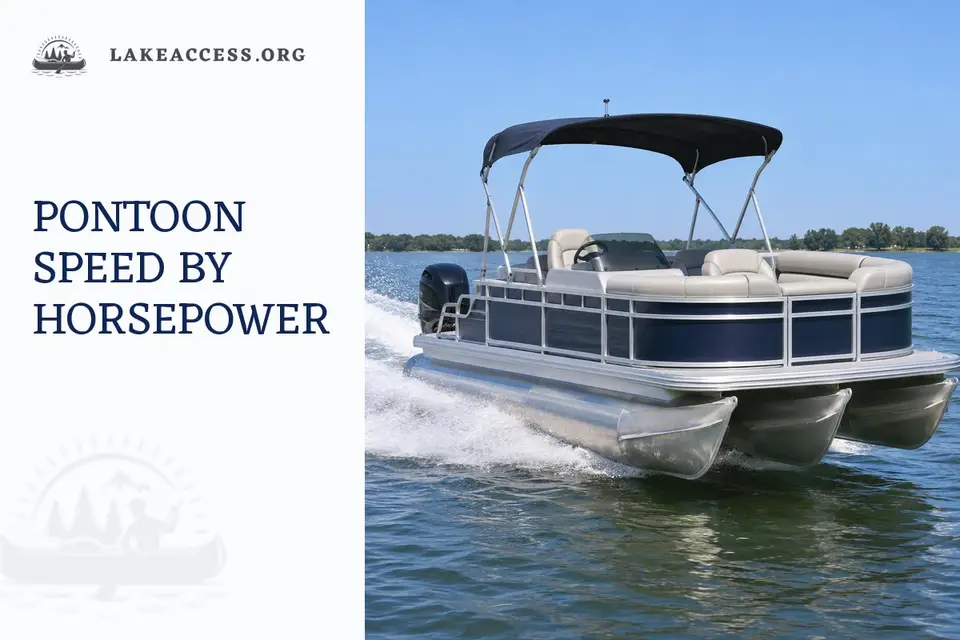
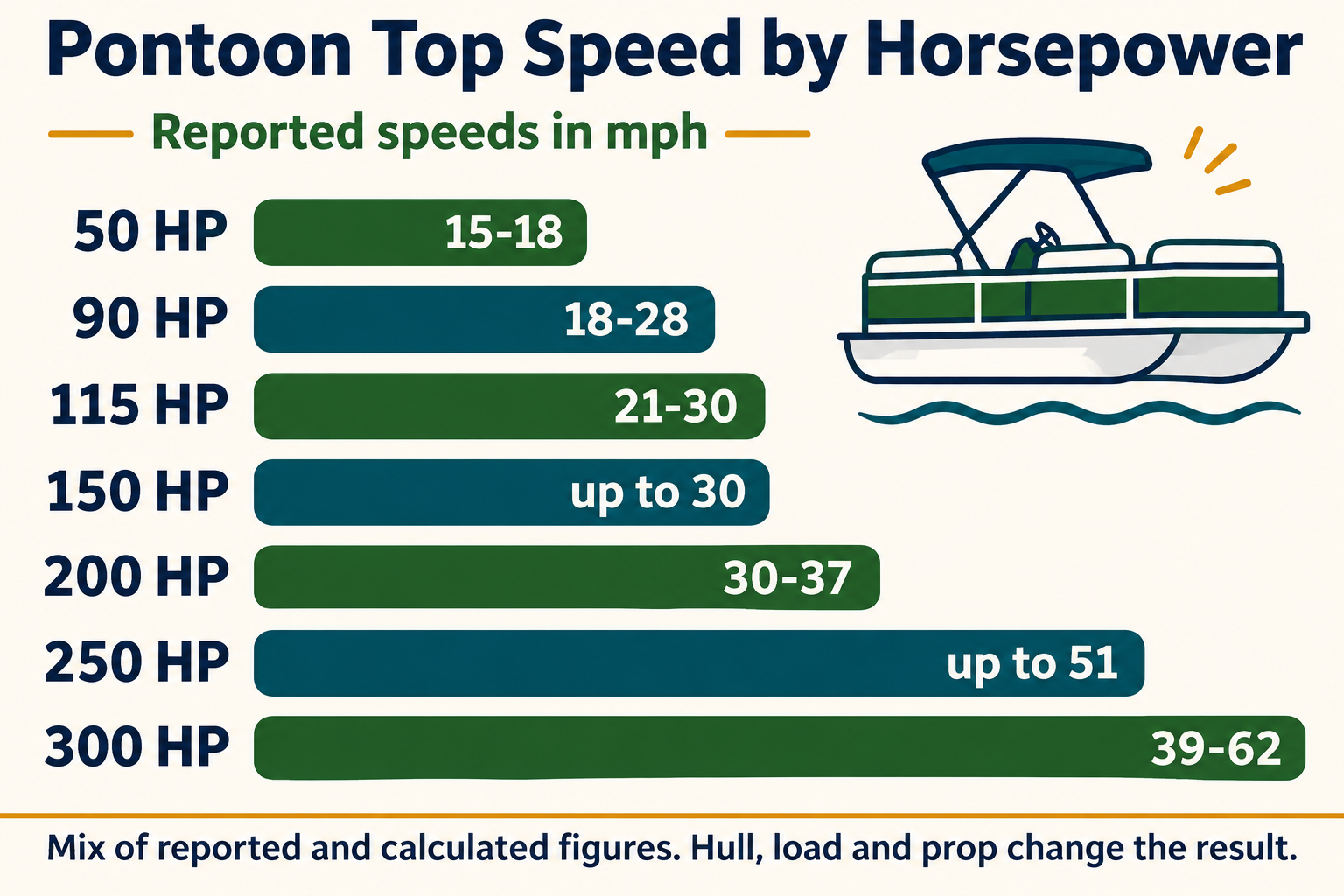
The honest answer is a range. A pontoon with 50 horsepower tops out in the high teens, a 90 or 115 usually lands in the twenties, and the big tritoons with 250 hp or more can pass 50 mph. What you get depends on the hull, the load, the prop and the engine, so use these numbers as a planning guide and not as a promise.
This page pulls together reported speeds from three kinds of sources: owner and dealer charts, a pontoon-specific calculation from engine makers’ published gear ratios, and a handful of named boats. They are not controlled tests, and where a figure comes from only one boat we say so.
Pontoon speed by horsepower#
| Horsepower | Reported top speed | Where it comes from |
|---|---|---|
| 50 hp | 15 to 18 mph | Boating Basics Online |
| 60 hp | 17 to 18 mph | Two Bass Buggy pontoons, 18 and 20 ft, on Pontoonopedia’s chart |
| 90 hp | 18 to 28 mph | Pontoonopedia chart (24 ft Sweetwater at 18 mph, 26 ft Crest III at 28 mph), Boating Basics Online (about 22), PontoonHQ’s computed 20 to 27 mph for a two-tube Yamaha F90 |
| 115 hp | 21 to 30 mph | Pontoonopedia (21 and 25 mph), Boating Basics Online (22 to 25), PontoonHQ’s computed 22 to 30 mph for a Suzuki DF115B |
| 150 hp | up to about 30 mph | Boating Basics Online |
| 175 hp | about 35 mph | One 26 ft tritoon on Pontoonopedia’s chart |
| 200 hp | 30 to 37 mph | PontoonHQ’s computed range for a Suzuki DF200A tritoon, Boating Basics Online (up to 32 or 35) |
| 250 hp | about 51 mph | One boat: a 28 ft Bennington QR27 on Pontoonopedia’s chart |
| 300 hp | 39 to 62 mph | Boating Basics Online (39 to 40), and two performance models at 50 and 62 mph on Pontoonopedia’s chart |
Two things stand out. First, the jump from 90 to 115 hp buys only a few mph. Second, the numbers above 250 hp come from performance tritoons and are not what a typical family pontoon does. Pontoonopedia says most commercially available pontoons average 18 to 25 mph, with a few very fast production and modified boats above that.
How the numbers are worked out#
Speed on a prop-driven boat comes from engine speed, gearing and prop pitch, less the water the prop slips through. PontoonHQ uses this formula:
- Take the engine rpm at full throttle.
- Divide by the gear ratio.
- Multiply by the prop pitch in inches.
- Divide by 1,056.
- Subtract 15% to 25% for prop slip.
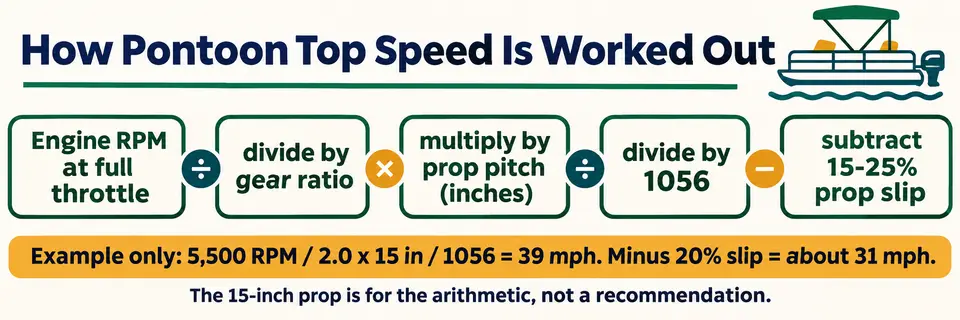
As an example, a Yamaha F150 has a 2.00:1 gear ratio and a rated full-throttle band of 5,000 to 6,000 rpm. At 5,500 rpm with a 15 in prop, the math is 5,500 divided by 2.0, times 15, divided by 1,056, which is about 39 mph with no slip. Take off 20% for slip and you get roughly 31 mph.
PontoonHQ also turns this into a per-inch rule of thumb. On a Yamaha F150, each inch of pitch is worth about 1.78 to 2.41 mph after slip. On a Suzuki DF150A, with its 2.50:1 gearing, it is about 1.42 to 1.93 mph per inch. That is one reason two 150s can run differently on the same boat. We compare these engines in 150 HP outboards compared.
What changes your top speed#
Horsepower, but not in a straight line. PontoonHQ notes that water resistance climbs faster than speed does. In its chart, going from 90 to 200 hp more than doubles the power and adds about 10 mph at the top end, and part of that gap comes from the tritoon hull and the bigger prop.
Weight and load. More weight pushes the tubes deeper, which means more wetted surface and more drag. PontoonHQ cites Mercury Racing putting the full-load drop at 200 to 300 rpm. A boat sitting low at the stern pays for it. See our pontoon boat weight guide.
Two tubes or three. A third tube adds buoyancy, so the boat floats higher for the same load and the hull can carry a bigger engine. It is the extra horsepower, not the tube, that makes a tritoon faster.
Prop pitch and rpm. A prop that lets the engine reach its rated rpm band at full throttle is what makes the formula work. Too much pitch and the engine cannot reach its band, and too little and it over-revs. A dealer should check this on your boat.
Tube condition and drag on deck. Pontoonopedia lists clean pontoon tubes, underskinning and resistance on deck, such as a bimini top, among the factors that affect speed.
What each power level is used for#
Boating Basics Online describes the power levels this way, and it is a dealer-style view, not a test:
- 50 hp. Enough for a relaxed tour with a few people, and for letting children go tubing.
- 90 hp. Suited to pulling kids on tubes and kneeboards.
- 115 hp. For households with teens or older children and more active water sports.
- 200 hp. It says docking, maneuvering and headwinds are easy, and that it suits a full boat of passengers.
- 300 hp. Maneuverability stays easy with several passengers on board.
The same site notes that pulling skiers and tubers is possible even at the low end of the chart. Pontoonopedia agrees that a pontoon at around 18 mph can still pull skis and tubes.
Top speed is not cruising speed#
Every number on this page is a wide-open-throttle figure. PontoonHQ is explicit that cruising speed is lower than any of the top speeds it computes. Most of your time on the lake is spent at a much lower throttle setting, where fuel use and noise are lower too. If you buy for the week-to-week trip, think about the load you carry and the water you run, not the speed you might reach once.
Speed is not the same as safe speed#
Pontoonopedia reminds owners that a boat that can go fast should not always do so. Slow down when there are other boats or swimmers nearby, in wind and waves, and in posted no-wake zones. Pontoonopedia notes that a pontoon is designed to stay afloat, not to take waves at speed, and suggests slowing down and heading into waves at about 45 degrees.
Before you think about more power, read the capacity plate on your boat. It lists the maximum horsepower, and you should stay at or below it. Our guides to the pontoon capacity plate and to choosing pontoon motor horsepower explain how to read it.
Measure your own speed#
The most reliable number is your own. Pontoonopedia suggests using a free GPS speedometer app on your phone, which uses the phone’s GPS to log your speed. Run the boat at the load you normally carry, in calm water, in both directions to cancel out wind and current, and note the rpm. If the engine cannot reach its rated rpm at full throttle, the prop is the first thing to look at.
Frequently asked questions#
How fast is a 90 hp pontoon boat?
Reported speeds run from about 18 to 28 mph. PontoonHQ computes about 20 to 27 mph for a two-tube pontoon with a Yamaha F90, and one chart lists a 24-foot Sweetwater at 18 mph and a 26-foot Crest III at 28 mph.
How fast is a pontoon with a 150 hp motor?
Boating Basics Online says up to about 30 mph. For a deeper look at one engine size, see how fast a 150 HP pontoon boat will go.
Is a tritoon faster than a two-tube pontoon?
Usually, but mostly because it carries more horsepower. A third tube adds buoyancy, so the hull floats higher for the same load and can carry a bigger engine. The third tube does not add speed by itself.
How do I make my pontoon faster?
PontoonHQ suggests starting with the cheap fixes: get wide-open-throttle rpm into the engine’s rated band by changing prop pitch, clean the tubes, take weight off and move it forward, and have the motor height checked. Consider strakes, larger tubes or a third tube next, and more horsepower last, never above the maximum on the capacity plate.
Can I put a bigger motor on my pontoon to go faster?
Only up to the maximum horsepower shown on the boat’s capacity plate. PontoonHQ points to the Coast Guard capacity-plate rules, 33 CFR 183.51 and 183.21. Read how to choose pontoon motor horsepower before you shop.
Sources#
Written by
We started this blog as a place to go to when we had questions about buying our first home on the lake. There was a lot of information on the internet, but we always spent hours...