Lake Kachess Weather and Water Temperature by Month
There is no public Lake Kachess water temperature, but NOAA normals from nearby Easton show July highs near 76°F and January highs near 36°F. Here is the month-by-month picture.
On this page
Quick answer: We found no published Lake Kachess water temperature, so we do not give one. For air, NOAA’s 1991-2020 normals at nearby Easton, Washington show July and August highs around 75 to 76°F with lows near 50°F, and January highs near 35°F. Treat the lake as cold water in every month: the National Weather Service says cold shock can be as severe at 50 to 60°F as at 35°F.
Air temperature and precipitation by month#
These are NOAA 1991-2020 climate normals for the Easton station (USC00452384, elevation 2,170 feet), the closest station we could confirm. WDFW lists the lake at 2,258 feet, so air at the lake may differ a little from the station, and we have no data on how much.
| Month | Avg high (°F) | Avg low (°F) | Mean (°F) | Mean precipitation (in) |
|---|---|---|---|---|
| January | 35.5 | 24.6 | 30.0 | 8.13 |
| February | 40.1 | 25.4 | 32.8 | 5.84 |
| March | 46.0 | 28.7 | 37.3 | 4.94 |
| April | 52.5 | 32.5 | 42.5 | 3.42 |
| May | 61.0 | 39.0 | 50.0 | 2.21 |
| June | 66.9 | 45.1 | 56.0 | 1.77 |
| July | 75.5 | 50.5 | 63.0 | 0.71 |
| August | 76.1 | 49.8 | 63.0 | 0.87 |
| September | 69.0 | 43.3 | 56.2 | 1.88 |
| October | 56.0 | 35.2 | 45.6 | 4.93 |
| November | 42.5 | 29.4 | 35.9 | 7.77 |
| December | 35.2 | 25.0 | 30.1 | 7.37 |
Cle Elum, a second NOAA station at 1,900 feet down the valley to the east, runs warmer in summer, with July and August average highs of 81.1°F and 81.4°F. That spread is a reminder that one station does not describe every shoreline.
What the numbers mean for a trip#
- July and August: warm days and cool nights. Lows stay around 50°F, so bring layers for the evening. These are also the driest months, at 0.71 and 0.87 inches.
- June and September: highs of 66.9°F and 69.0°F, with lows of 45.1°F and 43.3°F. The campground’s posted season, early June to mid-September, covers this stretch. See our Lake Kachess camping guide.
- October to December: highs fall from 56.0°F to 35.2°F while precipitation climbs to 4.93, 7.77 and 7.37 inches. With highs near or below freezing in winter, some of that likely falls as snow, but the table does not separate rain from snow.
- January: the coldest and wettest month in the table, at a 35.5°F high, a 24.6°F low and 8.13 inches.
Water temperature: what we can and cannot say#
We did not find a daily or seasonal Kachess water-temperature record, and we have not seen a source that measures it at the swimming area. What we can say comes from general safety guidance:
- NWS says cold shock can be as severe at 50 to 60°F as at 35°F.
- NWS says the sudden-immersion gasp can be triggered by water as warm as 77°F.
- NWS recommends dressing for the water temperature rather than the air temperature.
- WDFW says kokanee prefer depths near 50°F. That is about where the fish sit, not what the surface feels like.
- The Forest Service says summer snowmelt runoff can swell rivers and streams and create powerful currents. That is general guidance, not a Kachess gauge forecast.
To look for live data yourself, read how to find live lake water temperature data. For the swimming side, see can you swim in Lake Kachess and how to know if a lake is safe to swim in.
Reservoir level, checked November 6, 2026#
Kachess is a Bureau of Reclamation storage reservoir with a 239,000 acre-feet capacity. Reclamation’s latest reading we saw was 55,716 acre-feet and a water-surface elevation of 2,212.72 feet on November 6, 2026, marked preliminary and subject to change. Against the capacity, that is roughly 23%. Elevation figures vary by source (WDFW lists the lake at 2,258 feet), and we could not reconcile them, so do not subtract one from the other.
Reclamation says the reservoir usually fills in winter and spring and is used for irrigation and fisheries enhancement in summer and fall. Irrigation releases begin in mid-March, diversions in September and October come primarily out of Kachess, and the reservoir does not fill every year even in normal runoff. Recreation.gov posted a low-water closure of the boat launch on August 1, 2026. Our boat launch guide covers the details.
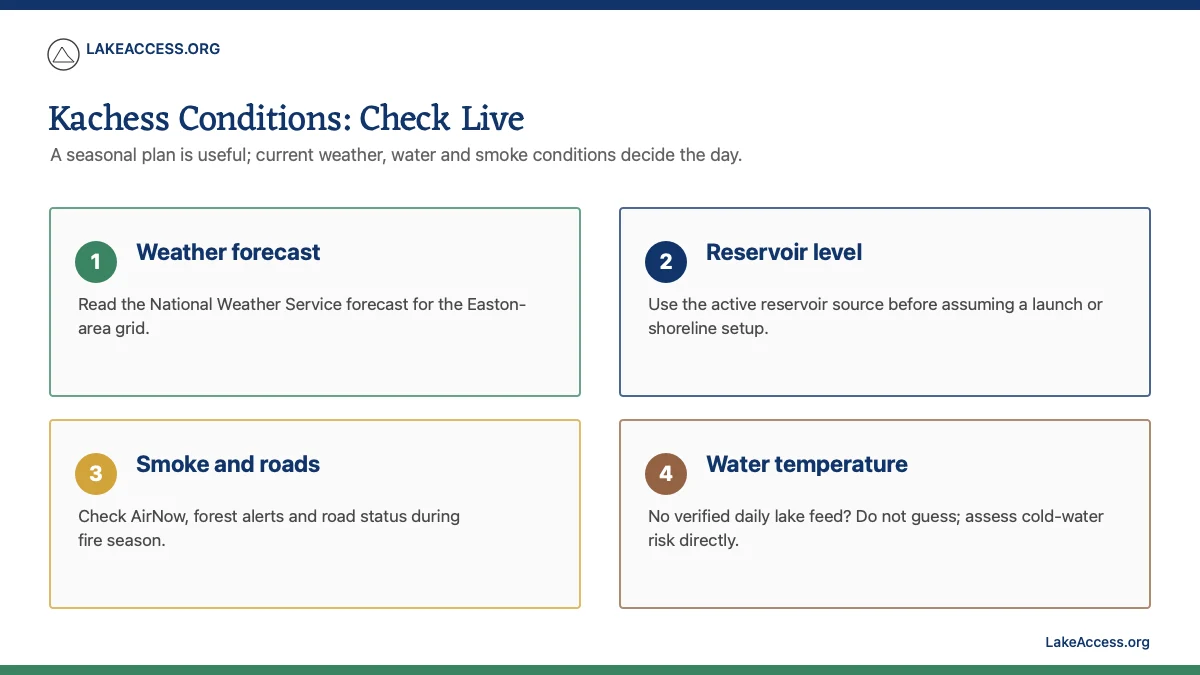
Fire, smoke and roads#
- Closure order: a Three Queens Fire closure order runs from November 1, 2026 through April 30, 2027 unless rescinded sooner.
- Campfires: the 2026 forestwide campfire restriction was rescinded on September 18, 2026. The Forest Service still asks visitors to be fire-wise.
- Road: the Forest Service conditions page listed Kachess Road 49 as open, with a warning that conditions on open roads may be unknown and that winter conditions are possible.
- Smoke: we found no Kachess-specific smoke history. Check AirNow and the forest alerts.
Plan around the water, not the thermometer#
Warm air at the campground says nothing about how the lake will feel if someone falls in. Keep life jackets on boaters, supervise swimmers closely, and keep a way to warm up quickly. Our Lake Kachess fishing guide and things to do near Lake Kachess show how the season shapes your options.
Sources#
Checked on November 7, 2026: NOAA NCEI 1991-2020 normals for Easton, NWS cold water safety, NWS Seattle cold water, Forest Service water safety, WDFW kokanee species page, WDFW Kachess Lake, Reclamation Kachess storage data, Reclamation Kachess dam-safety finding, Reclamation fish passage study, Forest Service current conditions, Three Queens closure order, Recreation.gov Kachess.
Frequently asked questions#
What is the water temperature at Lake Kachess?
We could not find a measured Lake Kachess water temperature, so we will not guess one. The National Weather Service says cold shock can be as severe at 50 to 60°F as at 35°F, and that sudden-immersion gasping can be triggered by water as warm as 77°F. NWS Seattle adds that warm air does not mean warm water. WDFW says kokanee prefer depths near 50°F, which is a fish-behavior fact and not a surface reading.
What is the weather like at Lake Kachess in summer?
NOAA’s 1991-2020 normals for Easton, Washington show a July average high of 75.5°F and low of 50.5°F, and an August high of 76.1°F and low of 49.8°F. July and August are the driest months, with 0.71 and 0.87 inches of mean precipitation. Cle Elum, down the valley to the east, runs warmer, with July and August average highs of 81.1°F and 81.4°F.
Which months are wettest at Lake Kachess?
At Easton, the wettest months are January (8.13 inches of mean precipitation), November (7.77) and December (7.37). Those months have average highs of 35.5°F, 42.5°F and 35.2°F, so some of that precipitation may fall as snow, although the table does not separate rain from snow.
How full is Lake Kachess right now?
Reclamation’s latest reading we saw was 55,716 acre-feet on November 6, 2026, marked preliminary. That is roughly 23% of the 239,000 acre-feet capacity Reclamation lists. Reclamation says Kachess does not fill every year even in normal runoff. See our boat launch guide for what low water did to the ramp in 2026.
Is there wildfire smoke at Lake Kachess?
We found no Kachess-specific smoke history, so we cannot say how often it happens. The Forest Service rescinded the 2026 forestwide campfire restriction on September 18, 2026, and a Three Queens Fire closure order runs from November 1, 2026 through April 30, 2027. Check AirNow and forest alerts before you go.
Written by
We started this blog as a place to go to when we had questions about buying our first home on the lake. There was a lot of information on the internet, but we always spent hours...