
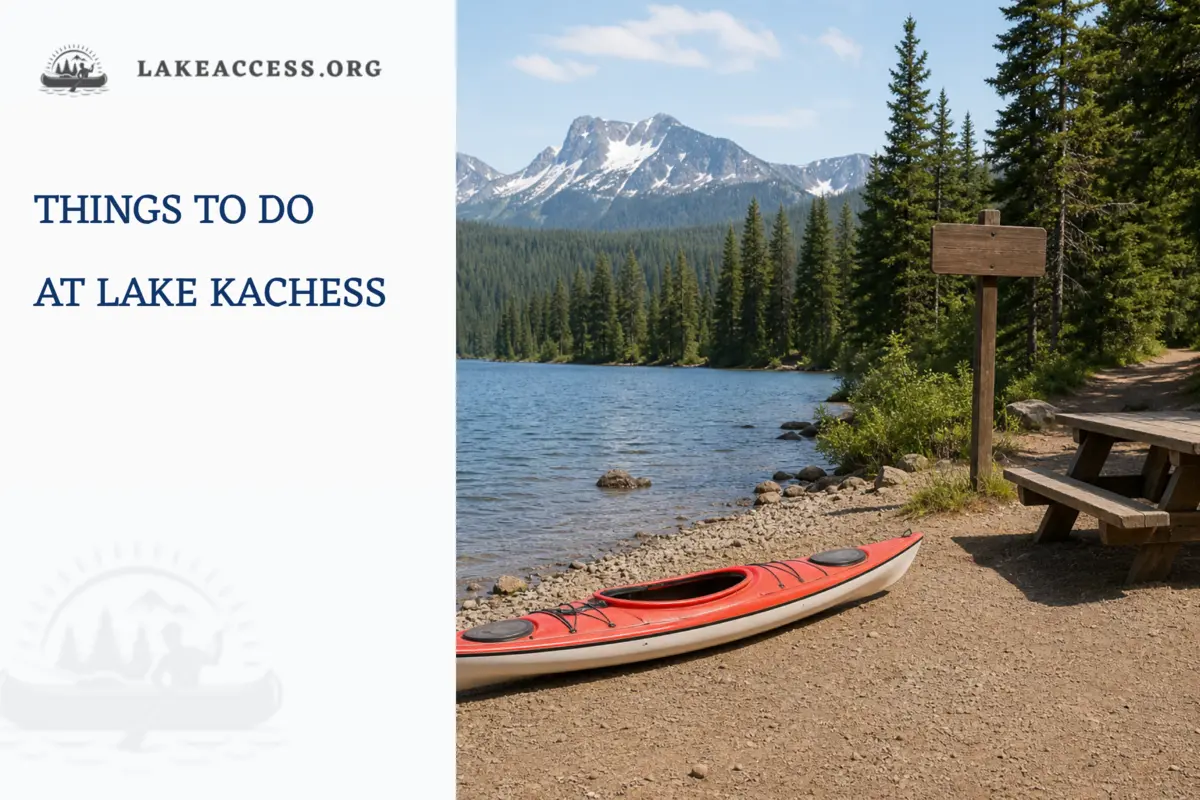
Quick answer: A Lake Kachess trip can include boating, paddling, fishing, swimming, picnicking, birding, biking, and a short lakeside walk from the developed campground, according to the official Recreation.gov listing. The best plan is not a fixed bucket list: choose one or two activities that match the live facility status, weather, water level, and your group’s experience. Kachess is a reservoir and mountain setting, so a responsible day has a backup for wind, smoke, closures, or a launch that is not usable.
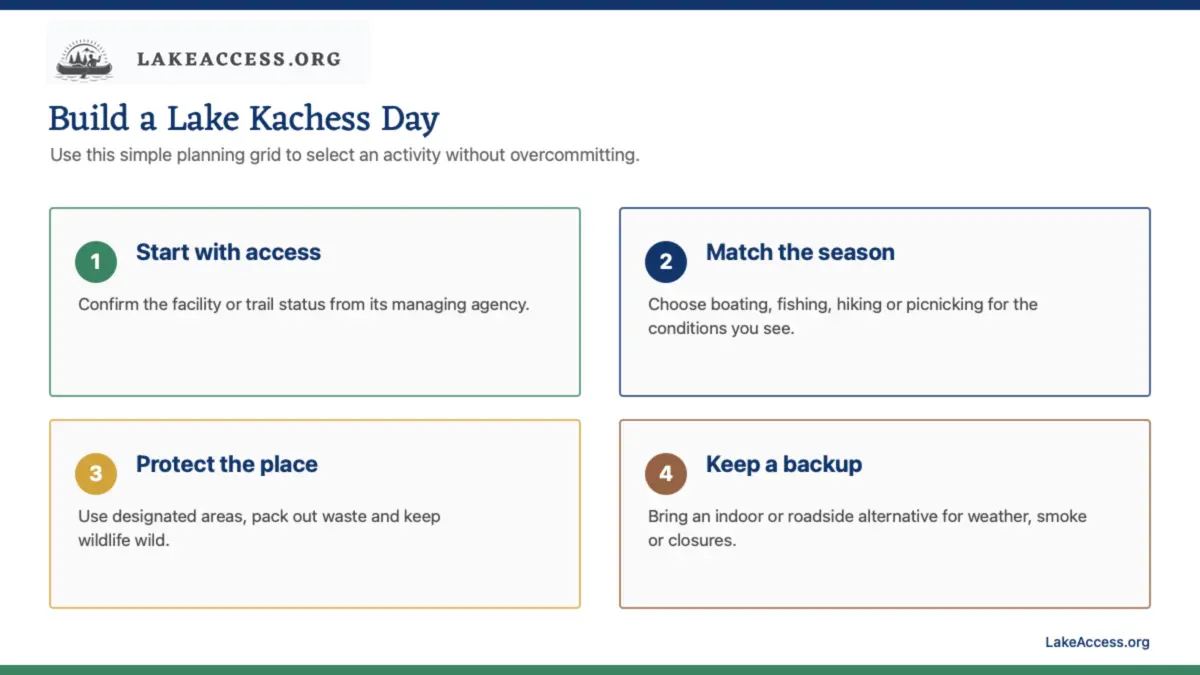
Use the campground as the verified starting point
The official Kachess listing identifies Kachess Campground as a developed recreation base in Okanogan-Wenatchee National Forest. It lists hiking, fishing, biking, birding, motor boating, kayaking, and picnicking, plus the campground swimming area and launches. Those are the activities this guide treats as established options. Before adding a trail, viewpoint, road, or commercial operator, confirm it with the managing agency rather than following a map pin or travel forum.
| Activity | Official basis | Day-of decision |
|---|---|---|
| Picnic and shoreline time | Recreation.gov lists picnic areas. | Check open facility areas and weather. |
| Boating or paddling | Recreation.gov lists motor boat and kayaking; it lists motorized and non-motorized launches. | Confirm launch conditions, wind, and your equipment. |
| Fishing | Recreation.gov and WDFW list fishing opportunities. | Read current WDFW rules and access status. |
| Swimming | Recreation.gov lists a swimming area. | Follow notices and assess water, weather, and supervision. |
| Lakeside walking | Recreation.gov describes a short Kachess Lake Trail loop from the campground. | Check trail and forest alerts before starting. |
A four-hour Lake Kachess outline
A short visit works best when it stays compact. Start by reading the access board and choosing one main activity. For example, a group can have a picnic, take the short lakeside loop described by Recreation.gov, and spend time at the shoreline without turning the visit into an unprepared backcountry outing. A boater can make the launch decision first; if the ramp or wind is not right, switch to a walk and picnic rather than trying to salvage the original plan.
Build time for the unglamorous parts: parking lawfully, reading notices, preparing gear away from a ramp, returning to the vehicle, and cleaning up. A four-hour schedule does not need a long drive to every nearby landmark to be worthwhile.
A full-day outline
For a longer visit, choose a morning activity and an afternoon activity that share the same developed base. One sensible pattern is a lakeside walk or fishing plan early, followed by a picnic and either paddling or a supervised swim only if conditions still support it. The official listing says the campground can be a base for day hiking and overnight backpacking, but a full-day article should not imply that every visible route is suitable for every visitor. Check the relevant trail source, carry navigation and weather essentials, and turn around when conditions or time do not match the plan.
The official page also notes that the Pacific Crest Trail can be accessed near the campground. That is useful context, not an instruction to improvise a PCT excursion. Use the Pacific Crest Trail Association and Forest Service information for route-specific planning.
A weekend outline
Camping can provide a base for two modest days rather than a reason to overload a schedule. Reserve or confirm the campsite through the official listing, then organize activities by condition: water time when wind and access are suitable; walks and picnic time when the water plan is not; and a quiet, low-impact camp routine at the end of the day. The listing describes 150 sites, a group site, drinking water, vault toilets, and no electric hookups. Verify availability, rules, and any current restrictions at booking and again before travel.
Keep wildlife wild, secure food as required, use established facilities, and pack out what the site does not accept. Fire restrictions and smoke conditions are not details to be discovered at the fire ring. Check forest alerts before you leave and follow every onsite instruction.
When weather changes the plan
Mountain weather should decide the activity, not merely the clothing. The National Weather Service point near Lake Kachess provides the current forecast grid; it showed a sunny July 10 forecast during this article’s research, but forecasts are time-sensitive and should never be copied into a future trip plan. If wind, thunderstorms, smoke, or poor visibility make water activity unsuitable, choose a developed-land activity or leave the area. Do not use a rain jacket as a reason to keep paddling or fishing in weather beyond your capability.
For a truly rainy lake-day alternative, see what to do at a lake when it rains. For smoke, closures, or road concerns, use official forest and public-safety sources first.
Leave No Trace in a reservoir landscape
Lake Kachess is both a recreation destination and part of the Yakima Basin water-storage system. Respect the shoreline and access routes as they exist today. Stay on lawful access, do not create new launch paths, keep trash and fishing line out of the lake, and avoid feeding wildlife. If an exposed shoreline looks dramatically different from a prior visit, that is a reminder to check conditions, not an invitation to drive or camp wherever the water used to be.
Build your day from these LakeAccess guides
- Lake Kachess boat launch and day-use guide.
- Lake Kachess fishing guide.
- Can you swim in Lake Kachess?
- Lake Kachess camping guide.
Pick activities by information quality
Not every activity needs the same level of current information. A picnic in an open, developed area can be a good choice when water conditions are uncertain. A paddle, boat launch, swim, or backcountry route needs more confirmation because the consequence of bad information is higher. Sort the day this way: first choose the activities supported by current official status, then choose the ones that match the weather and the group, and finally remove anything that relies on an unverified assumption.
This approach makes a better visit than racing from one map pin to another. It also prevents a common failure mode in travel content: treating an old list of attractions as though every road, trail, beach, and facility is open and suitable at the same time.
Bring a simple day kit
For a shore-based day, bring water, food, sun and rain protection, warm layers, a charged phone, a basic first-aid kit, and a way to pack out waste. For a water activity, add the required safety gear, a properly fitted life jacket, and a conservative weather window. For a walk, add navigation appropriate to the route, footwear for changing ground, and enough time to turn around before conditions worsen.
Do not overpack fragile or disposable items that become lakeside litter. A small, organized kit supports better decisions because the group is not forced to continue an activity simply to justify the gear it carried.
Access and courtesy checklist
- Use the facility or trail that the managing agency confirms is open.
- Park only where allowed and leave lanes, gates, and ramps clear.
- Keep music, dogs, cooking, and group space within the applicable rules.
- Give wildlife distance and never feed it.
- Leave the shoreline cleaner and less obstructed than you found it.
These basics are not ornamental etiquette. They keep a busy recreation area usable for anglers, campers, paddlers, walkers, people with mobility needs, and staff.
When to stop or change course
Stop the plan when an official closure, smoke advisory, road condition, lightning risk, unsafe wind, or access problem changes the underlying assumption. Change course when a group member is tired, cold, uncomfortable, or outside the skills needed for the activity. Neither decision is a failed trip. The developed campground and nearby community options are a better fallback than forcing a water or trail activity because it appeared in an itinerary.
A useful end-of-day habit is to note what you verified, what changed, and what you would check earlier next time. That is more valuable than preserving a misleading “perfect day” story for the next visitor.
Match the season to the least complicated activity
In a mild, clear summer window, the developed campground’s listed water and shore activities may fit a day plan after live checks. In a smoky, windy, or uncertain window, a short walk, picnic, or a return trip can be the better use of the destination. In snow season, access and road information can take priority over every warm-weather idea. The calendar is a prompt to check conditions, not an answer.
Spring and early summer can bring changing water conditions and lingering mountain-weather variability. Late summer can bring drawdown and smoke concerns. Fall has shorter daylight and cooler evenings. These are planning themes, not promised dates. The agency source, the forecast, and the onsite notice are what turn a theme into a real decision.
Build a water-activity decision tree
For boating or paddling, start with official facility status, then check the forecast and the launch. If all three are suitable, add the group’s skill, equipment, and return window. If any step fails, shift to a shore activity. For swimming, start with notices and water appearance, then check weather and the group’s supervision plan. A “maybe” at any point should lead to a shorter, lower-risk option.
This approach is more useful than a list that says every visitor should fish, swim, paddle, and hike in one day. A well-planned Lake Kachess visit may include only one main activity. It can still be rich, because it leaves attention for the setting and capacity to respond when conditions change.
Accessibility and group comfort
Do not promise accessibility features that are not identified by the managing agency. Check the official facility listing and contact information for current details when mobility, parking distance, restroom access, or a particular surface matters to your group. The same care applies to pets, large groups, and children: verify the rule and choose an activity that fits rather than asking the setting to absorb a mismatch.
Group comfort is a legitimate planning factor. Heat, bugs, noise, fatigue, lack of cell service, and a long drive can make a technically open activity a poor choice. A conservative itinerary respects the least experienced person rather than rewarding the person most willing to push through.
Make the return part of the itinerary
Set a departure time before you arrive. It protects against a common lake-day problem: delaying the return until light, weather, energy, or traffic has already shifted. Leave enough margin to pack out, move the vehicle, and drive safely. The best outdoor plans include a graceful end.
Use official sources for specific routes and services
This guide intentionally does not list travel times to trailheads, stores, beaches, or rental operators beyond the official campground directions. Those details change and can become misleading when a road, facility, or business is unavailable. For a route-specific day, use the Forest Service, Recreation.gov, Washington State Parks, or the relevant operator’s own current page. For a general destination day, the developed campground is the evidence-backed place to begin.
Likewise, do not treat a generic map as a navigation approval. Carry an appropriate map for the exact activity, know the route’s management rules, and choose a turnaround point before the group becomes tired or weather obscures the plan.
Protect the water while you visit
Use toilets and waste facilities where provided; do not leave soap, food waste, fishing debris, or pet waste at the shoreline. Avoid washing gear or vehicles in the lake. These choices keep a recreation day from adding to the water-quality and wildlife pressures that visitors say they value. They are especially important when many people share a developed area in the same weather window.
Respect other users’ experience as part of that protection. A quiet launch lane, clear path, and clean picnic area reduce conflict and make it easier for staff to manage the place safely.
End with a conditions note
Before leaving, note which official sources were useful and what changed on the ground. This is a better memory aid than a broad claim that Lake Kachess is always one way. A later visit can begin with current evidence, while your personal note helps you pack and schedule more thoughtfully.
Keep the plan useful for everyone
A flexible itinerary gives each person a way to participate without pressure to enter the water, hike farther, or stay out later than they want. Set the group’s expectations early: conditions may narrow the plan, and a simpler activity is still a successful day. This makes it easier to follow an alert or turn around without treating caution as a disappointment.
That same flexibility helps protect the destination. Fewer rushed decisions mean fewer blocked access points, less shoreline impact, and more attention for signs and other visitors.
It also leaves time for the most important part of the trip: getting everyone home safely.
That is a success worth planning for.
Use the same standard when the original plan needs to become a simpler one.
Sources
- Recreation.gov: Kachess, Okanogan-Wenatchee National Forest (checked July 10, 2026).
- US Forest Service: Okanogan-Wenatchee National Forest (checked July 10, 2026).
- Pacific Crest Trail Association (checked July 10, 2026).
- Washington Department of Fish and Wildlife: Kachess Lake (checked July 10, 2026).
- Bureau of Reclamation: Kachess recreation context (checked July 10, 2026).
- National Weather Service forecast point near Lake Kachess (checked July 10, 2026).