
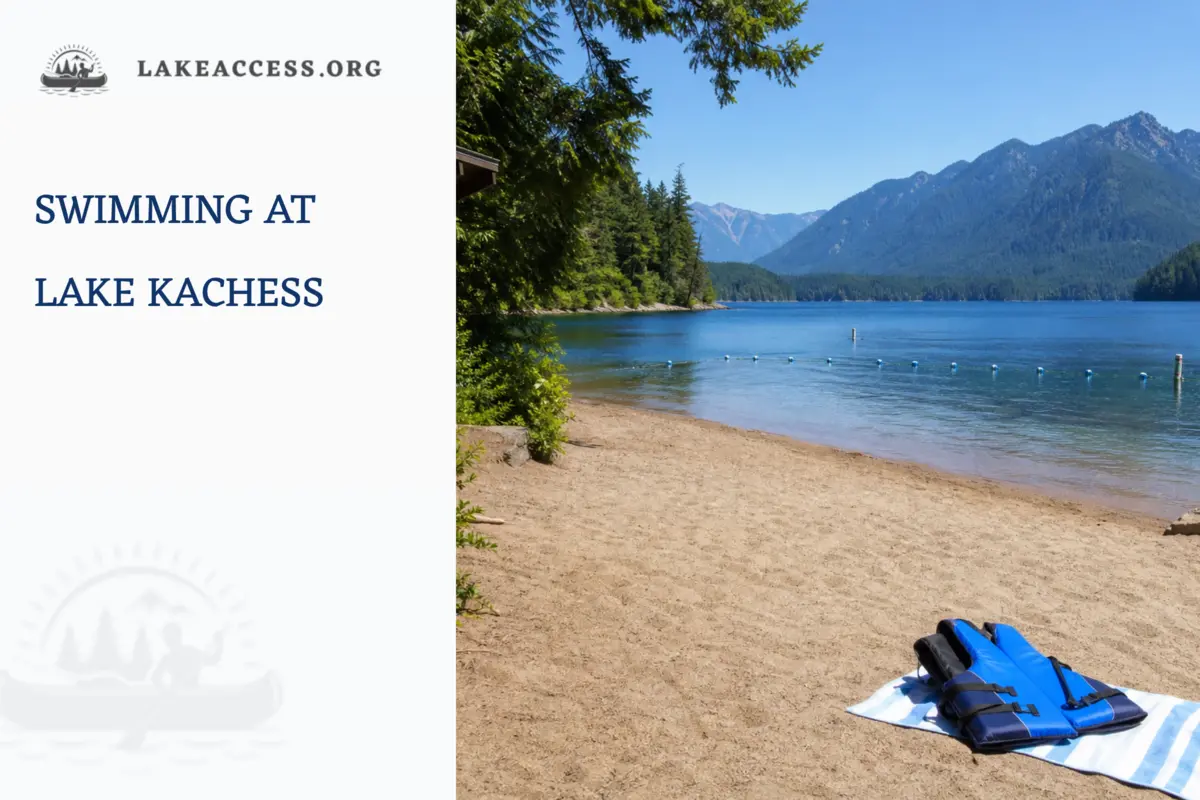
Quick answer: Recreation.gov lists a swimming area at Kachess Campground, so swimming is an official recreation use at the developed facility. Whether it is a good idea on a particular day depends on current conditions: posted notices, water appearance, weather, wind, water temperature, your group’s ability, and whether the area is actually open. We did not find an official daily Lake Kachess water-temperature feed or a standing public-water-quality clearance that would justify promising that the water is “safe” every day. Use the checklist below and follow all onsite instructions.
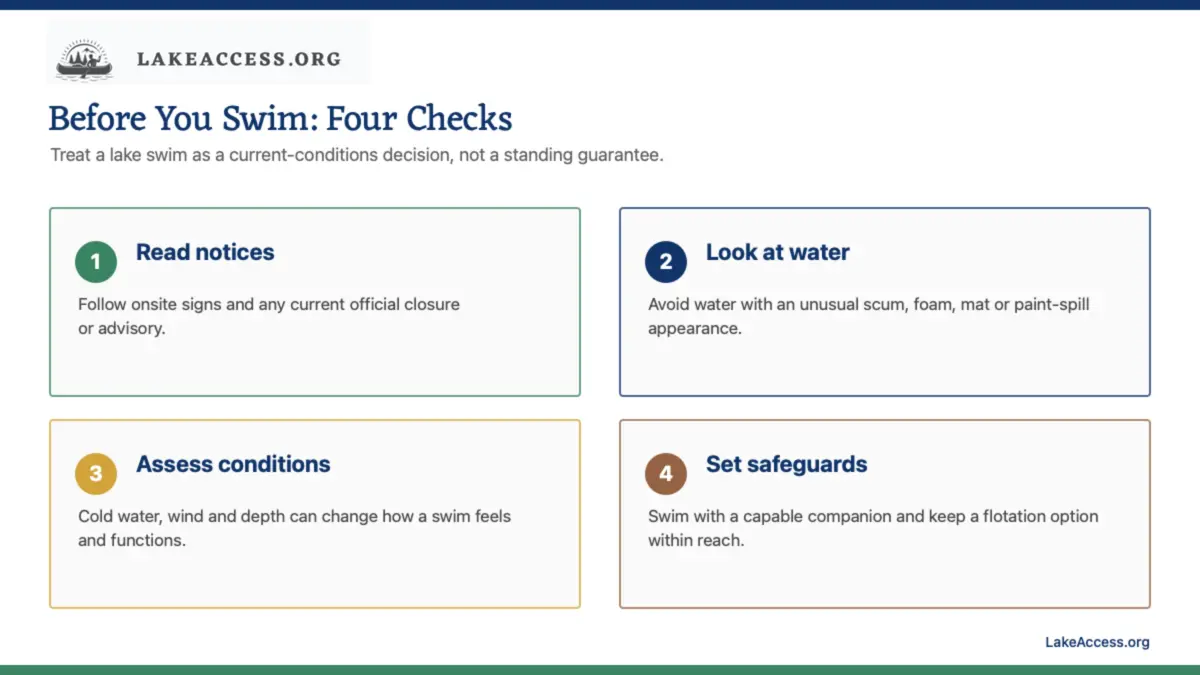
Swimming at a designated area still requires a current decision
The official Kachess listing names a swimming area, but a listing is not a lifeguard service, weather forecast, or water-quality certificate. Do not plan around assumed rescue coverage; we found no official statement establishing lifeguard availability. Bring capable supervision for children and inexperienced swimmers, keep a flotation aid within reach, and make the first decision before anyone gets in the water.
| Condition | What to do | Why it changes the plan |
|---|---|---|
| Closure sign, official advisory, or restricted area | Do not enter the water. | Onsite direction overrides an evergreen guide. |
| Visible scum, foam, mat, or paint-spill appearance | Avoid contact and check the local-health or toxic-algae source. | Appearance alone cannot confirm whether algae are toxic. |
| Cold water, gusty wind, thunder, or impaired visibility | Choose a shoreline activity or leave. | Conditions can reduce swimming ability and complicate rescue. |
| Calm conditions with no warning and a capable group | Continue cautiously and remain close to shore. | It is still an unmanaged natural-water setting. |
What the official sources say
The Kachess Recreation.gov listing includes one motorized launch, one non-motorized launch, a swimming area, and picnic areas. That supports the limited claim that the developed facility is intended to accommodate swimming. It does not identify a daily water-temperature reading, a bacteria-monitoring schedule, or an all-season condition rating.
Washington’s Department of Ecology explains that freshwater swimming safety is generally monitored by local health jurisdictions and other local partners, while its BEACH program focuses on saltwater beaches. Ecology also points visitors to Washington Toxic Algae information for freshwater reports. This is why a Lake Kachess swimmer should check local and onsite information rather than infer safety from clear-looking water or an old vacation photo.
How to check today’s status
- Read the current Kachess facility listing and Forest Service alerts for operating or closure information.
- At the site, read every notice at the entrance, beach, and water access. Do not treat the absence of a social-media post as evidence of no advisory.
- Check the Washington Department of Ecology freshwater algae guidance and contact the local health department if there is a question about a bloom or water contact advisory.
- Use the National Weather Service forecast for the Easton-area grid. Cancel a swim for lightning, unsafe wind, or a forecast that your group cannot manage.
- Look at the water from shore. A color alone does not diagnose contamination, but unusual scum, foam, floating mats, or a paint-spill look are reasons to stay out and seek an official answer.
Cold water: do not let warm air make the decision for you
Lake Kachess is a mountain reservoir. The available official sources do not provide a verified daily surface-temperature number that this article can responsibly repeat, and a single shoreline reading would not represent every part of the lake. Assume the water may be cold enough to affect breathing, movement, and judgment. Ease in rather than dive, keep the first swim short, and get out at the first sign of shivering, numbness, fatigue, or distress.
Children, weak swimmers, and anyone returning to the water after a long break benefit from a conservative plan: close supervision, a properly fitted life jacket when appropriate, one person designated to stay out of the water and watch, and an easy exit path. Do not use inflatable toys as safety equipment.
Water quality: what an article cannot tell you
No article can certify a lake’s water quality for today. Ecology notes that cyanobacteria can be hard to predict and that only laboratory testing can determine whether a bloom is toxic. Not all algae are harmful, and not all harmful conditions look the same. The appropriate response is not to diagnose the water from a screen: follow posted warnings, avoid suspicious water, keep pets away from it, and use the current local or state information.
Do not drink untreated lake water. Keep wounds covered where practical, rinse after swimming, and do not swim if you are ill. These are ordinary precautions, not a substitute for an advisory or an individual medical assessment.
Plan the beach and boat areas separately
The campground’s official listing includes both swimming and boat launches. That does not make launch lanes a place to swim, linger, or set up towels. Keep swimming activity within the designated area and give boat traffic room. If the site is crowded, the better choice may be a picnic, a short walk, or another part of your trip rather than forcing a swim in a space that does not feel controlled.
Useful LakeAccess planning links
- Lake Kachess camping guide for the developed-facility context.
- How to know if a lake is safe to swim in for a general source-first checklist.
- What lake water color can and cannot tell you for a careful reading of appearance.
Set up the group before anyone enters
Decide who is swimming, who is supervising, where the exit point is, and what condition ends the activity. A group can call the day “swimming” and still spend most of the time on shore, which is often the right outcome for cold water or changing wind. Children and weaker swimmers need active, capable supervision close enough to respond; a person scrolling from far away is not a safety plan.
Use a buddy system for every swimmer. Keep a properly fitted life jacket available for boating and for people who need extra buoyancy, but do not assume a flotation device makes a person safe without supervision. Know how you will get warm and dry quickly. Pack layers, drinking water, and a way to leave rather than treating a beach towel as the whole plan.
Keep the swim area and boat area separate
The official facility has both launches and a swimming area. Their coexistence is not a license to cut through a launch lane, use a ramp as a play area, or drift into boat traffic. Keep a clear boundary around the swimming plan. If a group cannot stay within the designated area or cannot see a safe exit, choose shore time instead.
Wind can push floating gear and swimmers farther from shore than expected. Boats, paddlers, and anglers may also be using the lake. That is one more reason to keep the first entry shallow and conservative, with an observer who is not in the water.
How to interpret the water without pretending to test it
Clear water is not a laboratory result, and colored water is not automatically a toxic bloom. Ecology explains that toxicity is difficult to predict and needs laboratory testing. The useful decision is behavioral: avoid water that looks unusual or has visible scum, foam, mats, or a paint-spill appearance; obey any posted warning; keep pets away; and ask the local health authority for current information when there is uncertainty.
Do not rely on a single annual report or a page that does not name Lake Kachess. Monitoring coverage differs by waterbody and by season. A current official source can be incomplete, but it is still more reliable than inventing a local clearance from general state guidance.
After a swim
Rinse off with clean water when available, wash hands before eating, and keep food preparation separate from wet gear. Watch children and pets for signs that they are cold, tired, or unwell. When a person feels unwell after water exposure, leave the water, warm and clean up as appropriate, and seek medical advice when symptoms are concerning. This is general safety information, not medical diagnosis.
Pack out all trash, including tape, broken toys, and food scraps. A careful departure protects both the next visitors and the lake’s wildlife. The reward for a conservative swim decision is a group that is ready to enjoy the rest of the day.
Swim readiness is more than confidence
Ask each person a practical question before entry: can you get back to shore comfortably if the water is colder, windier, or deeper than expected? A confident swimmer can still lose capability quickly in cold water or after fatigue. Keep the first entry close to shore, avoid horseplay that hides distress, and make it socially easy for anyone to say no.
For families, identify a single responsible adult whose only job is active supervision during water time. Rotate that role deliberately rather than assuming another adult is watching. For mixed-age groups, separate the activity zones and expectations so that an experienced swimmer’s plan does not become a standard imposed on a child or beginner.
Weather and visibility change the margin
Thunder, gusts, rain, low light, and smoke are reasons to reassess, not inconveniences to power through. A sudden wind can make the shoreline feel colder and move floating gear quickly. Poor visibility makes it harder to see another swimmer or a boat. Build time to dry off and leave before the forecast becomes a problem, and do not wait for a dramatic condition to make the conservative call.
The safest water plan is often short. It leaves energy for the walk back, the drive, and the rest of the trip. A lake swim does not need to become a distance challenge to be enjoyable.
Simple emergency preparation
Know the site’s access route and have a charged phone, but do not depend on a phone as the only rescue plan. Keep a reachable flotation aid, watch for changing behavior, and call emergency services when there is immediate danger. In a non-emergency concern, leave the water, warm up, and decide calmly whether the group needs medical advice or a different activity.
Preparedness supports good judgment. It should never be used to justify entering water that has a closure, an advisory, a hazardous appearance, or conditions beyond the group’s ability.
Questions to ask before driving to the beach
Is the developed facility open? Are there posted restrictions? Does the forecast still support the trip? Can everyone in the group get in and out of cold water without pressure? Is there a shore-based alternative that would still make the day enjoyable? These questions have no glamorous answer, but they prevent a safety decision from being made at the water’s edge by momentum alone.
When any answer is unclear, reduce the plan. Fewer people in the water, a shorter visit, or no entry at all are ordinary adjustments in a mountain reservoir setting.
Sources
- Recreation.gov: Kachess campground facilities (checked July 10, 2026).
- Washington Department of Ecology: Freshwater algae control (checked July 10, 2026).
- Washington Department of Ecology: Harmful algal bloom safety (checked July 10, 2026).
- Washington Department of Ecology: Lake water-quality monitoring (checked July 10, 2026).
- Kittitas County Public Health: Water recreation resources (checked July 10, 2026).
- National Weather Service forecast point near Lake Kachess (checked July 10, 2026).