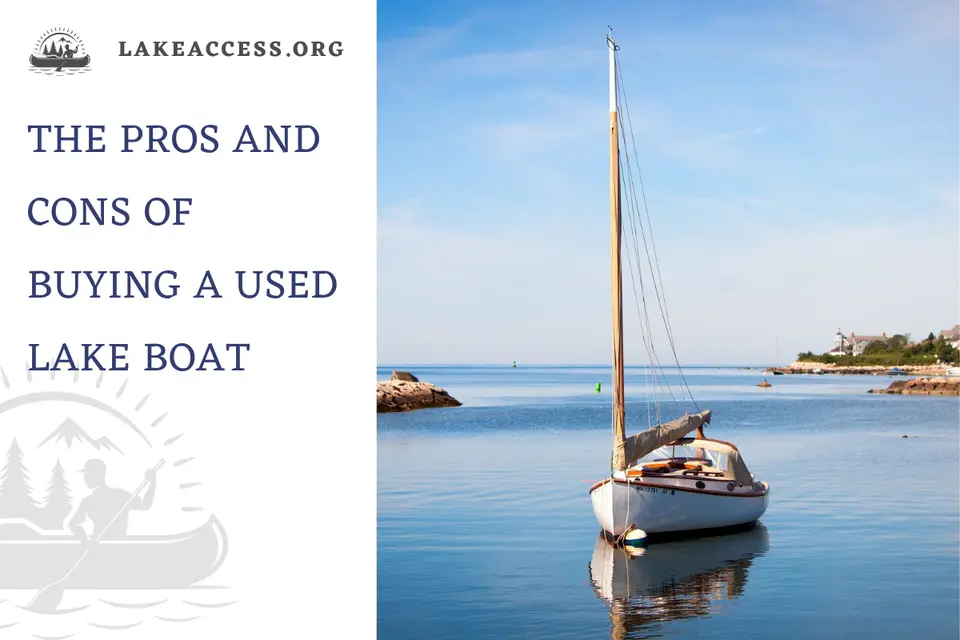
The Pros and Cons of Buying a Used Lake Boat
A used lake boat can be a sensible buy if you check it properly. Here is what BoatUS, the Coast Guard rules and three state agencies say to verify before you pay.
On this page
- The pros
- The cons
- Before you go: decide what you need
- Check 1: the hull identification number
- Check 2: recalls
- Check 3: title, liens and registration
- Check 4: your own walk-through
- Check 5: an independent survey and a sea trial
- Check 6: the written contract
- After you buy: the safety gear
- What the sources do not cover
- Sources
- Frequently asked questions
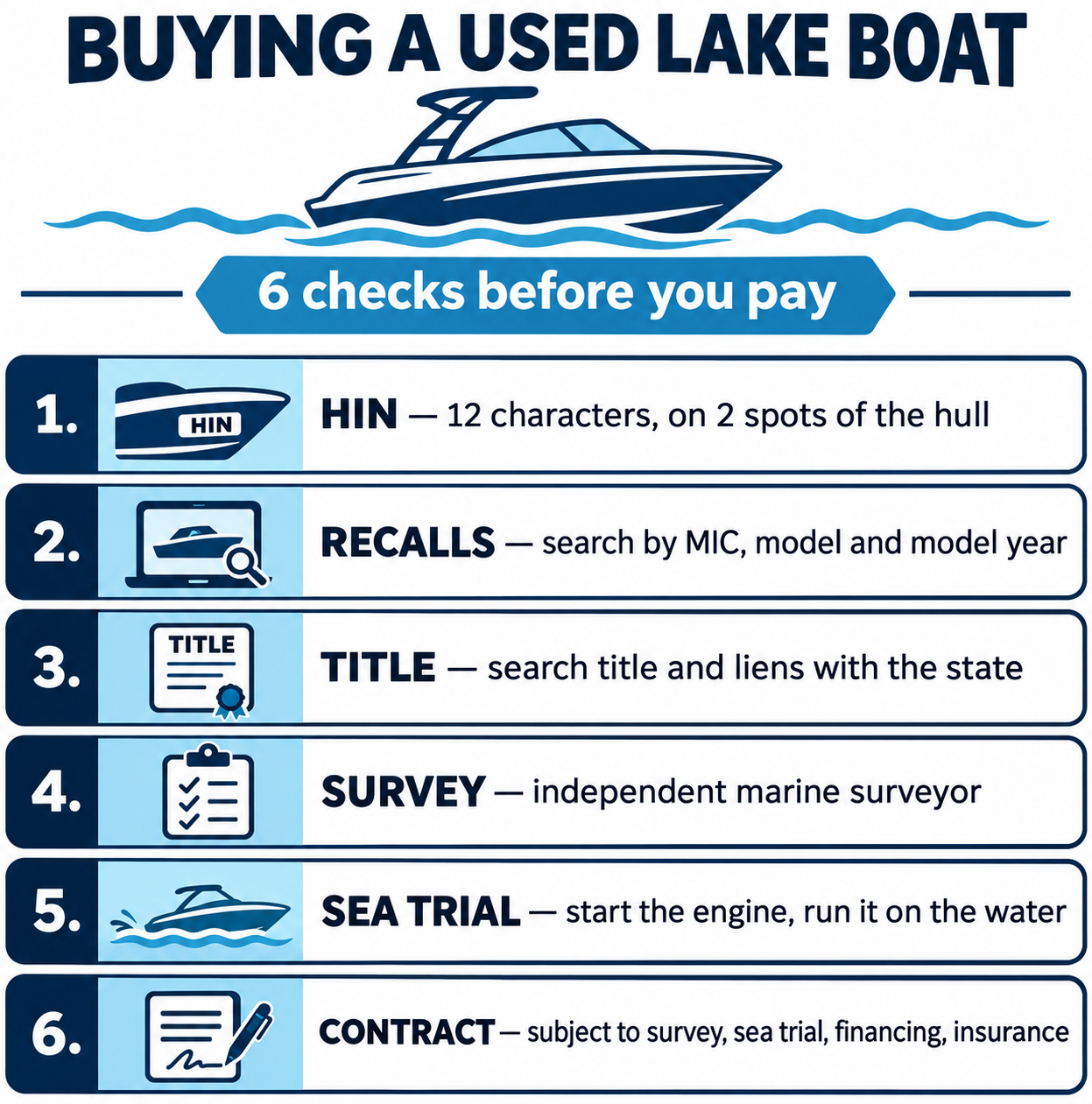
Quick answer: Buying a used lake boat can get you more boat for your budget and some room to negotiate, but you give up most of the protection a new-boat warranty provides, and the risk of hidden problems moves to you. The fix is a short, boring routine: check the hull identification number (HIN), search recalls, search the title and liens, hire an independent surveyor, take a sea trial, and put it all in a written contract.
An earlier version of this page made claims about depreciation, fuel efficiency, insurance costs, typical prices and how many days owners use their boats. We could not find a source for them, so they are gone. What remains comes from BoatUS, federal regulations and three state agencies.
The pros#
You can negotiate. BoatUS says not to assume the asking price, because there is usually room for negotiation. A survey makes that easier: according to the BoatUS buyer’s guide, deficiencies in a survey can be used to renegotiate the sales price or scrap the deal if the repairs are too expensive or complicated.
The checks are well defined. Federal rules fix what a HIN must look like, the Coast Guard publishes recalls, and state agencies publish their titling rules. A buyer who works through them knows a lot more than a buyer of a used car does from the listing alone.
A survey gives you a repair budget. BoatUS says nearly any boat will have some defects, and that a survey typically lists recommended repairs in priority order, with safety items first. You go in knowing what the next season will cost you, at least roughly.
Financing is possible. BoatUS says loan terms up to 20 years with down payments of 10 to 20 percent are common, and that terms vary with the boat’s age, size, type and use. With used boats, lenders check for a clear title or record of ownership.
What the sources do not support: that a used boat holds its value better than a new one, burns less fuel, or costs less to insure. We found no official data on any of those, so we make no claim either way.
The cons#
Little or no warranty. BoatUS says the warranty is, for most people, the biggest advantage of buying new. It advises finding out whether warranties transfer to later owners, and warns that when boats are sold “as is,” recourse may be impossible if problems arise.
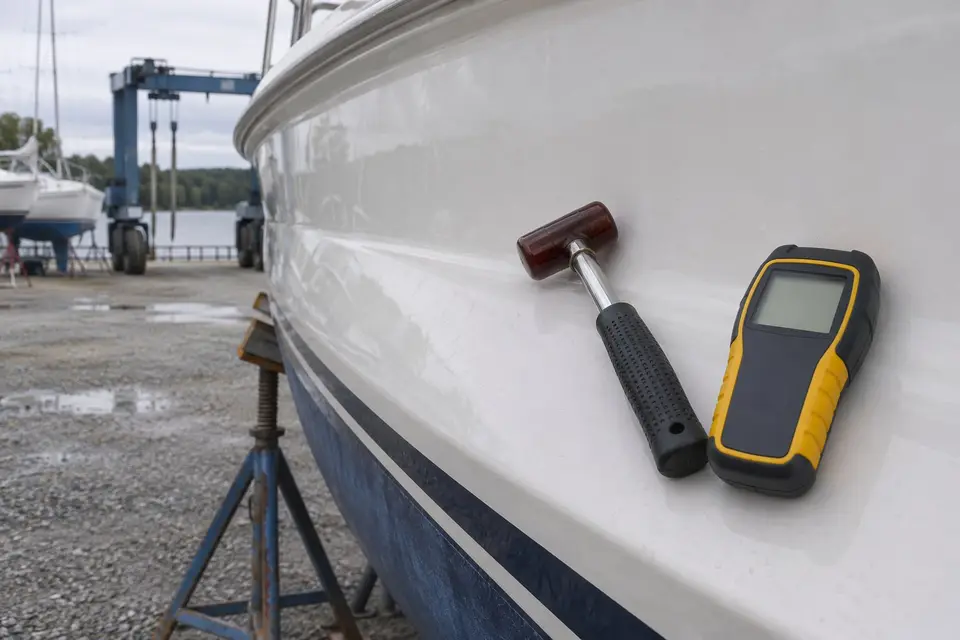
Hidden damage is your problem. BoatUS says a good surveyor can sound the hull for voids or delamination and spot parts of the core that may eventually rot before a buyer can detect them, and that a proper condition and valuation survey requires hauling the boat so the hull and underwater gear can be inspected.
Value is hard to judge. BoatUS says online value estimates assume a clean, properly equipped boat with everything working. It adds that no one can give you an accurate value sight unseen; that takes an experienced marine surveyor’s hands-on time.
Paperwork can bite. Title, registration and trailer rules change from state to state. A boat without a clean title can turn a cheap price into a slow, expensive process, as the Texas example below shows.
Scams exist. The BoatUS guide describes fake listings with good photos for boats that do not exist, fake escrow sites and overpayment tricks. Its advice: if a boat is out of state, send a local accredited surveyor or someone you trust to confirm the boat is real and the seller holds the title and registration. And if anyone offers to pay more than the agreed price, walk away.
Before you go: decide what you need#
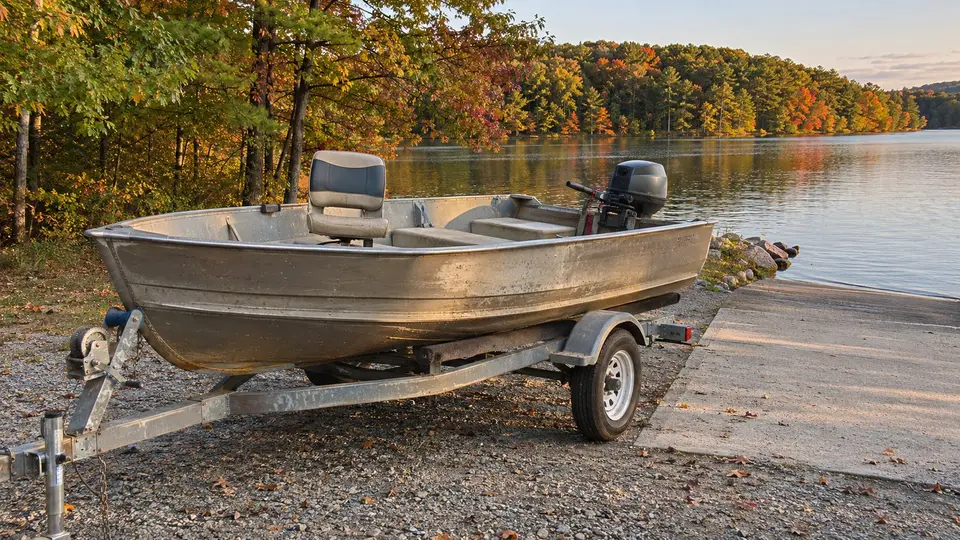
Pick the type and size first, then shop. Our guide on how to choose the right lake boat covers the trade-offs, and our budget lake boat list is a starting point if you are on a tight budget. If you are looking at pontoons, read the capacity plate guide so you know how many people and how much horsepower the boat is rated for.
Check 1: the hull identification number#
Federal rules say each HIN has twelve characters with no slashes, hyphens or spaces:
- Characters 1 to 3: the manufacturer identification code (MIC) or importer designation.
- Characters 4 to 8: a serial number from the manufacturer, which never uses the letters I, O or Q.
- Characters 9 and 10: the month and year of certification, when a certification date is required.
- Characters 11 and 12: the last two digits of the model year.
Two identical HINs are required on each hull, and each must be permanently fixed so that alteration, removal or replacement would be obvious. Find both, compare them with each other, and then, as BoatUS advises, crosscheck the HIN against the seller’s records to make sure it is the same boat. A HIN that looks altered, or two that do not match, is a reason to stop.
Check 2: recalls#
The Coast Guard recall search lets you look up a boat by MIC, company or recall number, model and model year. The list keeps growing, so run the search again for the exact model and year near the day you buy, and ask the seller whether any recall work was done.
Check 3: title, liens and registration#
BoatUS says to search the boat’s title and registration with the state where the boat is registered, and to have the sales contract state that the boat is free of all liens and encumbrances. Rules differ, so treat these three states as examples, not a national standard (checked November 2026):
- Texas: Texas Parks and Wildlife says not to buy a used boat or outboard without the original title, signed on the front and back, and a signed bill of sale from the person on the title. Without them, the buyer may face a more expensive and lengthy bonded title process. Transfers filed later than 45 working days from purchase face tax penalties and interest, and trailers are titled separately through the county tax office.
- Florida: the FLHSMV says all motorized vessels on public waterways must be titled and registered. A buyer has 30 days to do it and must keep proof of the purchase date aboard meanwhile. Operating an unregistered vessel after 30 days is a second-degree misdemeanor.
- California: the DMV requires registration for any boat with a motor, whatever its size. A valid certificate of title proves ownership, and ownership changes must be reported within 10 days. Boats used on fresh water also owe a mussel fee.
BoatUS adds that most states title and register trailers separately from boats, which usually means two different agencies. For a feel of how many offices one boat can involve, see our houseboat registration and permit checklist.
Check 4: your own walk-through#
The BoatUS evaluation checklist is a good first screen. Rate each area from 1 (poor) to 5 (excellent), and consider walking away if more than 10 areas score 2 or under. Look for rust, hull blisters, peeling paint or varnish, previous repairs, cracks and corrosion, and check steering, lights, electronics and the bilge pump.
Ask for the engine hours and service records too; our guide on how to check boat engine hours explains where to find the meter. If you buy, the lake boat maintenance guide covers what comes next.
Check 5: an independent survey and a sea trial#
BoatUS says a visual inspection is probably enough for a jon boat or canoe, but if you are spending a few thousand dollars or more, you need a marine surveyor. Its checklist says plainly that it is not a substitute for a competent marine surveyor and a marine engine mechanic. Three points from the guide:
- Marine surveyors are not regulated or licensed, so check affiliations and experience with your type of boat.
- Never hire a surveyor referred by the seller or broker.
- Do not rely on a survey done for a previous owner, even a recent one.
Then start the engine and take a sea trial, as the checklist says.
Check 6: the written contract#
BoatUS says a sales contract should describe the boat and engine with make, model, year, HIN and engine serial numbers, and make the sale contingent on a satisfactory survey and sea trial, acceptable financing and marine insurance. Read our guide to insuring a lake boat before you sign; BoatUS notes that a few states require liability cover on some boats, such as powerboats over 50 horsepower.
After you buy: the safety gear#
Federal rules require at least one wearable life jacket for each person, readily accessible. A boat 16 feet or longer also needs one throwable device and visual distress signals, and fire extinguishers, where required, must be aboard and readily accessible. See the federal equipment rules and our lake boating safety guide.
What the sources do not cover#
We found no official figures on used-boat prices, depreciation, fuel use or insurance premiums, and no national rule on titles: each state sets its own. The eCFR is updated continuously but is not an official legal edition, so confirm current requirements with your state agency before closing.
Sources#
Checked on November 27, 2026: eCFR HIN rules, eCFR equipment rules, Coast Guard recalls, BoatUS buyer’s guide (dated 3/19), BoatUS evaluation checklist, Texas Parks and Wildlife, Florida FLHSMV, California DMV registration, California DMV titles.
Frequently asked questions#
Do I need a marine survey for a small used boat?
It depends on the boat and the money involved. BoatUS says a visual inspection is probably enough for a jon boat or canoe, but if you are going to spend a few thousand dollars or more, you need to hire a marine surveyor. Its own checklist says it is not a substitute for a surveyor and a marine engine mechanic.
How do I check whether a used boat has been recalled?
Use the Coast Guard recall search at uscgboating.org. It lets you search by manufacturer identification code (the first three characters of the HIN), company or recall number, model and model year. The list changes over time, so run the search again close to the day you buy.
What paperwork should I get from the seller?
At minimum, the title (in states that title boats) and a signed bill of sale. Texas Parks and Wildlife says not to buy a used boat or outboard without the original title, signed on the front and back, and a signed bill of sale from the person on the title. Rules differ by state, so check the agency where the boat is registered and where you will register it. Our houseboat registration checklist shows how many agencies can be involved.
Does a used boat come with a warranty?
Sometimes, but do not assume it. BoatUS says the warranty is the biggest advantage of buying new for most people, and advises finding out whether warranties transfer to later owners. It also warns that when boats are sold as is, recourse may be impossible if problems arise.
How long do I have to register a used boat after buying it?
It varies by state. Florida gives a purchaser 30 days to title and register a new or used vessel. California says ownership changes must be reported to DMV within 10 days, and a boat bought from an out-of-state seller must be registered within 120 days of bringing it into the state. Texas applies tax penalties and interest to transfers filed later than 45 working days from purchase. Recheck the current rule before you buy.
Can I get a loan on a used boat?
Often, yes. BoatUS says loan terms up to 20 years with down payments of 10 to 20 percent are common, but rates and terms vary with the age, size, type and use of the boat. With used boats, lenders check for a clear title or record of ownership, and BoatUS says a lender will want proof of insurance covering the boat’s full value. See how to insure your lake boat.
Written by
We started this blog as a place to go to when we had questions about buying our first home on the lake. There was a lot of information on the internet, but we always spent hours...