Do Outboard Motors Charge the Battery? How It Works
Most electric-start outboards charge the battery while running, but the output depends on engine speed. Here is how it works and how to test yours.
On this page
Yes, most outboards with electric start charge the battery while the engine runs. But the charging system is built to keep a starting battery topped up and run a few instruments. It is not built to refill a drained battery bank, and how much it puts out depends heavily on engine speed. This guide explains how it works, what to expect at idle and while trolling, and how to check that yours is charging.
The short answer#
- Most electric-start outboards have a charging system. It is driven by the engine, so it only works while the engine is running.
- The smallest portables may have none. OutboardSpecs says Mercury’s FourStroke 2.5 and 3.5 do not specify a charging output because they are built to run without one, and the FourStroke 6 offers an optional 5-amp alternator.
- The rated number is a full-throttle number. At idle or trolling speed, output can be far lower.
Stator or alternator: how an outboard makes power#
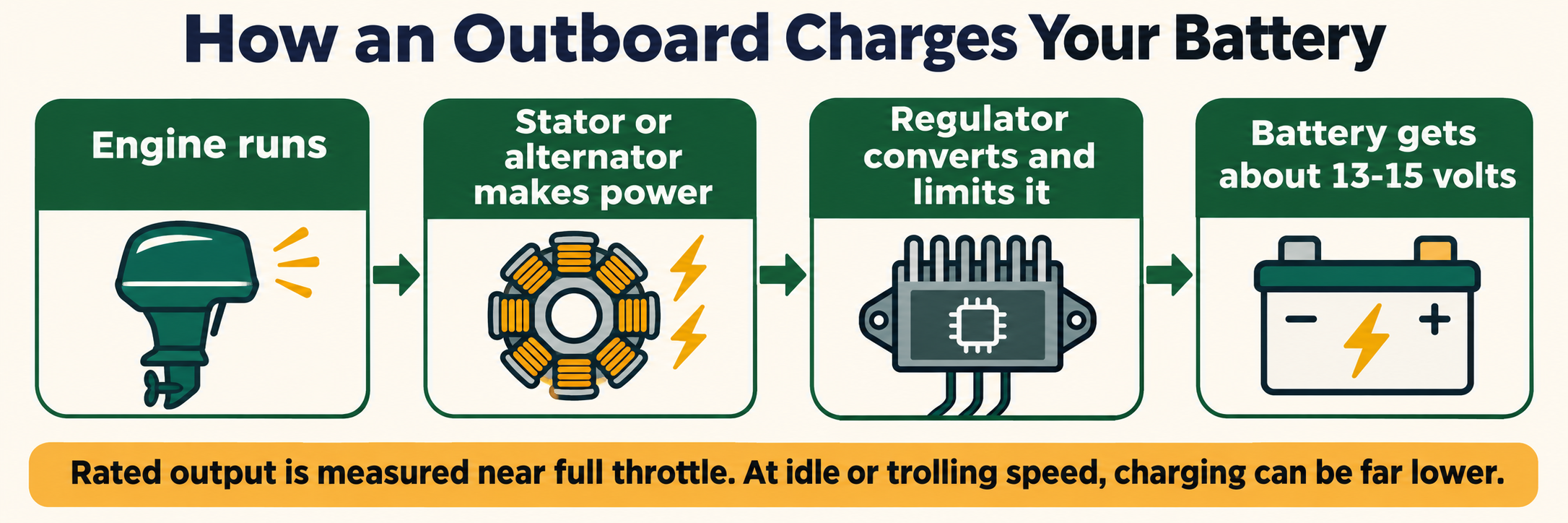
Born Again Boating explains the difference. A stator sits under the flywheel and makes electricity from magnets built into or glued onto the flywheel. It outputs alternating current, which has to pass through a rectifier regulator to become direct current. The regulator also limits the voltage sent to the battery, usually to around 13 to 15 volts, because otherwise the stator would burn up the battery and other parts.
An alternator has the rectifier regulator built in and produces direct current directly. It is usually driven by a belt on the engine and can generally put out much more current than a stator.
Another supplier puts it this way: a stator is a generator on earlier outboards and an alternator on later ones, and it also supplies the energy for the ignition system. Either way, the key point is the same. The output is tied to how fast the engine is turning.
How much do outboards put out?#
Charging ratings vary a lot, and horsepower does not predict them. A battery maker’s technical note lists a spread from 5 amps on an optional Mercury FourStroke 6 alternator to 150 amps on a Mercury Verado 350 or 400. Among four 90 hp engines, it lists Suzuki’s DF90A at 27 amps, Yamaha’s F90 at 35, Tohatsu’s MFS90A at 41 and Honda’s BF90 at 44, all with the same horsepower rating.
The 150 hp class shows the same spread, based on the makers’ own pages:
- Mercury 150 FourStroke: 60 amps.
- Honda BF150: 55 amps in total, with 40 amps for battery charging.
- Tohatsu BFT150D: 55 amps, and Tohatsu says 30 amps at 1,000 rpm and 40 amps at 2,000 rpm and above.
- Yamaha F150: 50 amps on the digital models.
- Suzuki DF150A: 44 amps.
We compare these engines in more detail in 150 HP outboards compared.
Why idle and trolling are the weak spot#
OutboardIgnition puts it plainly: an outboard stator only reaches its rated output at wide-open throttle. With lower-output stators, charging at idle or low rpm is very minimal. If you idle for long periods, troll a lot or run accessories that draw heavy current, the battery may discharge instead of charge, and you could be left stranded. The same supplier says that on motors with less than about 16 amps of stator output, it is a good idea to use a battery charger to bring the battery to full charge before heading out.
Makers know this is where boats spend time, and some now advertise low-speed output. A battery maker’s note says Mercury markets 20 amps at idle on its V8 FourStroke as a deliberate feature. Mercury says the 150 FourStroke has idle charge battery-management technology that automatically increases idle rpm to boost alternator output. Saltwater Sportsman reports that Yamaha’s XTO 450 produces 96 net amps even while slow trolling. Those are the exceptions, and the manual is the only place to find the output curve for your engine.
How to test whether your outboard is charging#
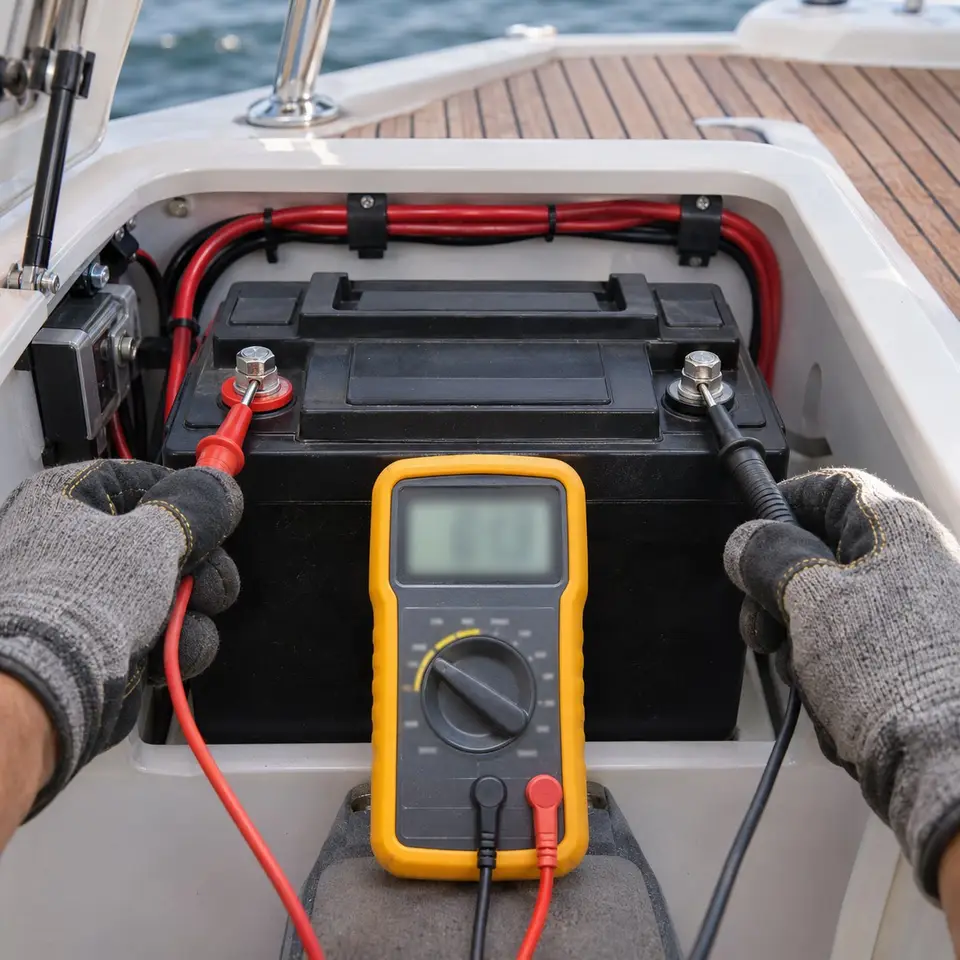
You only need a voltmeter. Born Again Boating describes the check like this, and our guide to testing a boat battery with a multimeter covers the meter itself.
- Set the meter to DC volts and read the battery with the engine off. Write the number down.
- Make sure the engine has cooling water, either in the water or on a flushing attachment or earmuffs, and start it.
- With the engine idling, read the battery again. It should be a little higher than with the engine off.
- Raise the engine to about 1,200 rpm. The voltage should rise as rpm rises and peak somewhere around 14 volts. Born Again Boating says a little under that is fine, and the main thing is that it climbs with rpm. It also warns against revving the engine too high if you are using a flushing attachment instead of earmuffs.
If the reading never rises above the resting voltage, something in the charging path is not working. Have a marine technician check the stator or alternator, the regulator and the wiring.
Can an outboard charge a trolling motor battery?#
Only as a top-up. A technical note from lithium battery maker LINEX, so treat it as one view, says outboard charging circuits on small and mid-size engines deliver 6 to 20 amps, rated near wide-open throttle. It works out that a 100 Ah lithium trolling battery needs about 50 Ah to recover from a half discharge. On a steady 10 amps, that is five hours of charging at full output. A 30-minute run back to the ramp at 10 amps returns only 5 Ah.
The same note quotes the marine alternator maker ARCO: alternators are not battery chargers, and most can safely charge at only two-thirds of their rated output for extended periods. For lithium batteries, it recommends a DC-DC charger at the battery rather than relying on the outboard’s regulator, which it says can leave a lithium bank at 70% to 80% charge.
It also calculates that cable length matters. Over a 10 m loop, 10 AWG cable at 20 amps loses about 0.66 volts, so the battery sees less than the engine regulator provides. Plan a fishing day around engine hours rather than the alternator rating, and add solar or a shore charger for the rest. Our guides on how long a boat battery takes to charge and the best solar chargers for boat batteries cover those options.
Wiring and battery cautions#
- Never disconnect the battery while the engine is running. The same LINEX note warns that an alternator with no load can spike its output and damage the rectifier. Keep the starting battery on its original charging path so a dead trolling bank cannot leave the engine without cranking power.
- Size the battery to the engine. Born Again Boating says a 150 hp engine needs roughly 675 marine cranking amps, while a Verado 350 recommends 800 to 1,000 and a Group 31 AGM battery.
- Clean the top of the battery. Moisture, condensation and dirt on a boat battery can drain it just sitting there. Born Again Boating suggests checking for voltage leakage across the top and cleaning it if there is any.
- Have the wiring checked. A battery switch should isolate everything when the boat is not in use. If you are adding batteries, ask a marine electrician to look at the layout.
For routine care between trips, see how to keep a boat battery charged.
Frequently asked questions#
Do outboard motors charge the battery while running?
Most electric-start outboards do. A stator or alternator driven by the engine feeds a regulator that sends regulated direct current to the battery, usually around 13 to 15 volts. The smallest portable engines may have no charging system at all.
Do small outboards charge a battery?
It depends on the model. OutboardSpecs says Mercury’s FourStroke 2.5 and 3.5 do not specify a charging output, and the FourStroke 6 offers an optional 5-amp alternator. One parts supplier says stators commonly range from 6 amps to 40 amps, and that on motors with less than about 16 amps you should charge the battery fully before heading out.
What voltage should I see when the outboard is charging?
Born Again Boating says the voltage should climb as rpm rises and peak somewhere around 14 volts, and that slightly under is fine. The main thing is that it rises above the resting battery voltage and keeps climbing with rpm.
Can an outboard charge a trolling motor battery?
It can top one up, but it is not a good way to refill a drained bank. A battery maker’s technical note says outboard charging circuits on small and mid-size engines deliver 6 to 20 amps, rated near full throttle, and that a 100 Ah lithium trolling battery needs about 50 Ah to recover from a half discharge. See charging a boat battery on the water.
Is it safe to disconnect the battery while the engine runs?
No. A battery maker’s technical note warns that an alternator with no load can spike its output and damage the rectifier, so do not switch the battery switch off or pull a cable while the engine is running.
Sources#
- Outboard Alternator Output: Why Amps Matter More Than You Think, OutboardSpecs
- Outboard Alternators and Chargers, Born Again Boating
- How Outboard Stators Work, OutboardIgnition
- Trolling Motor Battery Charging from the Outboard, LINEX
- New Outboard Alternators Provide Increased Power Capabilities, Saltwater Sportsman
- Mercury FourStroke 75-150hp, Mercury Marine
- Honda BF115, BF140 and BF150 technical specifications, Honda News
- Tohatsu BFT150D, Tohatsu
- Yamaha F150 and F175 hot sheet (2017), Yamaha Marine
- Suzuki DF150A, Suzuki Marine
Written by
We started this blog as a place to go to when we had questions about buying our first home on the lake. There was a lot of information on the internet, but we always spent hours...