What is the warmest lake in California?
No agency publishes an official ranking of California's warmest lakes. Here is what measured records show for Lake Havasu, Lake Tahoe and the Salton Sea, and how to read them.
On this page
- Why there is no clean answer
- Lake Havasu: a measured summer record
- The Salton Sea: hot, salty and studied from space
- Lake Tahoe: the cold benchmark, warming
- Clear Lake and Lake Elsinore: warm-water problems, no comparable numbers
- What warm water means for swimmers and boaters
- How to check a lake yourself
- Sources
- Frequently asked questions
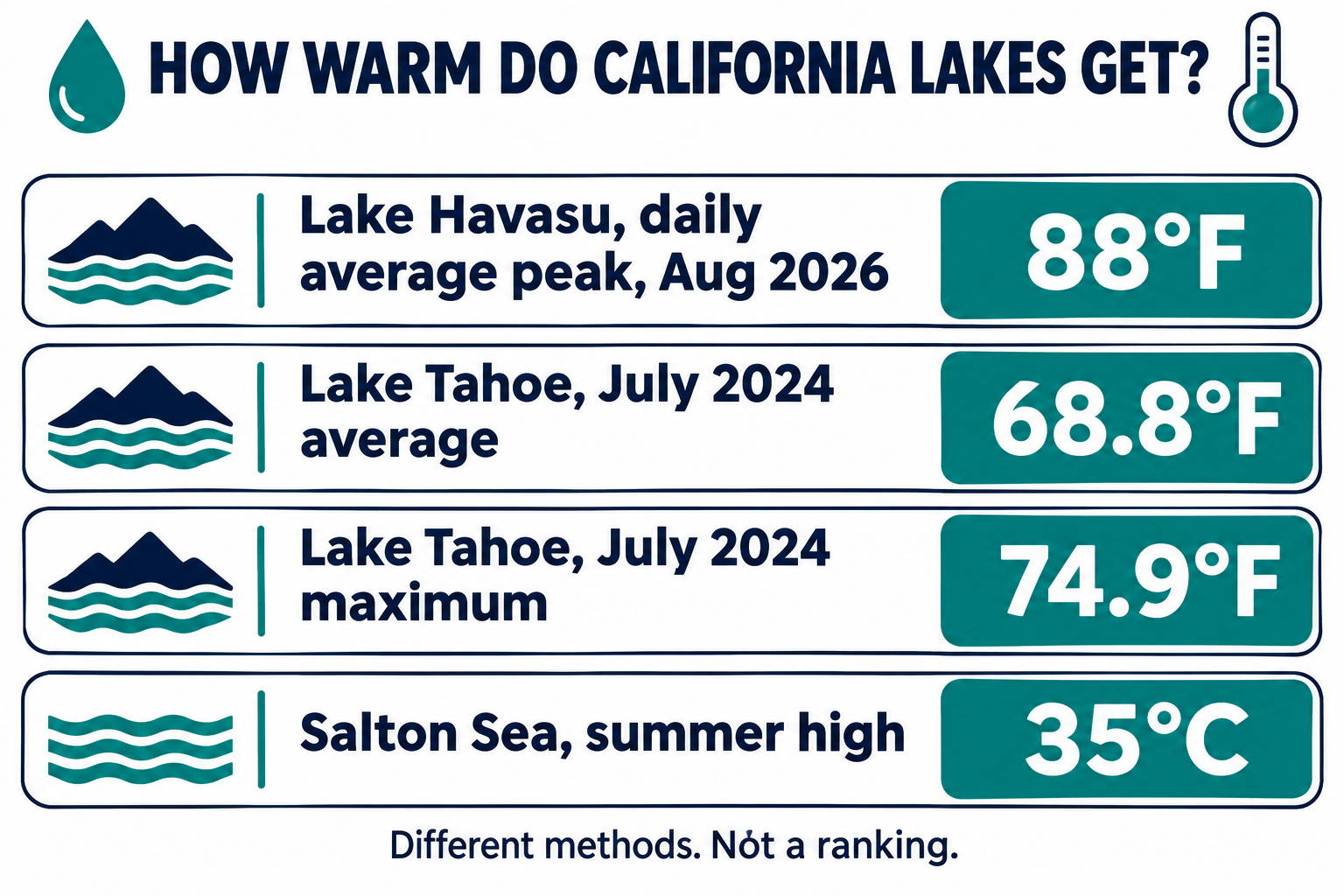
Quick answer: No official source names a single warmest lake in California. We found no agency that ranks the state’s lakes by one comparable temperature measure. What the records do show: a Bureau of Reclamation series for Lake Havasu, on the Colorado River, reached about 88°F as a daily average in late August 2026, and USGS says the Salton Sea’s summer temperatures reach up to 35 °C. Lake Tahoe, for contrast, averaged 68.8 °F at the surface in July 2024. These numbers come from different methods, so read them as examples, not a ranking.
Why there is no clean answer#
“Warmest” depends on what you measure. Three things change the number:
- Depth. A sensor a few feet down reads differently from the thin top layer of water. The USGS satellite dataset says its temperature data represents skin temperature at the water surface and may differ from readings taken below the surface.
- Time. A single hot afternoon, a daily average and a monthly average give three different answers for the same lake.
- Method. Satellite estimates carry their own errors. The same USGS release warns that biases in the Landsat product can produce unrealistically high or low water temperatures, for example under partial cloud cover.
To call one lake the warmest, you would need the same metric, measured the same way, over the same period, for every candidate. We did not find that comparison for California in any source we checked.
An earlier version of this page named five lakes as the warmest and gave winter and summer water temperatures for them that no measured record we found supports. We removed those claims and the monthly tables that went with them.
Lake Havasu: a measured summer record#
The Bureau of Reclamation publishes a daily water-temperature series for Lake Havasu at Parker Dam in its RISE catalog. It is an observed daily average in degrees Fahrenheit, updated once a day from the Lower Colorado Hydrologic Database. The agency says the data are provisional and subject to revision.
We downloaded the June to September data for four summers. The highest daily average in each:
- 2023: about 88°F, on July 25.
- 2024: about 88°F, on August 10.
- 2025: about 86°F, on August 23.
- 2026: about 88°F, on August 26.
The lowest summer readings, in early June, sat around 75°F to 77°F. The 2023 file has 14 blank days, so treat those figures as the range of recorded days, not a complete season. The record does not state the sensor depth, so this is not a surface-temperature figure either.
Is Havasu a California lake? Partly. The federal record files the Parker Dam station under Arizona, while California’s CDEC station page lists a Lake Havasu station in San Bernardino County at 451 feet, operated by the Bureau of Reclamation. If you want a lake entirely inside the state, Havasu’s numbers do not answer the question.
For beaches, access and safety at the lake, see our guide to swimming at Lake Havasu.
The Salton Sea: hot, salty and studied from space#
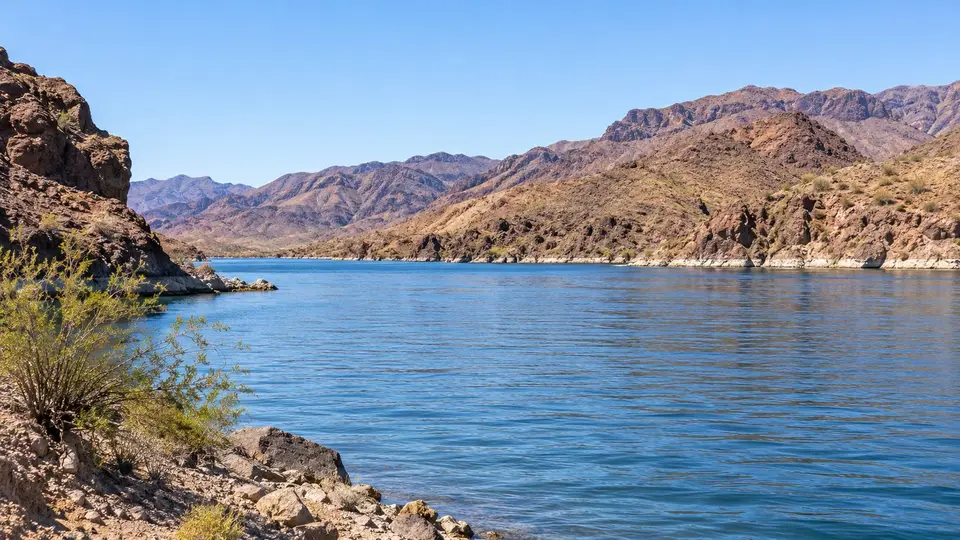
USGS describes the Salton Sea as an inland saline lake in the Sonoran Desert of southeastern California, and the largest inland water body by surface area in the state. Its high summertime temperatures, reaching up to 35 °C (about 95 °F), make it useful for calibrating satellite heat sensors. USGS gives its overall temperature range as 12 °C to 37 °C.
NASA’s Jet Propulsion Laboratory runs thermal validation sites at both the Salton Sea and Lake Tahoe. That makes these two of the better-measured lakes in the state, at opposite ends of the temperature scale. It does not make the Salton Sea a swimming lake. We found no source in our set covering current swimming conditions there, so check with local agencies before you go.
Lake Tahoe: the cold benchmark, warming#
Tahoe is the useful contrast. In its State of the Lake report, UC Davis says July 2024 was the warmest month of the year at the lake, with a maximum of 74.9 °F and an average of 68.8 °F. That average was the warmest July in its 26-year record, taken with sensors suspended 5 feet below four buoys it maintains with NASA.
The longer trend matters too. UC Davis puts the lake’s warming at 0.21 °F per decade, with the fastest rate at the surface, 0.39 °F per decade, and in summer. It also explains why that matters: warm water floats on top of cold water, and the bigger the difference, the more the lake resists mixing.
Fishing at Tahoe follows that cold water. See our Lake Tahoe fishing guide.
Clear Lake and Lake Elsinore: warm-water problems, no comparable numbers#
Two other lakes come up often in this discussion. Neither has published numbers in our source set that we could compare with Havasu or Tahoe.
- Clear Lake. UC Davis calls it California’s largest natural freshwater lake. Its researchers logged water temperature every hour for five years, and found that a warm surface layer in summer keeps oxygen from reaching the bottom, which feeds harmful algal blooms. The news release does not give the temperatures themselves. Anglers can read our Clear Lake fishing guide.
- Lake Elsinore. The city calls it Southern California’s largest natural freshwater lake and a shallow lake that struggles with rising temperatures, algae blooms and falling oxygen in the hotter months. Its lake management plan mentions five monitoring buoys that collect temperature data, but the page does not publish a temperature series. If you are planning a stay, our Lake Elsinore camping guide has the basics.
What warm water means for swimmers and boaters#
A warm lake is pleasant, but warmth brings its own risks.
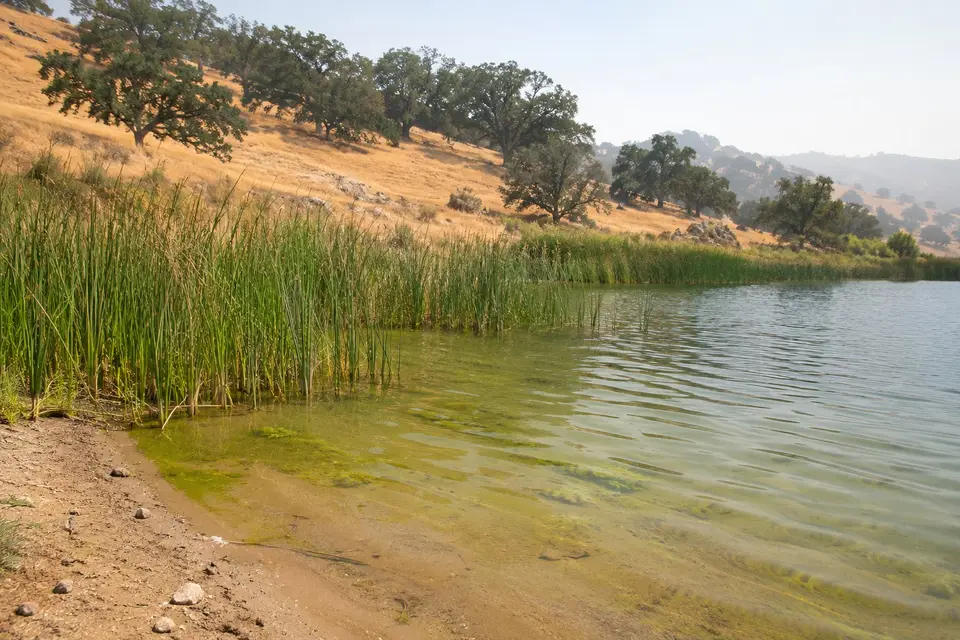
- Algae. The California Department of Water Resources says blue-green algae grow fastest in warm water, calm conditions and certain nutrients. There is no sure way to tell a toxic bloom by looking at it, and dogs and small children are most likely to be affected. Follow posted advisories and stay away from scum. Our page on blue-green algae in lakes explains the warning signs.
- Naegleria fowleri. The CDC says this ameba lives in warm fresh water like lakes, ponds and hot springs. Infection is rare, with typically fewer than 10 deaths a year in the United States compared with thousands of drowning deaths. The CDC suggests holding your nose or using a nose clip when you jump in, not stirring up sediment in shallow water, and avoiding water activities in warm months when temperatures rise and water levels go down.
- Cold water still exists. The National Weather Service warns that warm air doesn’t always mean warm water, and that weather can drop water temperatures sharply even in midsummer. Cold shock can cause gasping and rapid breathing for the first 2-3 minutes. That matters at a mountain lake like Tahoe more than at Havasu.
Wear a life jacket either way. Our lake boating safety guide covers the rest. California summers can also bring smoke and fire closures, so read our notes on camping through wildfire smoke and closures before a late-summer trip.
How to check a lake yourself#
- Find the operator. For reservoirs, that is often the Bureau of Reclamation, a state agency or a water district. Check whether it publishes a temperature series, and at what depth.
- Use the same metric. Compare daily averages with daily averages and surface readings with surface readings.
- Try satellite data for breadth. USGS has a dataset of surface temperatures for nearly 140,000 lakes from 2013 to the present, including lakes as small as 4 hectares. It is the best tool we found for broad comparisons, with the cloud and bias caveats above.
- Look up advisories the day you go. Water quality changes faster than temperature data.
Our step-by-step guide to finding lake water temperature data goes further. If fishing is the goal rather than swimming, our list of the best fishing lakes in California is a better starting point.
Sources#
Checked November 2026: Bureau of Reclamation RISE, Lake Havasu water temperature (CSV extracts downloaded November 7, 2026), CDEC Lake Havasu station, USGS Landsat lake temperature data release, USGS EROS lake temperature summary, USGS Salton Sea test site, UC Davis State of the Lake, UC Davis Clear Lake report, City of Lake Elsinore Lake Watch, Lake Elsinore management plan, California DWR algal blooms, CDC Naegleria fowleri, National Weather Service cold water safety.
Frequently asked questions#
What is the warmest lake in California?
There is no official answer. We found no agency that ranks California lakes by one comparable temperature measure. Lake Havasu, on the Colorado River, has a Bureau of Reclamation record whose daily averages reached about 88°F in late August 2026, and USGS says the Salton Sea’s summertime temperatures reach up to 35 °C. Those records use different methods, so they do not settle a winner.
How warm does Lake Havasu get in summer?
The Bureau of Reclamation’s daily water-temperature series for its Parker Dam station peaked at about 88°F in the summers of 2023, 2024 and 2026, and at about 86°F in 2025, based on the June to September extracts we downloaded. The agency says the data are provisional. See our guide to swimming at Lake Havasu.
How warm is Lake Tahoe in summer?
UC Davis reports that in July 2024 the lake’s surface water averaged 68.8 °F and peaked at 74.9 °F, measured by sensors 5 feet below four buoys. That July average was the warmest in its 26-year buoy record.
Is a warm lake safer to swim in?
Not automatically. Warm, calm water helps blue-green algae bloom, according to California DWR, and the CDC says Naegleria fowleri lives in warm fresh water. Check posted advisories, avoid scum, and hold your nose or use a nose clip if you jump in. Our guide on whether a lake is safe to swim in covers more checks.
Where can I check a California lake’s water temperature?
Start with the agency that runs the lake. The Bureau of Reclamation’s RISE catalog has a daily series for Lake Havasu, UC Davis publishes Lake Tahoe data in its State of the Lake report, and USGS offers satellite surface temperatures for nearly 140,000 lakes. Our guide to finding lake water temperature data walks through the options.
Written by
We started this blog as a place to go to when we had questions about buying our first home on the lake. There was a lot of information on the internet, but we always spent hours...