
Quick answer: Keep dogs on a short, non-retractable leash and well away from the water edge in alligator habitat. Do not allow a dog to swim, drink from the lake or investigate reeds, culverts or basking animals. Choose daylight routes with clear visibility, keep pet food secured, confirm the park pet rules, and save the nearest emergency veterinarian plus the wildlife reporting contact before the visit.
At-a-glance safety plan
| Situation | Immediate action | Do not do | Verify |
|---|---|---|---|
| Arrival and site choice | Pick an inland route with open visibility | Choose a waterside site only for convenience | Park pet rules and wildlife notices |
| Walk near water | Use a short leash and move well inland | Use a retractable lead at the edge | Trail, leash and closure rules |
| Drinking and cooling | Carry water and a bowl away from shore | Let the dog enter or drink from habitat | Heat plan and potable-water source |
| Wildlife sighting | Turn around, create distance and leave | Hold the dog closer for a photo | Wildlife line and emergency veterinarian |
Select the route before the dog leaves the vehicle
Use the park map and satellite or street imagery only to identify questions, then verify them with the managing agency. Favor developed inland paths, open sight lines and room to turn around. Avoid routes that pinch between dense vegetation and water, especially around dawn, dusk or darkness.
Confirm whether dogs are allowed at the beach, campground, fishing pier or trail. A pet-friendly park can still prohibit pets in swimming areas or sensitive habitat. Keep the dog inside the vehicle only when temperature and supervision make that lawful and safe; otherwise choose a different destination.
Use a short, controlled leash away from the edge
FWC and National Park Service guidance warns that pets resemble common prey and should be kept away from water. Gulf Islands specifies a leash no longer than six feet, while FWC visitor guidance favors a short non-retractable leash. Follow the stricter property rule and maintain enough inland distance that one lunge cannot reach the shoreline.
Do not tether a dog at a waterside campsite, fence or tree and assume the leash is protection. Stay with the pet. A low fence, vegetation or darkness can hide wildlife, and the dog may bark, pull or investigate before the handler sees the animal.
Bring drinking water and remove food odors
A dog should not swim in or drink from fresh or brackish water that may hold alligators. Carry enough potable water and use a bowl away from shore. Plan shade and heat breaks without turning the water edge into the cooling station.
Feed only while supervising, then remove bowls, food and leftovers. Secure human food, bait and fish remains as well. Food can attract wildlife directly or bring smaller animals into the same area.
Prepare for a wildlife or veterinary emergency
Save the park office, state wildlife number and the nearest open emergency veterinarian. Coverage and hours can change, so confirm them on the trip date. If wildlife appears, turn around and move inland; do not wait to see whether the dog reacts.
If a dog is injured, move people and the animal to safety, call emergency services when a person is threatened, and contact a veterinarian. Do not enter the water, pull against an alligator or attempt capture. Follow official instructions for the actual situation.
Treat every sighting as wildlife, not an attraction
An American alligator resting, swimming or crossing near suitable habitat is not automatically a nuisance animal. State wildlife agencies decide whether behavior and location create a reportable conflict. Observe from a substantial distance, keep a clear retreat path and never approach for a closer photograph. If the animal hisses, turns toward you, opens its mouth or changes direction because of your presence, you are too close and should back away.
Do not touch, corner, capture or move an alligator of any size. Young animals can bite, and a protective adult may be nearby. Stay out of the route between an alligator and the water. When an animal occupies a road, launch, playground or other immediate public hazard, move people and pets away and call the responsible agency or emergency services rather than attempting a rescue.
Never feed an alligator, directly or indirectly
Feeding alligators is illegal in the states covered by the official guidance cited here and can teach an animal to associate people with food. Handing over bait is not the only problem. Throwing fish scraps, carcasses or unwanted bait into the water near an alligator can create the same association. Feeding birds, turtles or fish at the shoreline can also draw wildlife and food into one repeated human-use area.
Use a closed trash container for fish remains and food. Clean grills, pet bowls and bait areas, and do not leave a catch where an alligator can take it. A conditioned animal may approach later visitors who never fed it, and wildlife managers may then have to remove it. The safest action protects both people and the animal by keeping human food completely separate from wildlife.
Use daylight, designated areas and visible shoreline
Florida guidance says alligators are most active between dusk and dawn and recommends swimming only in designated areas during daylight. A designated swimming area is not a guarantee that wildlife cannot enter, so obey closures and posted warnings and keep watching the water. Do not swim where the managing agency prohibits it or where visibility, vegetation, weather or an observed alligator makes the choice uncertain.
At any lake, separate alligator risk from other water hazards. Depth changes, cold water, algae, current, boat traffic, lightning and a lack of lifeguards require their own checks. Never convert a general state safety tip into a claim that one named lake is safe today. The park, wildlife agency and local emergency information for the exact access point control the decision.
Keep children and pets away from the water’s edge
Official guidance consistently treats pets as especially vulnerable because their size and movement can resemble prey. Keep a dog on a short, controlled leash and well back from fresh or brackish water in alligator habitat. Do not allow a pet to swim, drink or investigate reeds, culverts, canals, ponds or an animal on the bank. Children need close adult supervision and should not play unattended at the edge.
Choose a route with open visibility and room to turn around. Avoid night walks beside water, narrow shoreline paths and places where vegetation hides the edge. Food, bowls and fish remains should stay secured. If a pet is injured by wildlife, move to safety and contact a veterinarian; do not put another person in danger by entering the water or attempting to handle the alligator.
Know what behavior warrants a report
The presence of an alligator in normal habitat generally is not enough to label it a nuisance. More concerning signs include repeated close approaches to people or boats, loss of normal wariness, occupation of a place where the animal cannot return to water safely, or an immediate threat to a person or pet. Definitions and response programs differ by state, so the local wildlife agency makes the determination.
Record the precise location from a safe place, the time, the direction the animal moved and the behavior that caused concern. Do not estimate length unless you can do so without moving closer, and do not crowd the site to gather video. Use 911 for an active attack or immediate life threat. Otherwise use the published state or park reporting channel and follow the dispatcher’s instructions.
Plan the encounter before reaching the lake
Save the managing agency’s phone number, park office, after-hours wildlife line and emergency access details before the trip. Download the park map and identify developed swimming areas, launches, fishing platforms and routes that do not force a party along an overgrown edge. Cellular coverage can fail, so keep the address or coordinates of the access point available offline.
Brief the group in plain language: do not feed, do not approach, keep pets away from water, back away when an animal changes behavior, and report hazards to officials. Assign an adult to children and pets rather than assuming everyone is watching. A short plan prevents a calm sighting from becoming a crowd, a close photograph or an improvised capture attempt.
Keep emergency advice simple and official
If an alligator is nearby, create distance and leave it an open route to the water. Do not surround it, throw objects, rev toward it or try to make it move for a photograph. In the rare event of an attack, call 911 and seek immediate medical care. This guide does not replace emergency dispatch, wildlife officers or medical professionals.
Do not repeat myths as instructions. The practical prevention steps are distance, visibility, control of food and pets, and a prompt retreat. Agency guidance can change by location and circumstance, so open the current source on the trip date. When two official instructions seem different, follow the authority managing the exact property and describe the situation accurately.
Do not turn a safety minimum into a target
Official viewing distances differ by property and state because setting, visibility and management rules differ. A published minimum is not an invitation to approach until a tape measure would reach that number. Stay farther away when the shoreline is narrow, the animal is moving, young may be present, a dog is excited or the group cannot retreat without passing closer.
Distance must be judged from the closest person or pet, not only from the photographer. A long lens and open space make observation possible without changing the animal’s behavior. When there is any doubt, leave the area and ask staff for a safer wildlife-viewing location.
Document only after everyone is safe
A useful report identifies the access point, time and observable behavior without speculation. Note whether the animal repeatedly approached, occupied a developed public area or could return to water without crossing people. Do not move closer for scale, place an object beside it or ask another person to stand near the animal.
Share photographs directly with the responsible agency when requested. Avoid a real-time public location that could draw a crowd, encourage feeding or interfere with responders. Safety evidence should help officials assess the event, not transform a normal wildlife sighting into an attraction.
Pre-trip checklist
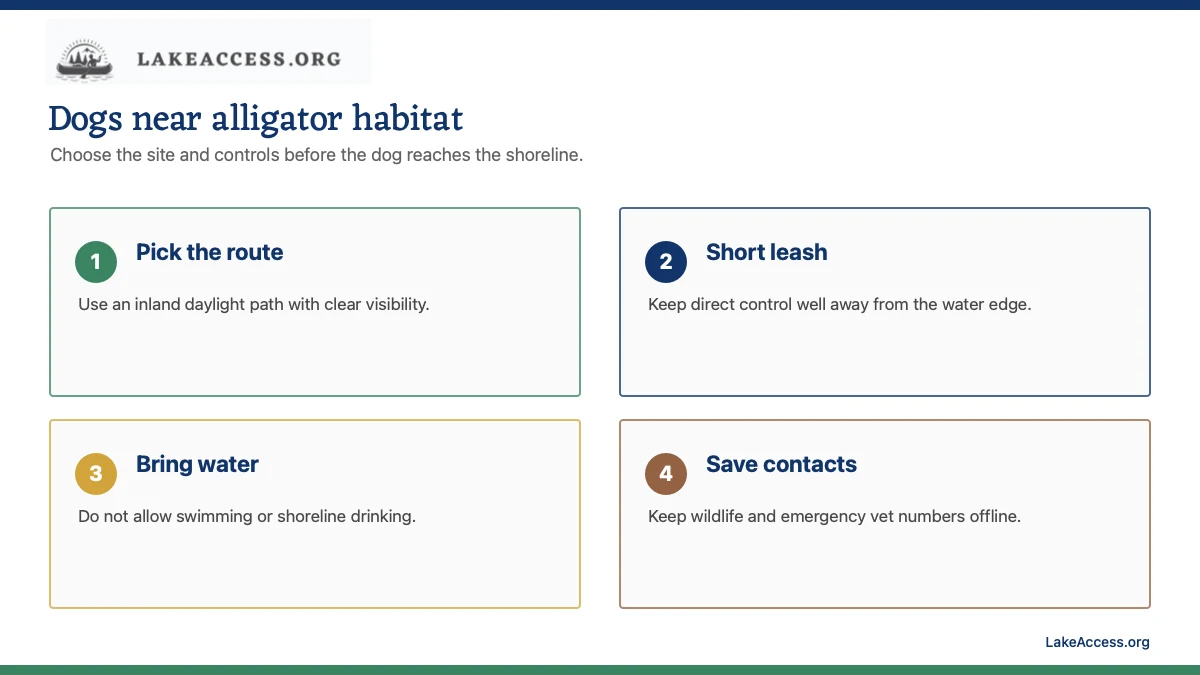
- Confirm the park permits dogs in the exact area.
- Choose an inland daylight route with clear visibility.
- Use a short non-retractable leash and direct supervision.
- Carry water; prohibit swimming and shoreline drinking.
- Save wildlife, park and emergency-veterinary contacts.
Related LakeAccess guides
- Dog-friendly beaches at Lake Tahoe
- Alligator safety at lakes
- How to check whether alligators live in a lake
- How to check whether a lake is safe to swim in
Sources
Wildlife rules, reporting contacts and access conditions can change. These official or high-trust sources were checked on July 24, 2026; open them again for the trip date.
- Florida FWC: pets and wildlife (checked July 24, 2026)
- Florida FWC: wildlife tips for visitors (checked July 24, 2026)
- National Park Service: Gulf Islands alligator safety (checked July 24, 2026)
- South Carolina DNR: alligator-safe guidance (checked July 24, 2026)
- Louisiana LDWF: alligator safety tips (checked July 24, 2026)
- UF/IFAS: managing conflicts with alligators (checked July 24, 2026)