Arizona Lake Fees, Passes and Boating Rules by Lake
Entry fees, passes, ramp closures and boating rules for 16 Arizona lakes, from Lake Mead and Powell to Tonto reservoirs and high-country trout lakes, checked in November 2026.
On this page
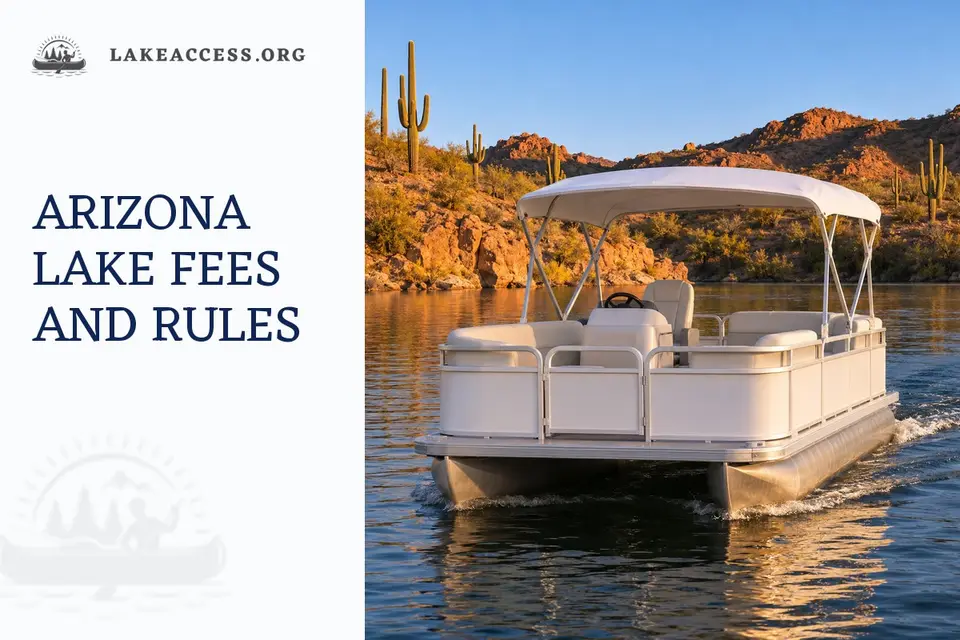
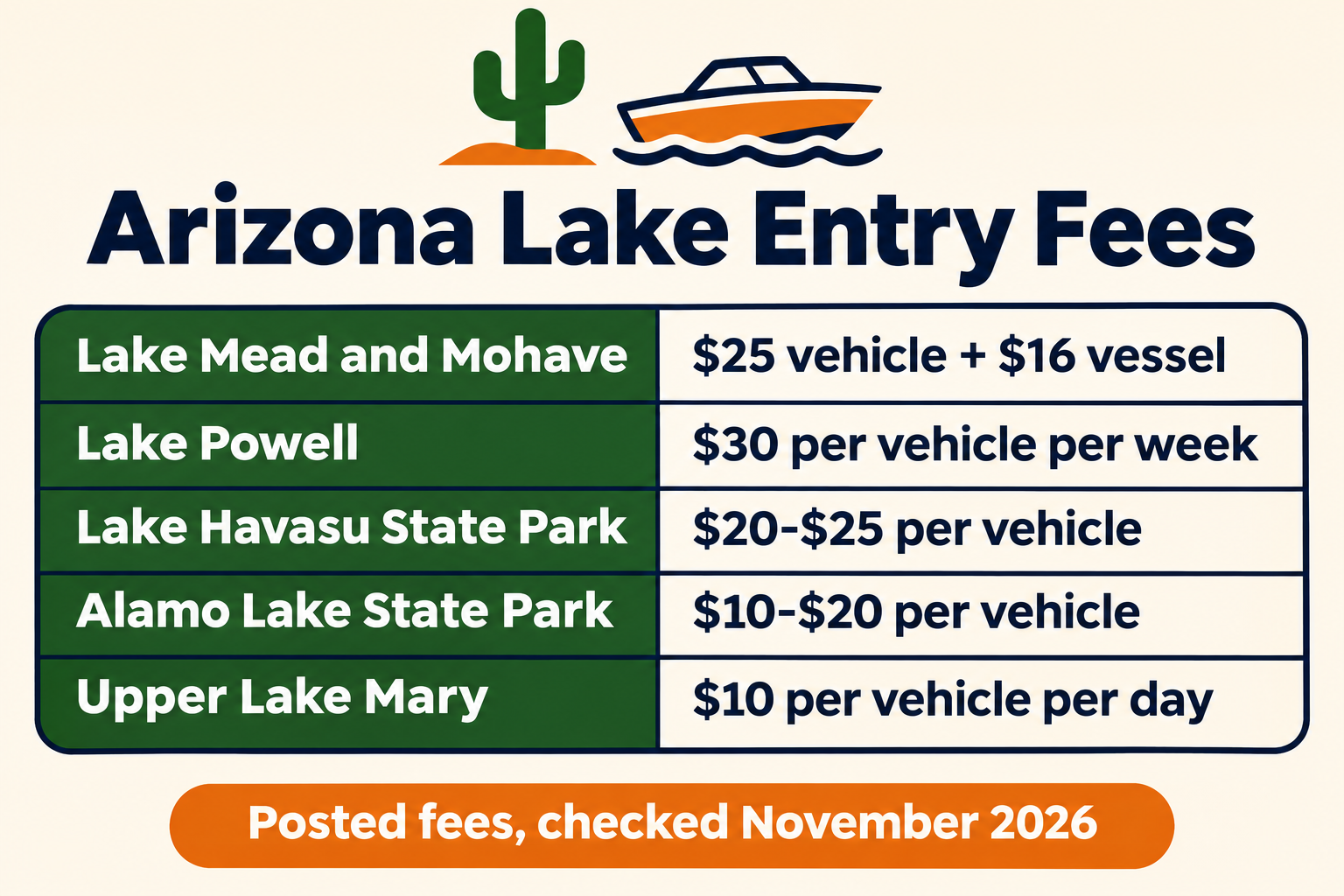
Quick answer: Arizona’s big lakes charge by agency, not by lake. Lake Mead and Mohave use a $25 vehicle pass plus a $16 daily vessel pass, Lake Powell charges $30 per vehicle per week, Lake Havasu State Park charges $20 to $25 per vehicle, and Tonto reservoirs use a day pass plus a watercraft sticker. We checked every number below against the agency page on November 7, 2026. Closures and low water change often, so verify before you tow.
Statewide rules that apply almost everywhere#
- Fishing license: Arizona Game and Fish requires a license for anglers age 10 or older on public water, with general-license prices of $37 for residents and $55 for nonresidents, valid 365 days.
- Life jackets: AZGFD says every vessel, with narrow exceptions, needs a properly sized Coast Guard-approved wearable life jacket for every person aboard. Children 12 and younger must wear one while underway, as must PWC occupants and people being towed.
- Young operators: NPS says Arizona restricts operation by children under 12 of vessels over 8 horsepower, including PWCs, unless an exception applies.
- Boating courses: AZGFD lists safety courses that cover operation, trailering, navigation, buoys, legal requirements and emergencies.
- Monsoon: Arizona State Parks defines it as June 15 through September 30, with dust storms, lightning, flash floods and dry-lightning fires. AZGFD advises boaters to leave the water when storms build.
- Heat: Arizona State Parks says to limit strenuous activity above 90°F and to seek an air-conditioned place above 105°F.
- Cold water: AZGFD warns that unexpected cold-water immersion can cause hypothermia, even in a desert state, and recommends a life jacket and appropriate clothing.
For general safety habits, see our lake boating safety guide and the broader best lakes in Arizona list.
Colorado River lakes: Mead, Mohave, Havasu and Powell#
Lake Mead. NPS gives a full-capacity surface of 157,418 acres, an average depth of 182 feet and a maximum depth of 532 feet. Fees are a $25 private-vehicle pass, a $16 daily vessel pass and a $50 annual vessel sticker, with the 50% discount for Senior and Access Pass holders only. NPS says boat operators are responsible for checking lake levels and ramp conditions. Its ramp table dated October 5, 2026 lists minimum safe elevations such as 1,065 feet at Callville Bay, 1,030 feet at Hemenway Harbor via pipe mat and 950 feet at Temple Bar. More: how deep is Lake Mead, Lake Mead drying up, how many boats are on Lake Mead and why Lake Mead is so dangerous.
Lake Mohave. NPS lists 28,084 acres, 309 miles of shoreline, an average depth of 85 feet and a maximum depth of 165 feet. The same vehicle and vessel pass applies, and both Arizona and Nevada vessel laws apply. Non-motorized vessels do not need the vessel pass.
Lake Havasu. Lake Havasu State Park charges $20 per vehicle Monday to Thursday, $25 Friday to Sunday and holidays, and $5 for an individual or bicycle. The park says Arizona and California share Colorado River jurisdiction, so follow the rules of the state you are in. The personal watercraft and jet ramp is at the north end in Lot 1 and does not allow watercraft with propellers. AZGFD calls it a year-round fishing lake where bass over 5 pounds and carp over 20 pounds are not uncommon. See Lake Havasu swimming and Lake Havasu boat rentals.
Lake Powell. NPS gives a full-pool elevation of 3,700 feet, a length of 186 miles, 1,960 miles of shoreline and a maximum depth of 561 feet at Glen Canyon Dam. Entry is $30 per passenger vehicle per week, plus tiered motorized-vessel fees. A PWC or eFoil of 16 feet or less is $20 weekly or $40 annually. On the NPS lake-level page dated November 5, 2026, the Wahweap Stateline Auxiliary ramp was the one shown as available to small motorized vessels in the table we read, so read the current table for every ramp. NPS also says quagga mussels are confirmed above and below the dam, so clean, drain and dry after contact with the water.
Tonto National Forest lakes near Phoenix#
The Forest Service’s passes page prints $8 for a Tonto Daily Pass, and says a motorized watercraft also needs a sticker. Saguaro’s own page prints higher numbers, $12 for a fee-machine pass and $16 with a watercraft, so confirm the amount at the launch you plan to use. A Tonto Discovery Pass also works for boating.
- Saguaro Lake: AZGFD says it can be a bass angler’s paradise and features 2,200 fish habitat structures. The Forest Service page requires counterclockwise travel.
- Canyon Lake: 950 acres, known for largemouth bass. It was closed when we checked. The Forest Service said the lake would be lowered for approximately 16 weeks starting September 16, 2026, which by our arithmetic runs into early January 2027 if the schedule holds.
- Apache Lake: motorized and non-motorized boating, trout and warm-water fishing. The upper end is closed to water skiing, many coves are no-wake, and travel is counterclockwise.
- Roosevelt Lake: 20,300 acres, with largemouth bass and crappie. The Tonto water-activities page says parasailing is allowed only at Roosevelt, with restrictions.
- Bartlett Lake: 2,815 acres, with consistent largemouth bass fishing. Free-flowing portions of the Verde River are closed to motorized use.
- Lake Pleasant: Maricopa County says the surface varies from more than 3,000 to almost 10,000 acres, highest in spring and lowest in fall. AZGFD lists largemouth bass, flathead catfish and popular striped bass fishing. We could not confirm current entry and launch fees from the county page, so check before you go.
State park lakes#
- Alamo Lake: 3,683 acres with largemouth bass, channel catfish and black crappie. Entry is $10 for one person per vehicle, $20 for two to four, and $5 for an individual or bicycle. Non-motorized boats may launch at either ramp.
- Patagonia Lake: day use is $20 on weekdays and $25 on weekends, and your day-use or camping permit covers launching. Motorized and non-motorized boats are allowed, but PWCs, jet skis, waterbikes, above-water-exhaust boats and V-8 jet boats are prohibited. The east end is no-wake and the west end allows unlimited speed, counterclockwise.
- Lyman Lake: a 1,500-acre reservoir at 6,000 feet, with walleye, channel catfish and largemouth bass. Entry is $10, $20 or $5 on the same tiers as Alamo. Due to low water, the boat ramps were closed until levels rise to a safe standard, while non-motorized vessels can launch from beach access points. The park also reports harmful algal blooms in White Mountains lakes, including Lyman.
High-country lakes#
- Woods Canyon Lake: Recreation.gov gives 55 surface acres, a 40-foot maximum depth and a 7,510-foot elevation. It is stocked regularly with catchable rainbow trout, and a few large brown trout remain. Only small boats with electric trolling motors or paddle craft are allowed. No gas motors. The picnic area and campgrounds are fee facilities, but the page prints no amount.
- Big Lake: the Forest Service launch page lists non-motorized boating only and prints no fee.
- Upper Lake Mary: no motor-size limit, with power boats, jet boats, rafts, canoes and sailboats. A pass is $10 per vehicle for a day, $15 for a week or $20 for a season. Due to low water, the Forest Service recommends the south ramp for motorized launching, and says the north courtesy dock is not in the water. Four-wheel drive is advised on the ramp, and smaller boats with shorter trailers are easier. Swimming is not allowed within 50 feet of any boat ramp.
Fees and closures: what changes fastest#
- Ramp elevations at Mead and Powell move with the reservoirs. Check the NPS table the day you go.
- Closures such as Canyon Lake’s drawdown and Lyman’s ramps can last months.
- Prices differ between a page, a fee machine and a tollbooth. When two official pages disagree, as with Saguaro, pay the number posted at the launch.
- Algae and heat matter in summer. Read our guide to blue-green algae in lakes.
Sources#
Checked on November 7, 2026: AZGFD licenses, AZGFD life jackets, AZGFD lake fishing, AZGFD boating courses, AZGFD winter boating, AZGFD monsoon skies, Arizona State Parks monsoon, Arizona State Parks heat, NWS inland boating, NPS Lake Mead fees, NPS Lake Mead FAQ, NPS motorized boating, NPS Lake Mead fishing, NPS Lake Powell statistics, NPS Lake Powell levels, NPS Lake Powell fees, NPS Lake Powell fishing, Tonto passes, Saguaro Lake, Canyon Lake, Apache Lake, Bartlett Reservoir, Tonto water activities, Lake Pleasant, Lake Havasu State Park, Havasu boating, Alamo Lake, Alamo boating, Patagonia Lake, Patagonia boating, Lyman Lake, Lyman boating, Woods Canyon Lake, Woods Canyon boating, Big Lake launch, Upper Lake Mary.
Frequently asked questions#
Do you need a fishing license to fish Arizona lakes?
Yes. Arizona Game and Fish requires a valid license for resident and nonresident anglers age 10 or older on public water, and lists general-license prices of $37 for residents and $55 for nonresidents. Licenses are valid 365 days from purchase and cannot be returned for a refund or exchange. At Lake Mead and Lake Mohave, NPS says a valid Nevada or Arizona license works, and at Lake Powell a Utah or Arizona license.
How much does it cost to boat on Lake Mead?
NPS prints a $25 private-vehicle entrance pass, a $16 daily vessel pass and a $50 annual vessel sticker for Lake Mead National Recreation Area, which includes Lake Mohave. Non-motorized vessels do not need the vessel pass. Only Senior and Access Pass holders get the 50% discount on lake-use passes and camping fees. See our Lake Mead depth guide for the lake itself.
Do kids have to wear life jackets on Arizona lakes?
Yes, children 12 and younger must wear a Coast Guard-approved life jacket while underway, according to Arizona Game and Fish. It also requires every vessel, with narrow exceptions, to carry a properly sized wearable life jacket for every person aboard, and requires PWC occupants and people being towed to wear one. Our boating safety guide covers the basics.
Is Canyon Lake open right now?
Not when we checked. On November 7, 2026, the Forest Service page was marked closed. It said the lake would be lowered for approximately 16 weeks starting September 16, 2026 for dam safety inspections and maintenance, and that Tonto National Forest would close the lake, including all boat ramps and access points, during that time. Check the page before you go.
When is monsoon season in Arizona?
Arizona State Parks defines monsoon season as June 15 through September 30, with a higher chance of dust storms, dangerous lightning, flash flooding and wildfires started by dry lightning or people. Arizona Game and Fish advises getting off the water when severe weather is likely or storms start to build around you. See our thunderstorm and wind safety guide for camping.
Written by
We started this blog as a place to go to when we had questions about buying our first home on the lake. There was a lot of information on the internet, but we always spent hours...