How to Build a DIY Layout Boat for Duck Hunting
A foam-core layout boat is a garage project that pays off on open water. Here is the materials list, the build order, and the safety and legal checks to make before you launch it.
On this page
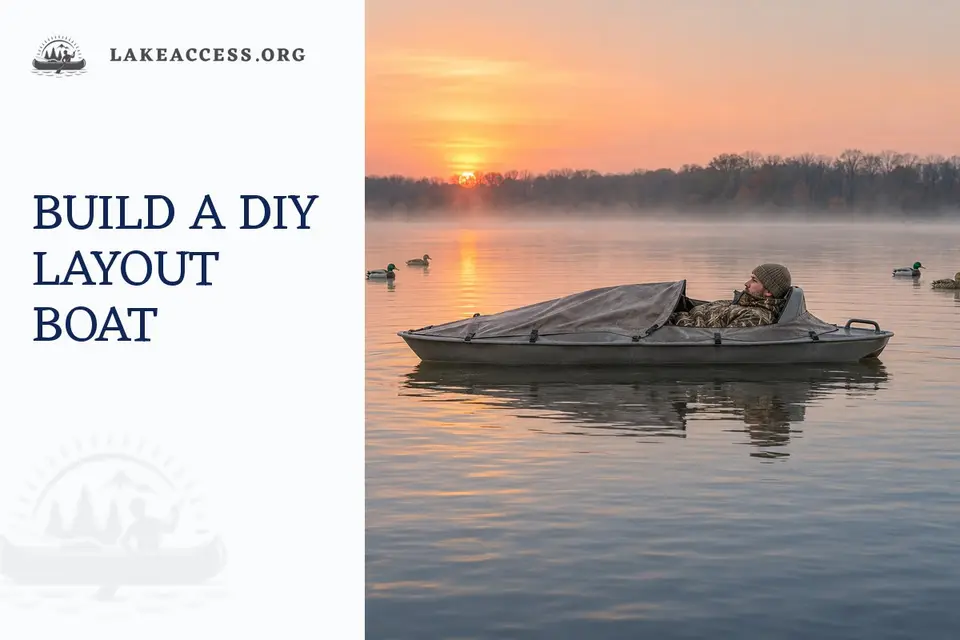
A layout boat is a low, narrow boat that lets you lie back near the waterline, hidden among decoys on open water. You can buy one, or you can build a foam-core version in a garage with rigid insulation board, a few pine boards, fiberglass cloth and epoxy. This guide follows a tested 12-foot, 48-inch design, adds what Ducks Unlimited and the federal rules say about using one, and flags the points where homebuilders get hurt or cited.
If you would rather buy, start with our guide to the best layout boats for duck hunting. If you are weighing a layout boat against a jon-style duck boat, see layout boat vs duck boat.
Check the rules and the risks first#
Two things decide whether this project ends well, and neither is carpentry.
The law. The federal migratory bird rule, 50 CFR 20.21, bans hunting from “a sinkbox or any other type of low floating device, having a depression affording the hunter a means of concealment beneath the surface of the water.” A layout boat is built so you lie above the waterline, which is a different thing, but do not design a deep cockpit that sits below it. The same rule also bars shooting from a motorboat unless the motor is shut off and the boat has stopped moving; a craft under power may be used to retrieve dead or crippled birds. States add their own rules on boat registration, motors and hunting hours, so confirm them with your wildlife agency before you launch a homebuilt hull.
The water. A layout boat sits low, so waves come over the side faster than in a normal boat, and late-season water is cold. The National Weather Service warns that cold shock can be as severe in 50-60°F water as in 35°F water, and that the involuntary gasp can be triggered by water as warm as 77°F. A life jacket buys you time. In the Coast Guard’s 2024 boating statistics, drowning caused about three-quarters of deaths, and 87% of the drowning victims were not wearing life jackets. Wear one, every trip, and read our lake boating safety guide before you take a new hull on open water.
Materials and tools#
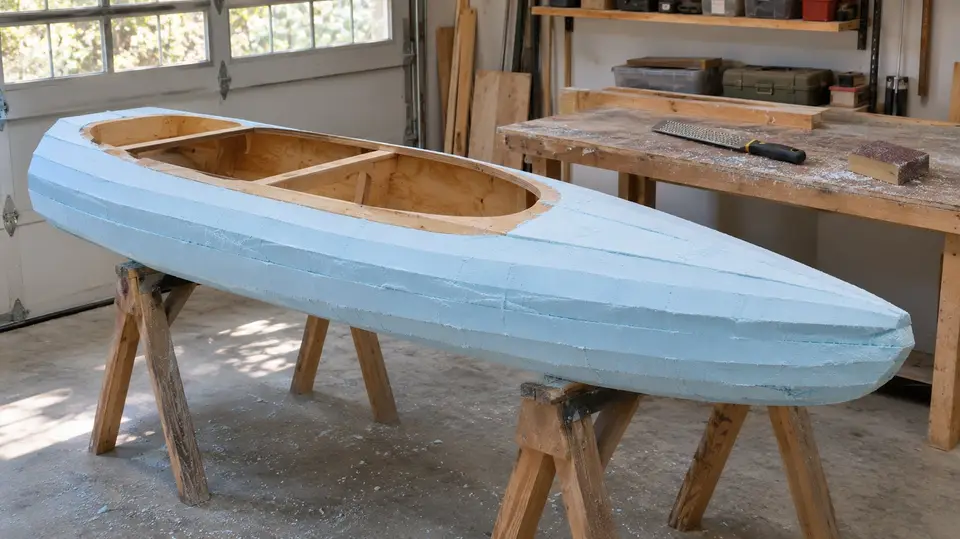
This list follows a 12-foot by 48-inch design published by waterfowler David Vaught, built in his garage with two friends. He reports building the boats for about $100 each at under 100 pounds. He wrote it up in 2021 about a build from years earlier, so treat the dollar figure as dated.
Materials
- Three 4 x 8 ft sheets of 2-inch rigid insulation foam
- Three 8 ft 2 x 8 pine boards for the cockpit walls
- 1/4-inch plywood or flooring board for the cockpit floor and the motor-mount deck
- A 4 ft length of 2 x 2 for supports
- About 10 yards of 7-oz, 60-inch plain-weave fiberglass cloth
- 1 gallon of thin epoxy resin with a slow-cure hardener
- Foam glue made for rigid foam board, plus expanding foam for gaps
- 3/4-inch dowels for side-protection attachment points
- Matte camouflage spray paint
Tools
- Long sharp knife or circular saw
- Rasp and an orbital or hand sander with 60-grit paper
- Rubber gloves and a respirator (fiberglass dust gets airborne when you sand)
- Roller or brush for epoxy, plus cheap scissors for cutting cloth
Build it step by step#
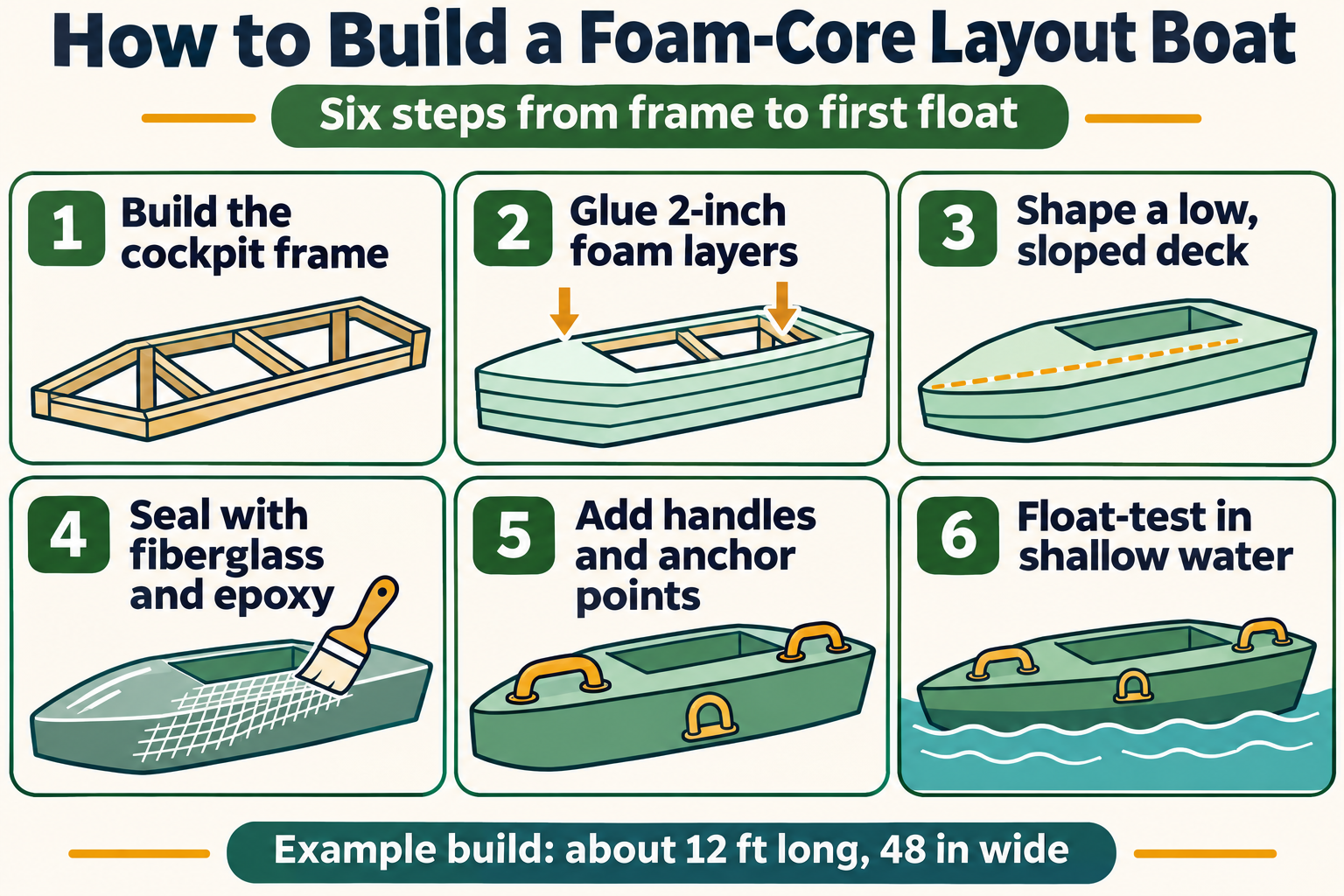
1. Fix the size#
The reference design is 12 feet long and 48 inches wide. You can narrow it, but Vaught warns that stability matters, so do not remove too much flotation. The cockpit interior ends up about 7 feet by 28 inches, enough legroom to stack empty decoy bags and shell bags.
2. Build the cockpit box#
Frame the cockpit with the 2 x 8 boards, then add the 1/4-inch floor. This box is the spine of the boat, so square it up before anything else gets glued to it.
3. Cut the foam around the box#
Lay the box on a foam sheet, trace it, and cut so the box drops into the first layers. Do it on the second sheet too. The foam you cut out becomes the bow and stern pieces that extend the boat to 12 feet. Measure twice, mark, measure again, then cut.
4. Glue and weight the layers#
Glue the cockpit box to the bottom foam sheet and weight it down so the joint grips. Add the bow and stern pieces, keeping the joints square, then stack the remaining layers the same way. Read the glue label: it has to be rated for the foam you bought.
5. Add the motor mount, handles and attachment points#
If you want power, build the motor mount from 2 x 2 pine that extends onto the bottom foam sheet, then cover it with more 1/4-inch plywood. Vaught’s boats ran 2.4 HP outboards and trolling motors. You can also skip the mount and pole the boat. Push 3/4-inch dowels into the sides if you plan to add side protection, and fit a wood block at the nose so you can grab and tow it. A reinforced handle at the bow and stern is worth the extra minutes.
6. Shape the hull#
Sculpt the bottom, bow and stern with a rasp and a sander. Round the nose slightly; a sharp point is more likely to crack the glass when you bump into things. Fill gaps with expanding foam. The goal is a low, sloped deck that sheds water and debris. A keel of some kind helps the boat track straighter.
7. Seal with fiberglass and epoxy#
Test first. Some epoxy products dissolve certain foam materials, and the advice from boat-supply sellers is to test a small scrap before you coat anything. Do that with your exact foam and your exact epoxy.
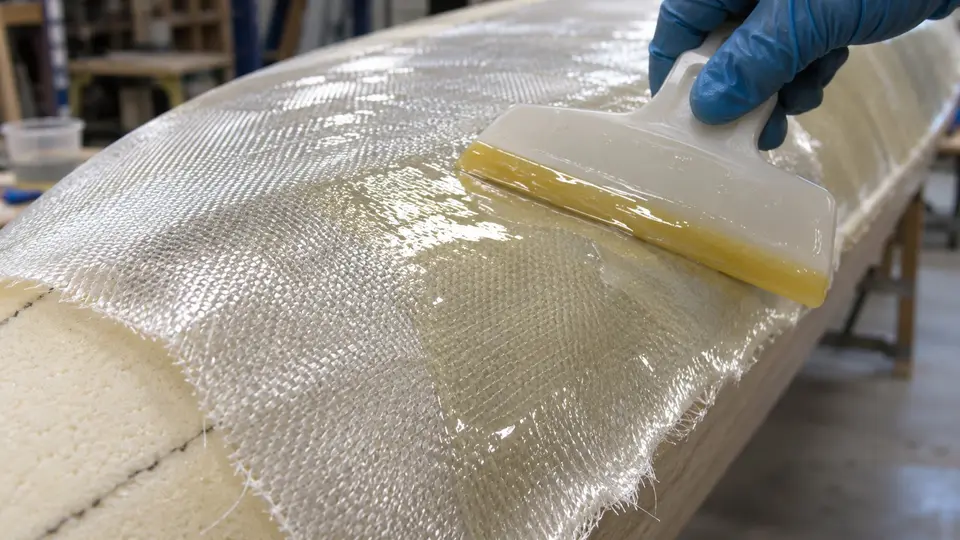
Do the bottom first, because it is the easiest. Lay the cloth, mix a small batch, and work the epoxy into the weave with a roller. A slow hardener gives you time. Drape the cloth over the sides and into the cockpit, cut the corners so the cloth folds in, and let the epoxy hold the fold. Wood parts do not need glass; coat them in epoxy. Sand the cured surface lightly to remove sharp points, wearing a mask, and do not sand through the glass.
8. Paint and conceal#
Press foliage onto the hull as a stencil and spray in layers of color. In the field, grass mats or local marsh plants finish the job. Ducks Unlimited quotes one builder whose fully grassed boat stands only about 15 inches above the water, which shows how little profile you need.
9. Float-test it before the season#
Launch in shallow water on a warm day, in a life jacket. Load it the way you will use it, lie down in the cockpit, shift your weight, and check how much freeboard you have. Practice climbing back in from the water. Do not skip this; a layout boat that handles well when empty can behave very differently with decoys, a dog, and a wet hunter.
Design choices and their trade-offs#
| Choice | Option | What you give up |
|---|---|---|
| Width | 48 inches (reference design) | Narrower is lighter and easier to carry, but less stable |
| Power | Poling, paddling | No motor to mount, but slow in wind and current |
| Power | Trolling motor or 2.4 HP outboard (reference builds) | Added weight, a battery or fuel, and the registration rules that may come with a motor |
| Nose shape | Slightly rounded | A sharper nose cuts wind and waves better but is easier to damage |
| Keel | Some kind of keel | A little extra shaping work for straighter tracking |
Using it on the water#
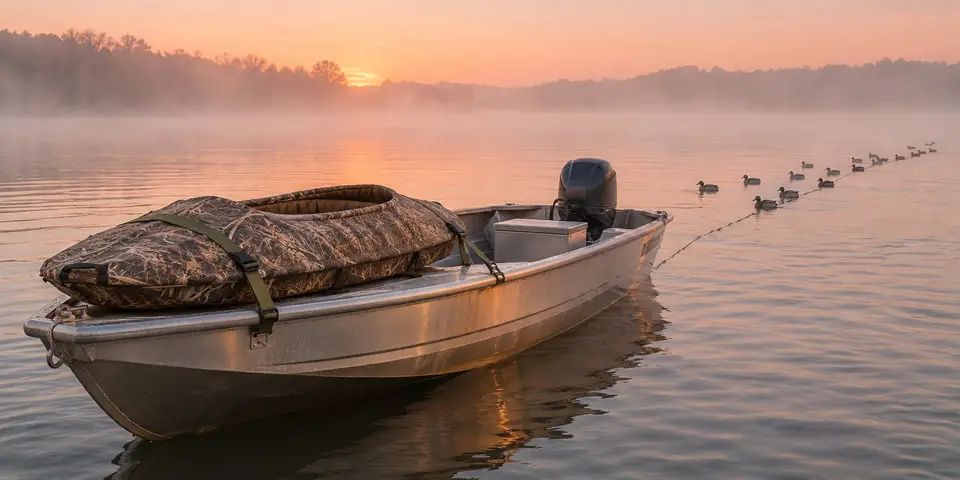
Traditional layout boats are carried or towed to the hunting area by a larger, more seaworthy tender boat, which stays nearby to retrieve birds. Ducks Unlimited describes setting the layout boat in the upwind third of the decoy spread, no farther than 30 yards from the downwind edge of the decoys, and notes that the style is most associated with diving ducks like canvasbacks, redheads and scaup on open water.
A light foam boat like this one is best suited to calm water and shallow wetlands. Big-water layout hunting is a different level of risk. If you plan to hunt open lakes, follow the tender-boat approach and read our notes on layout boat vs duck boat to decide which hull fits your water.
Mistakes that cost homebuilders the most#
- Skipping the resin test on a foam scrap. A coat that melts the hull is a total loss.
- Sanding without a respirator. Cured fiberglass makes fine dust that you do not want in your lungs.
- Building too narrow. Saving 6 inches of width is not worth a boat that rolls when you reach for a bird.
- No handles or tie-off points. You will want to drag, tow, and anchor this boat.
- Hunting from it without a tender or a life jacket. Open-water layout hunting is where the danger is, and a homebuilt hull has no safety record.
Build or buy?#
A foam-core build is a good fit if you like to work with your hands, hunt calm or shallow water, and want a light boat you can drag across a flat. If you hunt big water, or need a boat with a known stability record, a commercial hull built to Coast Guard standards is easier to defend. Our roundup of the best layout boats compares buying options.
Frequently asked questions#
How much does a DIY layout boat cost?
The builder behind a widely shared foam-core design reports about $100 per boat and under 100 pounds. His article was published in 2021 and describes a build from years earlier, so price the materials list at current rates before you commit.
How long does it take to build a layout boat?
Cutting and gluing the foam goes quickly. The fiberglass and epoxy stage is the slow part, because the epoxy has to cure and the sanding comes after. Plan to spread the work over several sessions.
Is a homemade layout boat legal for duck hunting?
Federal rules for migratory game birds (50 CFR 20.21) ban hunting from a sinkbox or other low floating device with a depression that conceals the hunter beneath the water’s surface. Layout boats are widely used, but check your state wildlife agency for design, registration, and motor rules before your first hunt.
Can I use any resin on foam?
No. Some epoxies can dissolve certain foam materials, so test a scrap piece of your exact foam with your exact epoxy first. Products made specifically for coating polystyrene exist if your test fails.
How much can a foam layout boat carry?
The builder behind the 12-foot, 48-inch design reports hauling about six dozen decoys, a dog, a trolling motor and a battery each trip, and floating two adults who together weighed over 500 pounds. Treat that as one builder’s experience, not a rating, and keep your own load well below what you tested.
Sources#
- The Lowdown on Layout Hunting, Ducks Unlimited
- Small-Craft Waterfowling, Ducks Unlimited
- Summer Project: Make Your Own Waterfowl Layout Boat, GunsAmerica
- 50 CFR 20.21, Hunting methods, Cornell Legal Information Institute
- Cold Water Hazards and Safety, National Weather Service
- Coast Guard reports fewest boating fatalities in more than 50 years, U.S. Coast Guard
- Can I apply epoxy over polystyrene foam?, Jamestown Distributors
Written by
We started this blog as a place to go to when we had questions about buying our first home on the lake. There was a lot of information on the internet, but we always spent hours...