
Quick answer: Big Foot Beach State Park is the primary public campground directly associated with Geneva Lake, about one mile south of the city of Lake Geneva. Wisconsin DNR lists 100 campsites, including 34 with electric pedestals, plus lower-loop walk-to tent sites. Other Lake Geneva-area campgrounds can provide RV amenities or a quieter base, but verify their actual road distance to the lake, beach and launch rather than treating near Lake Geneva as direct shoreline access.
Campground comparison: last checked July 16, 2026
Use this table to narrow the options, then verify the exact site and dates with the current operator record.
| Option | Camping fit | Water relationship | Verify before booking |
|---|---|---|---|
| Big Foot Beach upper loop | Gravel pads; 34 sites with electric pedestals | State park on Geneva Lake; use designated access | Site electricity, vehicle pass, rig length and availability |
| Big Foot Beach lower loop | Walk-to tent sites 30 to 100 feet from vehicles | Near park facilities, not a promise of private shoreline | Carry distance, tent fit, restroom route and weather |
| Lake Geneva-area private campground | May offer RV, cabin or seasonal options | Often a drive from the city beach or public launch | Exact mileage, transient sites, hookups and guest rules |
| Nearby regional fallback | Useful when the immediate area is full | Plan a dated drive to Geneva Lake activities | Parking, admission, beach or launch hours and route |
Use Big Foot Beach as the distance benchmark
Wisconsin DNR places Big Foot Beach State Park on Lake Shore Drive about one mile south of the city of Lake Geneva. The campground page lists 100 campsites and identifies 34 upper-loop sites with electric pedestals. It also describes a dump station, vault toilets and a shower building. Those facts create a dependable baseline for travelers who want a public campground close to Geneva Lake.
The lower-loop tent sites are a short walk from the vehicle rather than standard car-side pads. Confirm the exact carry distance and site map before bringing heavy equipment. Electricity at selected sites does not imply water or sewer hookups. A vehicle admission pass is separate from the campsite reservation under Wisconsin state-park rules, so include it in the trip plan.
Separate campground distance from beach access
A property can be within the Lake Geneva tourism area but still require a drive to a public beach, launch, shore path or downtown activity. Record route distance from the campground entrance and from the exact loop when relevant. Big Foot Beach is on the lake, but campers still use designated facilities and must follow posted beach, pet and park rules.
For a private campground, ask whether lake access belongs to the campground, a partner facility, or a separate public site. Verify fees, parking and hours at that second location. Avoid a listing that says minutes from the lake without naming the route and access point. The practical comparison is door-to-designated-access, not the distance from a map pin to open water.
Apply Wisconsin reservation and firewood rules
Wisconsin DNR says state-park camping reservations are required and may be made up to 11 months in advance. Current rules also address minimum stays during parts of the season, cancellation timing, park closed hours and the maximum stay. Read the live reservation record because the available site, date and fee can change after this guide is checked.
Wisconsin restricts movement of firewood to reduce the spread of pests and diseases. Use the current DNR firewood guidance and any active fire restriction rather than carrying wood based on an old trip. Confirm quiet hours, generators, pets and the vehicle pass at the same time, then save the rules with the reservation.
Build a camp plus beach itinerary with a fallback
Choose the campground first, then attach each beach, boat tour, shore-path segment or launch to a dated operating record. Summer demand can make the most convenient site unavailable, and weather can change a day on the lake. A nearby campground can still work well when the route and parking plan are explicit.
Keep one inland or town activity that does not require a beach or launch to operate. Recheck local weather, DNR notices and the access provider before leaving the campground. Do not interpret a campground reservation as admission, parking or guaranteed space at a separate attraction.
How to compare campgrounds without overpromising
A campground name is only the start of a booking decision. Record the operator, exact site number, camping unit type, pad length, hookups, occupancy limit, vehicle allowance, access route, and the date each fact was checked. A property can contain tent sites, electric sites, full-hookup sites, cabins, group areas, and day-use facilities under one name. Those options are not interchangeable, and an amenity shown for the property may not be present at the site you reserve.
Use the live reservation listing and a current campground map together. The reservation record establishes what can be booked for the selected dates; the map helps interpret loops, roads, bathhouses, ramps, shorelines, and accessible facilities. When the two records are unclear, contact the operator and save the written answer. Do not convert a marketing description such as waterfront, lake view, or near the beach into a guaranteed site feature without site-level evidence.
Waterfront, water-view, and lake access mean different things
A waterfront site may touch the managed shoreline but still have a steep bank, vegetation, rocks, seasonal exposure, or a rule against launching, swimming, mooring, or beaching a boat. A water-view site may provide a view without safe or permitted shore access. A campground described as being on a lake may require campers to walk or drive to a designated beach or ramp. Ask what the site-level description actually means before choosing it for swimming, paddling, fishing, or boat use.
Use designated facilities and current operator guidance for every water activity. Reservoir levels, storms, maintenance, erosion, harmful algal blooms, water-quality advisories, and staffing can change access after a campground page was written. Check the managing agency, weather service, waterbody operator, and local health or natural-resources notice close to the trip. Never treat an open campsite as proof that a beach, ramp, dock, trail, or swim area is open or suitable.
Match the campsite to the tent, trailer, or RV
For an RV or trailer, compare the equipment length and height with the listed pad, approach, turning room, overhead clearance, grade, hookup type, and vehicle rules. Confirm whether the length field includes the tow vehicle and whether a slide, awning, extra vehicle, or boat trailer can remain at the site. Electric service does not imply water or sewer, and a dump station elsewhere in the campground is not a full hookup. Follow the equipment manuals and operator instructions rather than improvising a connection.
For a tent, verify that the site permits tents and has a usable tent area rather than assuming every RV pad has one. Note whether the site is walk-in, cart-in, or next to the vehicle, and record the route to water, toilets, showers, food storage, and emergency access. Cabins also vary: bedding, kitchens, restrooms, climate control, cooking rules, accessibility, and pet policies must be checked in the specific lodging record.
Read reservation and cancellation terms before paying
Availability changes continuously, so this guide does not promise an open site. Enter the real party size, dates, equipment, and accessibility needs in the operator’s current booking system. Review the total price, taxes, service fees, minimum stay, deposit, cancellation deadline, refund method, change fee, check-in procedure, late-arrival rule, and no-show policy before submitting payment. Save the confirmation and the site description that supported the decision.
Confirm the identity of the operator and the booking domain. A directory or tourism page can help discover options, but the campground or government reservation record should control the transaction. Call the official number when a third-party listing conflicts with the current site. Recheck the reservation several days before departure and again after major weather, wildfire, water-level, road, or staffing news that could affect access.
Check pets, fires, quiet hours, and local restrictions
Pet rules may differ between campsites, cabins, beaches, trails, buildings, and designated swim areas. Record leash length, prohibited locations, pet fees, vaccination or documentation requirements, and the rule for leaving an animal unattended. Service-animal rules are not the same as general pet rules. Use the current operator policy rather than a review, an old photo, or a rule from another campground in the same state.
Fire rules can change quickly with drought, wind, invasive-pest restrictions, or a local burn ban. Verify whether fires are allowed, where they must be contained, and what firewood may enter the property. Note quiet hours, generator rules, gate closures, visitor hours, alcohol rules, food-storage guidance, and vehicle limits. These are conditions of the stay, not minor details to discover after arrival.
Plan accessibility from the complete route
An accessible campsite is most useful when the full route works: parking and pad, surface and slope, restroom and shower, picnic area, beach or fishing access, registration, and emergency communication. Do not reserve a designated accessible site solely because it appears larger. Read the site record and contact the operator about the features that matter to the traveler, while recognizing that individual needs differ.
Record which claims are confirmed by a current map, site listing, or staff response and which remain unknown. A general accessibility symbol cannot describe every surface, transfer, reach, or route condition. Check again after storms, construction, or seasonal changes, and keep a fallback activity that does not depend on a facility whose current condition could not be confirmed.
Use a short pre-departure verification window
One or two days before travel, open the operator’s alerts page, weather forecast, road information, waterbody notices, and reservation record. Confirm the arrival route, gate and office hours, after-hours procedure, potable water status, sanitation services, and any closure affecting the campsite or planned activity. Download the campground map and reservation details for offline use, but remember that a saved copy can become stale.
At check-in, read posted notices and ask about conditions that changed after the last online check. If water access, a road, a site, or an essential service is closed, follow staff direction and use the documented alternative. A practical campground plan is not the one with the most promises; it is the one that identifies the controlling source, records the check date, and leaves room for conditions to change safely.
Keep a claim ledger for the exact reservation
Create one row for every condition that could change the decision: site type, pad length, electrical service, water and sewer, tent permission, occupancy, vehicle count, pet eligibility, accessible features, shoreline relationship, launch or beach access, price, deposit, cancellation deadline and operating season. Beside each answer, record the current source, check date and whether it applies to the property, the campground loop or the exact site. This prevents a property-wide amenity from being assigned accidentally to a particular reservation.
Use simple status labels: confirmed in the live booking record, confirmed on a dated operator page, confirmed directly by staff, or still unknown. Resolve every unknown that would make the trip unusable before paying. Preserve screenshots or PDFs only as supporting evidence; the current operator can supersede them. When the reservation is changed, copy the ledger and recheck every field rather than assuming the replacement site has the same dimensions, hookups or access.
Plan family, pet, and group needs site by site
A family or group booking needs more than a maximum head count. Confirm how the operator counts adults, children, tents, camping units and daytime visitors, and whether adjoining sites must be booked separately. Record the walking route to toilets, potable water and shelter, plus the distance from traffic, shore edges and other hazards. Do not use a campground article as child-supervision or water-safety guidance; follow the site rules and choose activities that fit the people, conditions and current official advice.
For pets, plan heat, shade, water, waste disposal and a lawful activity when animals are prohibited from a beach, building or cabin. Never leave a pet in a vehicle, at an unattended campsite or in a situation that conflicts with operator rules. If the group depends on a cabin, accessible site, extra vehicle or pet-friendly unit, confirm that feature on the exact reservation and keep the operator response with the trip record.
Coordinate boats and trailers as a separate reservation problem
Bringing a boat creates several independent checks: campsite space, tow-vehicle and trailer parking, ramp access, launch fee, gate hours, current water level, required permits or registrations, fuel and marina availability, and weather. A campground can sit on a boating lake while requiring trailers to use overflow parking or a different launch. Obtain the current rule for the exact camping unit and boat combination instead of assuming that both fit on a paved site.
Use a designated launch and current navigation information. Do not create a path from a campsite to the water, cross a closed shore, tie to vegetation, leave a boat where overnight mooring is prohibited or treat an informal bank as a ramp. Check life-jacket and boating requirements with the responsible state or federal agency. Keep a land-based fallback for a closed ramp, unsafe weather, low water, an advisory or any condition that makes the planned outing unsuitable.
Review the total trip, not only the nightly rate
Compare the full stay on one worksheet: campsite or lodging charges, reservation fees, vehicle admission, additional vehicles, pets, utilities, marina or launch charges, firewood, required equipment and the travel needed to reach separate lake facilities. Record refundable deposits apart from nonrefundable fees and note when a rate applies only to residents, members, seasonal tenants or a longer stay. Do not publish or rely on a static total when the operator provides the current price during booking.
The lowest nightly line can become the less practical choice when it lacks the required site type, adds a long drive to the water or creates separate parking and launch costs. Choose from verified features first, then compare current totals for the actual dates. This keeps the guide useful without ranking campgrounds for payment, inventing availability or presenting a changing price as a standing promise.
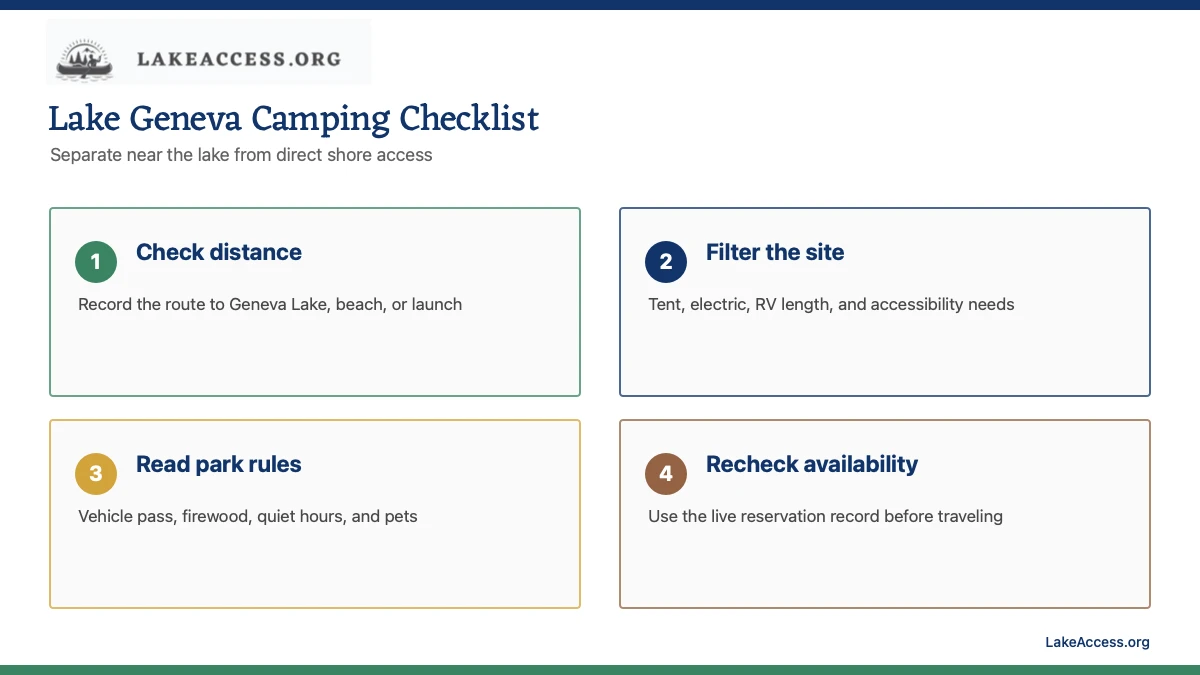
Booking checklist
- Measure the route to the exact Geneva Lake access point.
- Filter the reservation for tent, electric, RV-length and accessibility needs.
- Add the required state-park vehicle admission when applicable.
- Verify current firewood, pet, quiet-hour and cancellation rules.
- Recheck beach, launch and weather conditions close to the trip.
Related LakeAccess guides
- Beaches near Lake Geneva
- Lake Geneva boat tour guide
- Lake camping reservation guide
- What to pack for the lake
Sources
These sources were checked on July 16, 2026. Recheck the operator, reservation record, alerts, and local conditions for the actual dates.
- Wisconsin DNR: Big Foot Beach camping (checked July 16, 2026).
- Wisconsin DNR: Big Foot Beach information (checked July 16, 2026).
- Wisconsin DNR: camping rules (checked July 16, 2026).
- Wisconsin DNR: camping reservation FAQ (checked July 16, 2026).
- Visit Lake Geneva: area campgrounds (checked July 16, 2026).