Lake Muck Removal: Dredging, Aeration and Bacteria Compared
Only dredging reliably removes lake muck. Raking, pumping and blowers work on small areas, and the evidence for aeration and bacteria products is thin. Here is how each option compares.
On this page
Lake muck is the dark, oozy layer on the bottom that squishes between your toes at the dock. Getting rid of it is harder than the product pages suggest. Only dredging reliably removes it. Raking, pumping and blowers work on small areas but need repeating, and the evidence for aeration and “muck-eating” bacteria is thin.
This guide compares the main options using extension-service and agency sources, then covers the permits to check first. It is the muck half of our older overview, how to get rid of lake weeds and muck. The weed half has its own guide: lake weed removal.
What muck is and why it builds up#
The University of Florida’s lake specialists describe muck as the black or brown ooze on the bottom of lakes, with typically 20% to more than 80% organic matter. That organic matter comes from outside the lake (soil, leaves, pollen and grass clippings that wash in) and from inside it (dead aquatic plants, algae that settle, and animal remains).
Three things about muck are worth knowing before you spend money on it:
- Water movement is the main driver. The Florida specialists say lack of water movement is the most important factor in where muck builds up, and that docks can add to it by reducing currents.
- Plants matter. In their general ranking, algae produce the least muck, submerged plants a little more, and emergent, floating-leaf and floating plants the most. Dead weeds add to the layer, which is why weed and muck control overlap.
- It is not all bad. Muck is habitat for midge and mayfly larvae, worms, snails and other animals that feed fish and birds. The goal for lake managers, the Florida specialists say, is not to eliminate muck entirely but to keep the right amount in the right places.
Muck also smells. Bacterial decomposition can release methane and hydrogen sulfide, which has a rotten-egg odor. Midge larvae living in it can emerge as swarms that coat lights and equipment. The adults do not bite.
The main options compared#
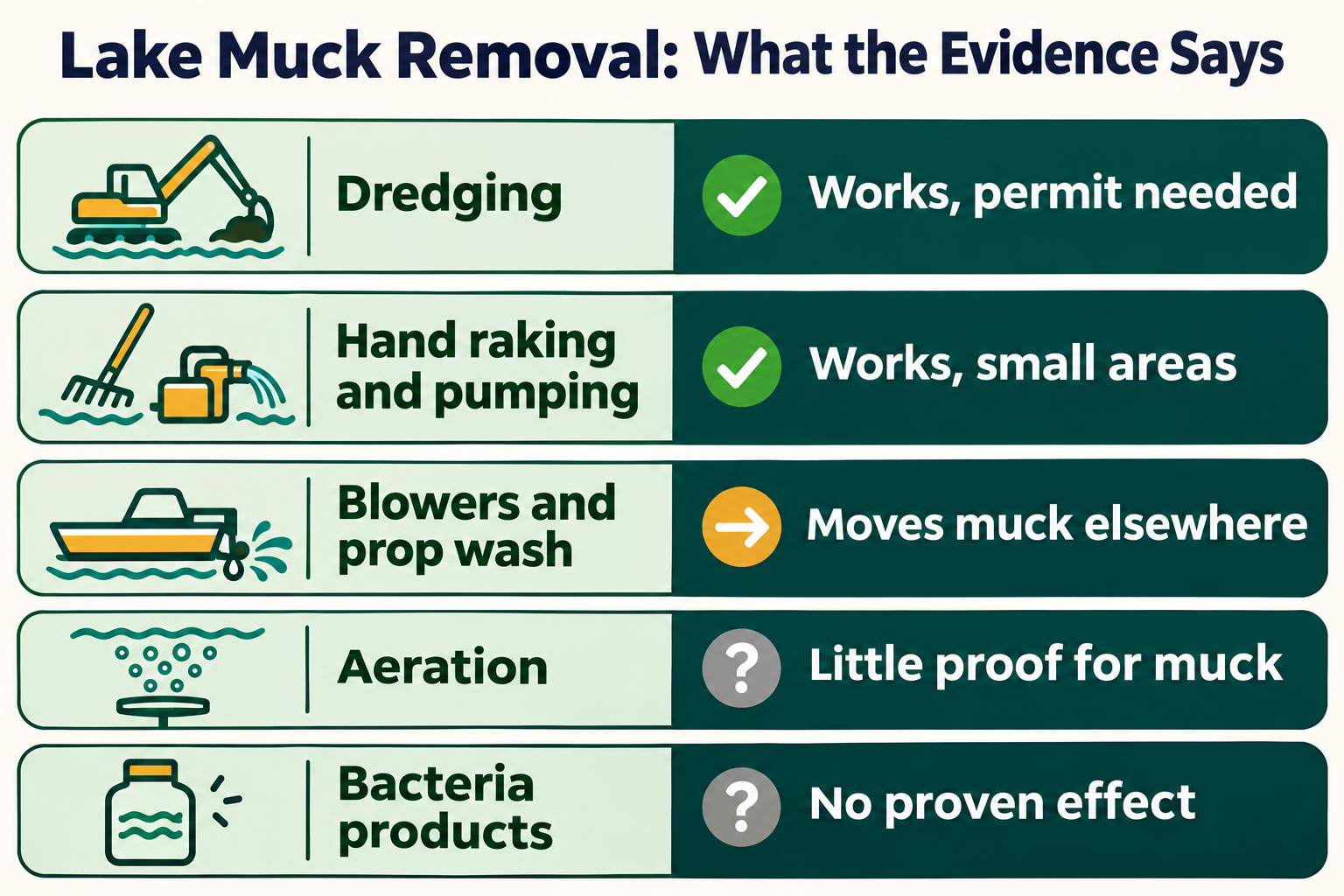
These ratings come from the University of Florida publication on muck, supplemented by the sources listed at the end. They describe Florida lakes in particular, so treat the cost and permit details as examples, not national rules.
| Method | How it works | What the evidence says | Main catch |
|---|---|---|---|
| Dredging | Removes muck with grab, dragline or suction equipment | The only approach that guarantees removal | Cost, permits and where to put the spoil |
| Hand tools and small pumps | Rakes, shovels, hand dredges, shore-based trash pumps, diver-assisted suction | Works for a dock or beach area | Hard physical work that has to be repeated |
| Blowers and prop wash | Currents push muck into deeper water | Quick and cheap for a small area | It moves the muck, not removes it |
| Aeration | Adds oxygen, creates currents | Little scientific support for muck removal | Any effect is likely redistribution |
| Bacteria products | Claim to digest muck | No reliable evidence for deep muck | Money spent with little to show for it |
Dredging#
The Florida specialists say dredging is the only management approach that guarantees muck removal, and that the biggest challenge is finding a cost-effective way to dispose of what you dig up. Methods include grab dredging with a clamshell bucket, dragline dredging and suction dredging, where a cutter head loosens the sediment and a pipeline carries the slurry to a settling basin.
Scale and cost vary a lot:
- Large projects tend to cost many millions of dollars and are usually run by federal or state government. Years can pass between the first proposal and the start of work.
- Small projects are often sponsored by local governments or homeowner associations and cost less than a million dollars. They can use ordinary road-maintenance equipment such as track hoes and backhoes, specialized walking excavators that work in the water, or smaller hydraulic dredges.
- Dewatering is often done in a geotube, a fabric container that holds the sediment but lets water drain back. The sediment can take weeks to months to dry before trucks remove it, and geotubes are expensive.
If you can lower the lake enough for the shoreline bottom to dry, muck can be scraped down to hard bottom with conventional construction equipment. The Florida publication says that approach was used at Lake Tohopekaliga, where the spoil was piled up as islands in the lake to cut disposal costs.
Hand tools, pumps and divers#
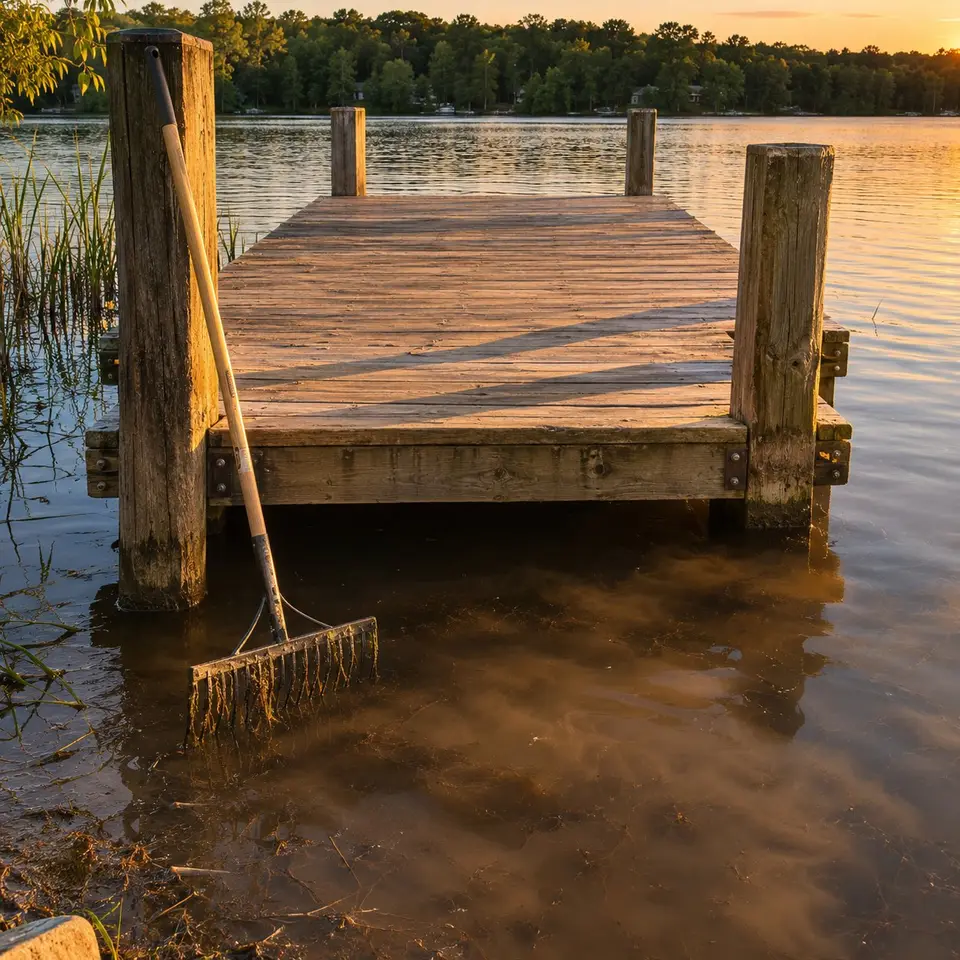
For a homeowner with one dock or beach, the Florida publication lists special rakes, shovels and hand dredges. It also lists shore-based portable trash pumps to vacuum the muck out, or to suction muck and plants with the help of a diver. Small self-cleaning wedge-wire screens can dewater the muck quickly so it can be carted off and the water returned to the lake. The authors are blunt that controlling muck this way takes arduous, unpleasant effort and that there is no work-free approach.
Blowers and prop wash#
Rotating electric blowers and outboard engines can suspend muck so that currents carry it into deeper water. The Florida specialists say an outboard engine used this way may be the quickest and least expensive option for a homeowner. They add that both approaches have to be repeated, and the muck ends up somewhere else in the lake. The same stirring can cloud the water, so check whether your state or lake association allows it.
Aeration#
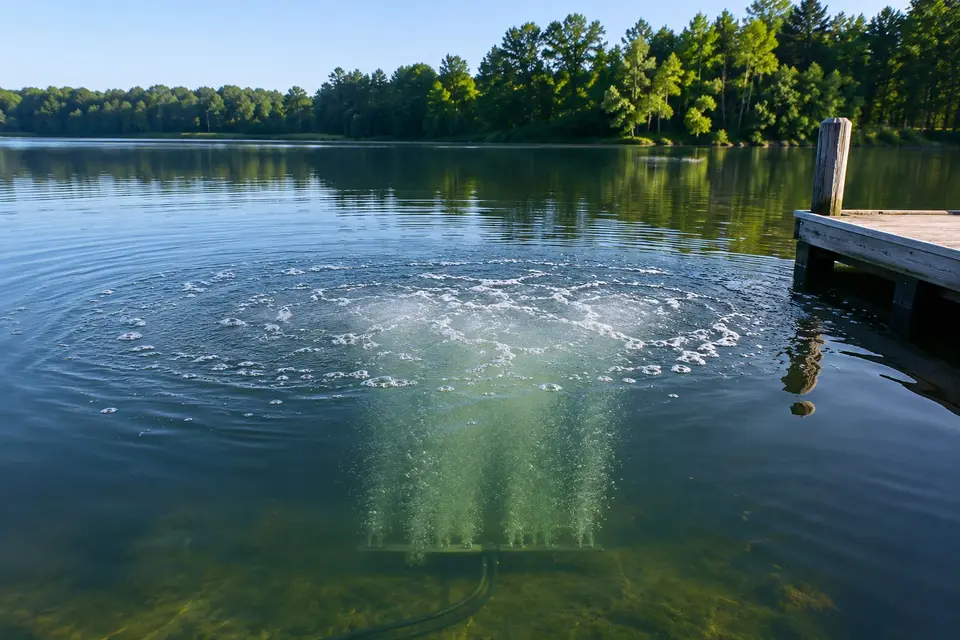
Aeration is often sold as part of a muck-reduction package. The Florida specialists say there is little scientific evidence that it works for muck. They point out that any aerobic bacteria needed are already present in water with normal oxygen levels, that the few studies suggest muck reduction is likely redistribution caused by aerator currents moving material to deeper water, and that oxygen cannot penetrate deep below the sediment surface. Stirring the muck up to get oxygen into it makes the water murky and can use up oxygen that fish need.
Aeration can still help fish in some lakes. The point here is only that it is not a proven way to remove muck.
Bacteria and enzyme products#
The same publication says that, although these products are supported by testimonials, there is little scientific evidence that they work, and recommends caution. Their reasoning is arithmetic. Most muck is less than 50% organic matter, and in waters without large wastewater inputs, sediment builds up at millimeters per year. Even if 90% of it could be digested, the layer would shrink by a few millimeters, which would be hard to measure. Some muck would always remain because not all organic material decomposes.
A peer-reviewed trial reached a similar result for one product. Texas Parks and Wildlife researchers tested a commercial probiotic in koi hatchery ponds for 4.5 months and found no significant effect on sediment accumulation or any of the water-quality measures. The authors said their small sample and low dose might have affected the result and called for more studies, so it is not proof for or against every product. But it does not support the marketing claims.
Check the permits first#
Even a modest project can fall under several layers of rules.
- Federal. The Army Corps of Engineers regulates work in navigable waters under Section 10 of the Rivers and Harbors Act of 1899, which can cover dredging and dock construction. It also regulates the discharge of dredged or fill material into U.S. waters under Section 404 of the Clean Water Act.
- State. Many states require their own permit. Wisconsin’s DNR, for example, has a general permit for small-scale dredging of lakes and streams. Applicants still need a full application with plans, a disposal plan, ownership documents and photographs, and must get any local and Army Corps approvals before starting.
- Local. Counties, towns and lake districts may add rules on shoreline work and disposal.
The Florida publication also says to determine whether a permit is required from the proper state agency before starting any muck-removal program, including small do-it-yourself ones. Call your state natural resources agency before you buy equipment or hire a contractor.
Slow the next layer#
You will not stop muck from forming, but you can reduce what you add.
- Keep leaves and grass clippings out of the water. The Florida specialists list them among the outside sources of organic material. For wider habits that help a lake, see how we can keep rivers and lakes clean.
- Think about water flow at the dock. Structures that reduce currents can add to accumulation. Our guide to lake boat dock ideas covers the common designs.
- Manage weeds and algae. Dead plant material and settled algae feed the muck layer. See lake weed removal, how to get rid of algae in a lake, and blue-green algae in lakes.
Which approach fits your situation#
- A small dock or swim area. Hand tools, a small pump or a blower. Expect to repeat the work, and confirm the permit rules.
- A silted-in cove or canal shared by several owners. A contractor with a small dredge or excavator, a permit in hand, and a disposal plan settled before the work starts.
- A lake-wide problem. This usually needs a lake association or agency. The Florida specialists note that dredging “a little bit” when the problem is system-wide may make people feel better but will not solve it.
- A product that promises to “eat” muck. Ask for independent, peer-reviewed results on lakes before paying.
Frequently asked questions#
What is the best way to remove muck from a lake?
Dredging is the only approach that guarantees removal, according to the University of Florida’s lake specialists. For a small dock or beach area, raking, shoveling or pumping the muck out can work, but you will have to repeat it. Check permit rules before you start.
Does aeration remove lake muck?
The evidence is weak. University of Florida specialists say the few studies on aeration and muck suggest any reduction is likely due to bottom material being moved by currents, not to bacteria breaking it down. Oxygen also does not penetrate deep into muck.
Do muck-eating bacteria work?
Not reliably. A study published in 2009, run in fish hatchery ponds, found that a commercial bacterial product had no significant effect on sediment accumulation or the water-quality measures tested, though the authors noted a small sample and a low application rate. University of Florida specialists say buying bacterial pellets or solutions for muck control is likely not the wisest investment.
Do I need a permit to remove muck from my lake?
Often, yes. Dredging and the discharge of dredged material can need federal Army Corps of Engineers permits under Section 10 and Section 404, plus state and local permits. Wisconsin, for example, has a general permit for small-scale dredging that still requires a full application. Call your state natural resources agency first.
Why does muck build up near my dock?
Muck settles where water moves little. University of Florida specialists say lack of water movement is the most important factor in muck distribution and that structures such as docks can add to accumulation by reducing currents. Leaves, grass clippings, dead plants and algae supply the organic material.
Sources#
- A Beginner’s Guide to Water Management: Muck: Causes and Corrective Actions (FA200), University of Florida IFAS
- Can the Liquid Live Micro-Organisms System, a Commercial Probiotic, Affect Sediment, Water Quality, and Koi Carp Production in Fish Hatchery Ponds?, North American Journal of Aquaculture
- Dredging: Small Scale Dredging of Lakes and Streams General Permit Application Instructions, Wisconsin DNR
- Fact Sheet 16: Regulatory Program, U.S. Army Corps of Engineers St. Paul District
Written by
We started this blog as a place to go to when we had questions about buying our first home on the lake. There was a lot of information on the internet, but we always spent hours...