Lake Weed Removal: Methods, Permits and Limits
Removing lake weeds is often regulated, and the plants usually grow back. This guide compares hand pulling, harvesting, barriers, drawdown and herbicides, with real permit rules from three states.
On this page
Lake weeds can make a dock unusable, but removing them is rarely as simple as it looks. In many states the plants belong to the public, so what you can pull, cut or spray depends on where you live and how big the area is. The plants also tend to come back. The best result is usually a small, well-chosen cleared area, not a bare shoreline.
This guide compares the main removal methods, shows what three state agencies actually allow, and explains the limits of each approach. If muck is also part of your problem, see our companion guide to lake muck removal. Our older combined overview is how to get rid of lake weeds and muck.
Start with the rules#
State rules vary a lot, so check yours before you touch a plant. Three examples show how different they can be.
Minnesota. Aquatic plants in public waters are state property. A public water is generally 2.5 acres or larger inside a city, or 10 acres or larger in rural areas. A shoreline owner may cut or pull submerged plants to maintain a swimming or docking area without a DNR permit if:
- the cleared area is no more than 2,500 square feet, and
- it extends no more than 50 feet along the shore or half the length of your shoreline, whichever is less.
A boat channel up to 15 feet wide can be added on top of that. The work can be done by hand or with hand-operated or powered equipment that does not significantly alter the lake bottom, and you must dispose of the plants on land. A permit is required for cutting or pulling submerged plants over 2,500 square feet, for any destruction of emergent plants such as cattails and bulrushes, for herbicides and algaecides, and for automated plant-control devices. Minnesota does not allow excavating the lake bottom for plant control, hydraulic jets, bottom barriers, or removing plants in posted fish-spawning areas or from an undeveloped shoreline. Fees generally run about $35.
Wisconsin. The DNR’s riparian-owner exemption example shows a homeowner who manually removed a single 30-foot swath of plants around a pier for boat access and swimming. No permit was needed, and there was no wild rice in the area. The agency’s guidance is “less is more”: remove only what you need to reach open water and recreate. Chemicals are stricter. You need a DNR permit before applying any in a lake, and homeowners in almost all cases also need a state pesticide-applicator certification. The DNR recommends hiring a commercial applicator.
Massachusetts. The state’s overview of plant-management methods says every method except no management requires some level of permitting.
Your state may differ from all three. Call your fish and wildlife or natural resources agency and ask about your lake, not just your state in general.
Methods compared#
Hand pulling and raking#
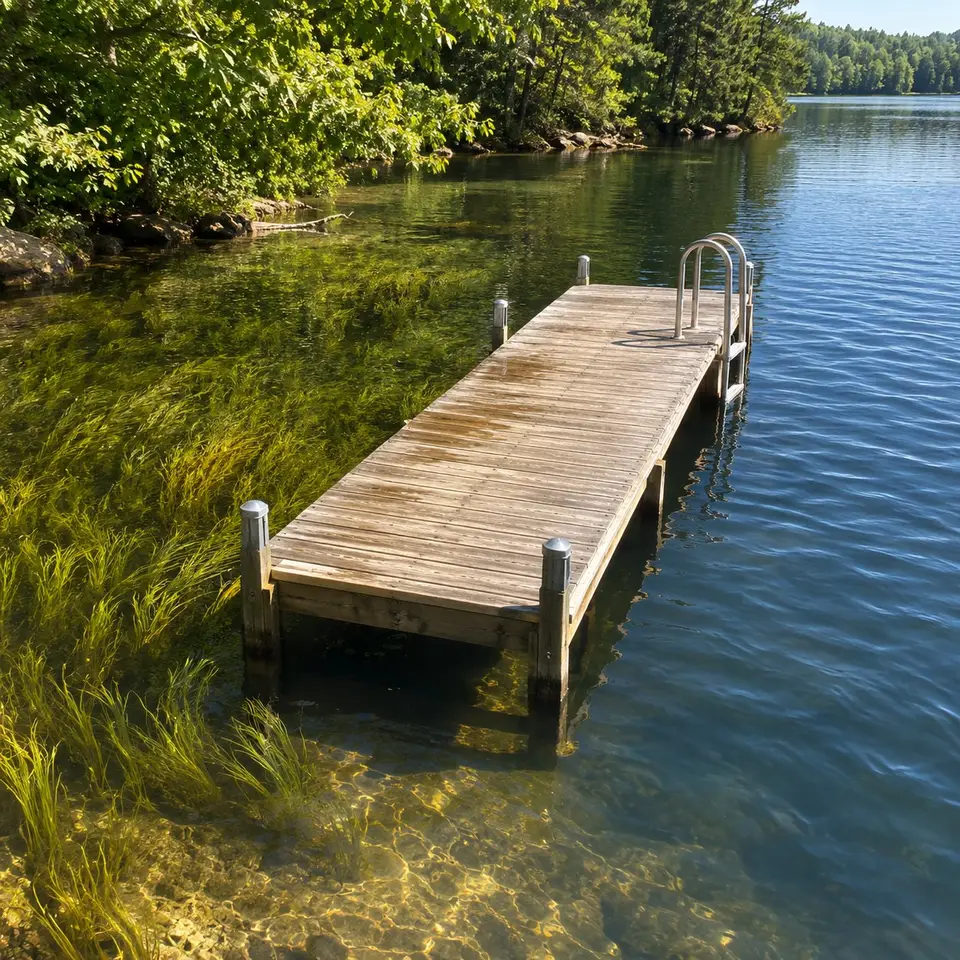
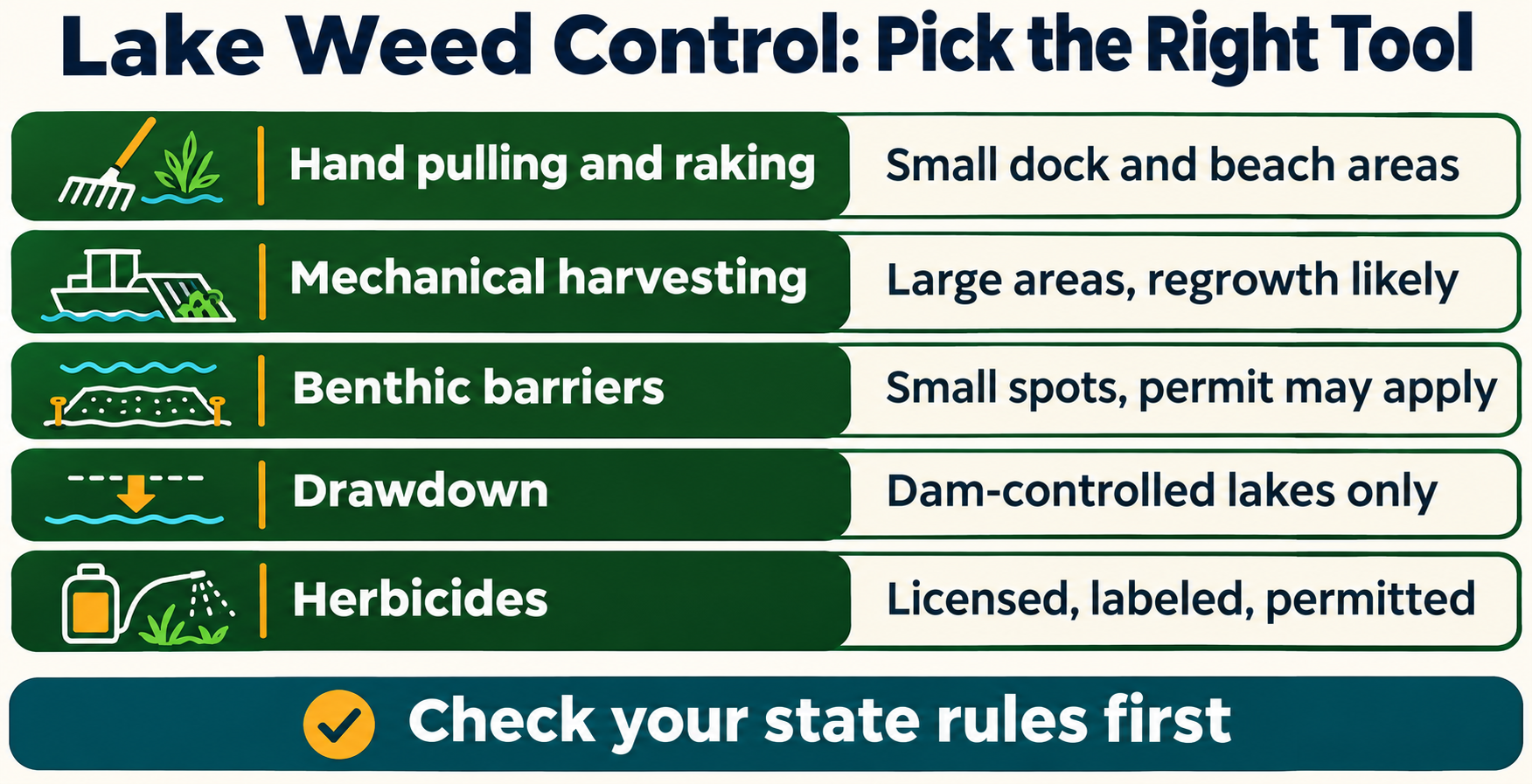
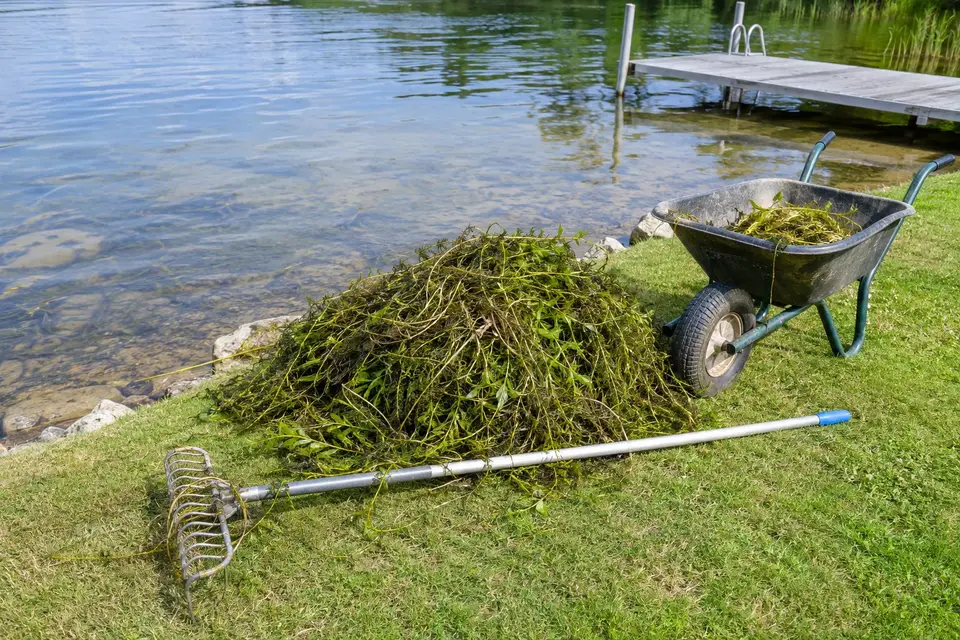
Hand pulling is the most selective method. Massachusetts says it suits pioneer infestations and small areas, though it is labor intensive. Rakes and weed cutters made for lakes are the usual tools for a dock or beach area. Minnesota’s no-permit rule covers this kind of work within its size limits. Collect what you remove and dispose of it on land so it does not drift back or onto a neighbor’s shore.
Diver-assisted suction harvesting#
In diver-assisted suction harvesting (DASH), divers hand-pull plants and feed them into a suction device on a boat. Massachusetts notes the suction does not remove roots. It is highly selective and effective for moderate infestations, but labor intensive and not a homeowner project.
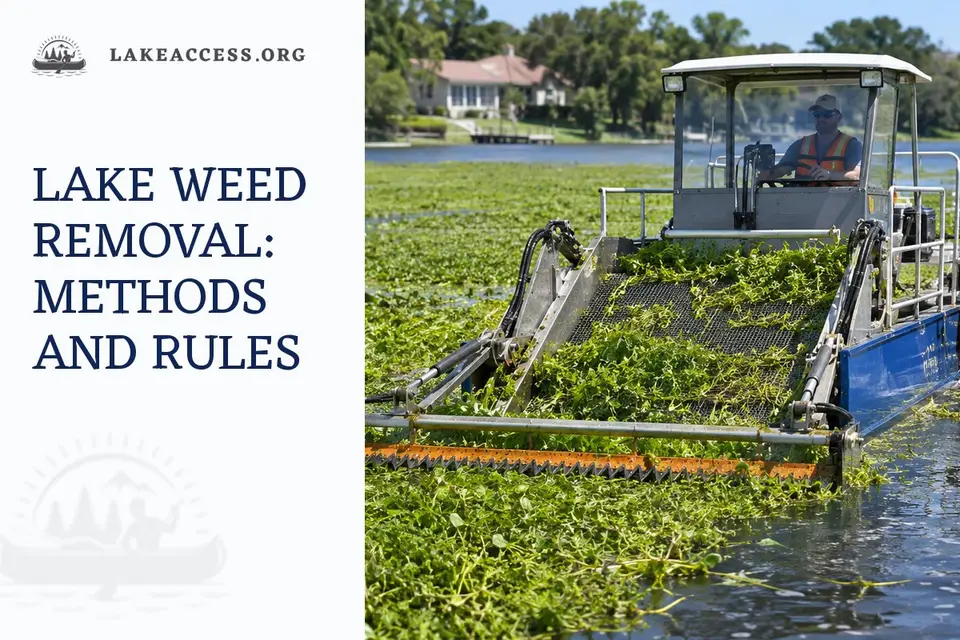
Mechanical harvesting#
A harvester cuts and collects plants, like mowing an underwater lawn. Minnesota’s invasive-species research center, writing about Eurasian watermilfoil, says it is effective at reducing plants now and useful for clearing channels and access, but it will not give long-term control, and several cuts per year may be needed. It estimates contractors charge $300 to $600 per acre per cut, and that buying a commercial harvester can cost $30,000 to $100,000. Transport and disposal of the plants are often harder than the cutting. Massachusetts adds that regrowth is expected, sometimes within weeks, and that harvesting is not recommended for species that spread by fragmentation.
Hydroraking#
A hydrorake is a floating backhoe with a rake that removes plant root masses and the sediment around them. Massachusetts lists it for waterlilies, Phragmites growing in water, and floating islands of plants, and says it is not recommended for fragmenting species. It is a contractor job.
Benthic barriers#
Benthic barriers are bottom covers that block light and restrain rooted plants. Massachusetts says they suit pioneer infestations or small areas, can affect non-target organisms, and are hard to install and maintain, as they are typically around 10 feet wide and 25 to 100 feet long. Rules differ sharply. Minnesota does not allow lake bottom barriers for plant control, while Massachusetts lists them as a method that can be permitted.
Winter drawdown#
Drawdown means lowering the water level in fall so sediments freeze and dry over winter, which can kill vulnerable plants. Massachusetts says the results depend heavily on the weather. It requires a way to control the water level, so it is a tool for lake managers, not homeowners. Minnesota’s research center notes that water-level management is generally not permitted in that state.
Herbicides and algaecides#
Herbicides are widely used because they are cheap and cover large areas, but they are the most regulated option. Minnesota’s research center explains that systemic herbicides are taken up by the plant and kill the whole plant, while contact herbicides knock the plant down but do not affect the roots. It puts professionally applied chemical control at $200 to $2,000 per acre, and notes that chemical controls often need repeating every year to every three years. The Minnesota DNR adds that product labels can restrict swimming, fish consumption and irrigation until the chemical breaks down or dilutes, and that sign posting is required.
Biological controls and dyes#
Massachusetts says very few biological controls are approved or effective and that grass carp, the best-known example, are prohibited there. Dyes that block light are an option in small ponds with limited outflow. Neither is a typical choice for a recreational lake.
Why you should not clear everything#
It can be tempting to remove every plant. The agencies mostly say not to.
- Wisconsin says aquatic plants provide significant benefit to shorelines and recommends removing only what you need for the boat and swimming.
- Minnesota does not allow removing plants where they do not interfere with swimming, boating or other recreation.
- Minnesota’s research center warns that dredging or rotovation can eliminate all plants, which reduces habitat for fish and food for waterfowl, and can destabilize sediments and make the water murky.
Dead plant material also adds to muck. The University of Florida’s lake specialists rank emergent, floating-leaf and floating plants as the biggest muck producers, so a heavy weed bed can become a muck problem later. See lake muck removal.
A practical plan for a dock and swim area#
- Identify the plants. Rules differ by plant type, for example Minnesota treats emergent plants like cattails differently from submerged plants.
- Confirm your lake’s status and your state’s rules. Know whether the lake is public water and what size of area you can clear.
- Decide the smallest area you need. A boat lane and a swim area, not the whole shoreline.
- Pull or rake by hand. Take roots where you can, collect all fragments and dispose of them on land.
- Repeat through the season. Expect regrowth and plan for several visits.
- Bring in a licensed contractor for anything bigger or chemical. Get the permit before the work starts.
Weeds are not the only reason a lake looks bad. If the water is green or scummy, see how to get rid of algae in a lake and blue-green algae in lakes. If you are deciding whether a weedy lake is safe to swim in, read how to know if a lake is safe to swim in.
Frequently asked questions#
Do I need a permit to remove weeds from my lake?
It depends on the state, the size of the area and the method. In Minnesota, a shoreline owner can cut or pull submerged plants without a permit up to 2,500 square feet under set conditions, and anything larger, plus herbicides, needs one. Wisconsin shows a 30-foot manual swath around a pier as permit-free. Massachusetts says every method except doing nothing needs some level of permitting.
How long until lake weeds grow back?
Often quickly. Massachusetts notes that regrowth after mechanical harvesting is expected, sometimes within weeks. A Minnesota research center says cutting plants is like mowing a lawn and that several removals may be needed each year.
Can I apply herbicide to my lake myself?
Usually not without a permit and, in some states, a license. Wisconsin requires a DNR permit before applying any chemical to a lake, and in almost all cases homeowners need a state pesticide applicator certification. Minnesota also requires a permit and suggests hiring a licensed applicator if you are inexperienced.
How much does professional weed removal cost?
A Minnesota research center gives ranges of about $300 to $600 per acre per cut for contracted mechanical harvesting and $200 to $2,000 per acre for professionally applied herbicide. Treat those as rough guides, since costs vary by region, plant and project.
Does cutting weeds make them spread?
For some plants, yes. Massachusetts advises against mechanical harvesting and hydroraking for species that reproduce by fragmentation, because cut pieces can root and start new plants.
Sources#
- Aquatic plant regulations, Minnesota DNR
- Manual Removal of Plants Around Your Dock, Wisconsin DNR
- Aquatic Plant Management Permit FAQs, Wisconsin DNR
- Types of Aquatic Plant Management, Mass.gov
- Eurasian watermilfoil control options, Minnesota Aquatic Invasive Species Research Center
- A Beginner’s Guide to Water Management: Muck (FA200), University of Florida IFAS
Written by
We started this blog as a place to go to when we had questions about buying our first home on the lake. There was a lot of information on the internet, but we always spent hours...