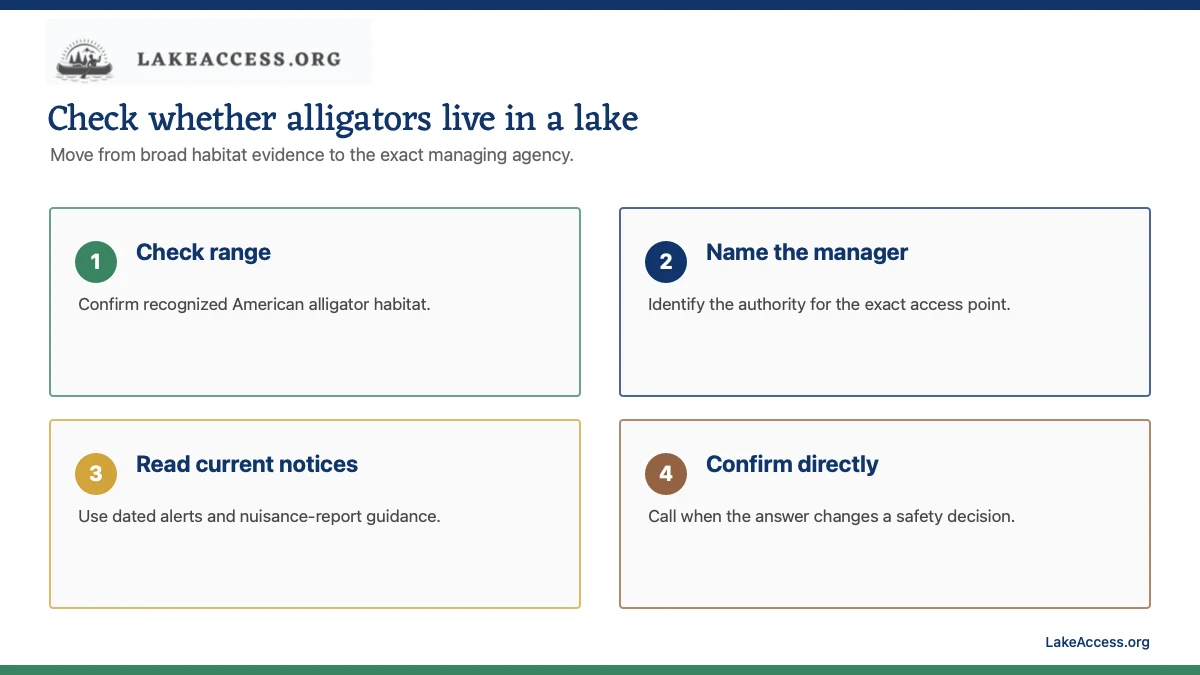
Quick answer: To check whether alligators may live in a lake, start with the American alligator range and the responsible state wildlife agency, then identify the lake manager, read current park notices and nuisance-report information, and call the manager when the answer affects swimming, pets or shoreline access. A crowd-sourced sighting can be a lead, not proof that the animal is present now or that an area is safe.
At-a-glance safety plan
| Situation | Immediate action | Do not do | Verify |
|---|---|---|---|
| Species-range check | Confirm whether the lake is within recognized habitat | Treat a national range as lake-level proof | USFWS, NPS and state species information |
| Lake and property manager | Identify who controls the exact access point | Assume the nearest city owns the shoreline | Official park, reservoir or municipal page |
| Current notice and report review | Read alerts, signs and nuisance guidance | Use an old post as current closure evidence | Dated agency notices and direct contact |
| Crowd-sourced sighting | Use only as a question for officials | Publish it as a safety determination | Date, photo context and agency confirmation |
Begin with range, habitat and the correct species
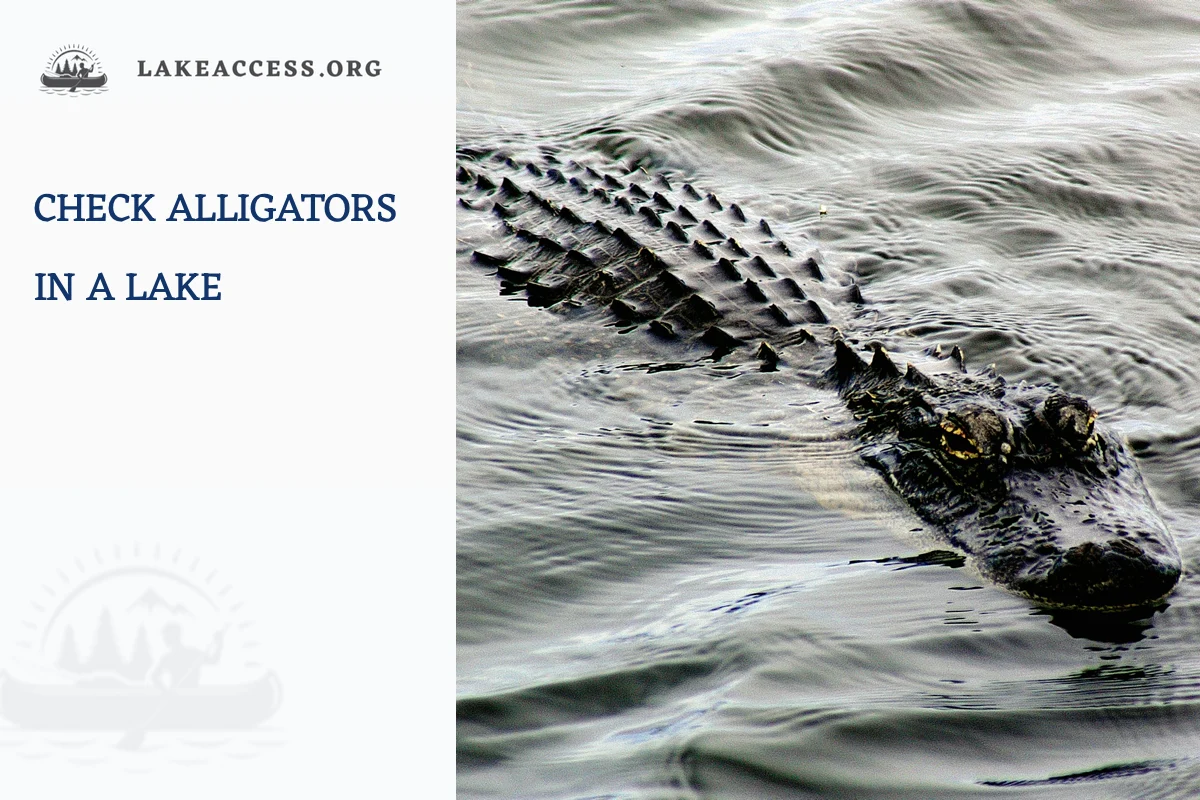
The American alligator is native to the southeastern United States and uses freshwater and brackish habitats. A range statement can make presence plausible, but it cannot show that one animal occupies a particular lake today. It also does not distinguish a verified alligator from a crocodile, caiman, floating log or an image posted from another location.
Use US Fish and Wildlife Service, National Park Service and state wildlife information to define the broad question. Then move to the state and lake manager. Do not build a lake map from generic image-search results or assume that every lake inside a state has the same habitat or population.
Identify the authority for the exact shoreline
A large lake can include state parks, federal land, private marinas, city parks and utility property. Each access point can have different notices, swimming rules and reporting contacts. Search the formal lake name, county and facility name, and confirm that the page belongs to the agency that operates the place you plan to use.
Look for dated alerts, wildlife pages, park maps, closure notices and contact information. Call when a pet, swim or camp decision depends on the answer. Ask about the exact facility and date rather than requesting a permanent yes-or-no statement for the whole lake.
Read nuisance reports as behavior records, not a census
State nuisance programs explain how concerning animals are assessed and reported, but a lack of public reports does not establish absence. Some reports are not published, some sightings need no response and an animal can move. A report from a different lake with the same name is especially easy to misapply.
Record the source, date and jurisdiction. If an official says no recent report is known, present that limited answer accurately rather than changing it to no alligators. If the agency confirms habitat, follow its general safety guidance even when no recent sighting appears online.
Use crowd sources only as secondary clues
A dated photograph with a recognizable location may justify asking the manager a specific question. An undated comment, copied image or pin without evidence cannot establish species, location or current conditions. Crowd-sourced platforms also reflect where people look and post, not a complete survey.
Never use a crowd report to encourage visitors to seek an animal, enter restricted property or declare a swimming area safe. Preserve the distinction between possible presence, official confirmation, current sighting and nuisance behavior. Those are four different claims.
Treat every sighting as wildlife, not an attraction
An American alligator resting, swimming or crossing near suitable habitat is not automatically a nuisance animal. State wildlife agencies decide whether behavior and location create a reportable conflict. Observe from a substantial distance, keep a clear retreat path and never approach for a closer photograph. If the animal hisses, turns toward you, opens its mouth or changes direction because of your presence, you are too close and should back away.
Do not touch, corner, capture or move an alligator of any size. Young animals can bite, and a protective adult may be nearby. Stay out of the route between an alligator and the water. When an animal occupies a road, launch, playground or other immediate public hazard, move people and pets away and call the responsible agency or emergency services rather than attempting a rescue.
Never feed an alligator, directly or indirectly
Feeding alligators is illegal in the states covered by the official guidance cited here and can teach an animal to associate people with food. Handing over bait is not the only problem. Throwing fish scraps, carcasses or unwanted bait into the water near an alligator can create the same association. Feeding birds, turtles or fish at the shoreline can also draw wildlife and food into one repeated human-use area.
Use a closed trash container for fish remains and food. Clean grills, pet bowls and bait areas, and do not leave a catch where an alligator can take it. A conditioned animal may approach later visitors who never fed it, and wildlife managers may then have to remove it. The safest action protects both people and the animal by keeping human food completely separate from wildlife.
Use daylight, designated areas and visible shoreline
Florida guidance says alligators are most active between dusk and dawn and recommends swimming only in designated areas during daylight. A designated swimming area is not a guarantee that wildlife cannot enter, so obey closures and posted warnings and keep watching the water. Do not swim where the managing agency prohibits it or where visibility, vegetation, weather or an observed alligator makes the choice uncertain.
At any lake, separate alligator risk from other water hazards. Depth changes, cold water, algae, current, boat traffic, lightning and a lack of lifeguards require their own checks. Never convert a general state safety tip into a claim that one named lake is safe today. The park, wildlife agency and local emergency information for the exact access point control the decision.
Keep children and pets away from the water’s edge
Official guidance consistently treats pets as especially vulnerable because their size and movement can resemble prey. Keep a dog on a short, controlled leash and well back from fresh or brackish water in alligator habitat. Do not allow a pet to swim, drink or investigate reeds, culverts, canals, ponds or an animal on the bank. Children need close adult supervision and should not play unattended at the edge.
Choose a route with open visibility and room to turn around. Avoid night walks beside water, narrow shoreline paths and places where vegetation hides the edge. Food, bowls and fish remains should stay secured. If a pet is injured by wildlife, move to safety and contact a veterinarian; do not put another person in danger by entering the water or attempting to handle the alligator.
Know what behavior warrants a report
The presence of an alligator in normal habitat generally is not enough to label it a nuisance. More concerning signs include repeated close approaches to people or boats, loss of normal wariness, occupation of a place where the animal cannot return to water safely, or an immediate threat to a person or pet. Definitions and response programs differ by state, so the local wildlife agency makes the determination.
Record the precise location from a safe place, the time, the direction the animal moved and the behavior that caused concern. Do not estimate length unless you can do so without moving closer, and do not crowd the site to gather video. Use 911 for an active attack or immediate life threat. Otherwise use the published state or park reporting channel and follow the dispatcher’s instructions.
Plan the encounter before reaching the lake
Save the managing agency’s phone number, park office, after-hours wildlife line and emergency access details before the trip. Download the park map and identify developed swimming areas, launches, fishing platforms and routes that do not force a party along an overgrown edge. Cellular coverage can fail, so keep the address or coordinates of the access point available offline.
Brief the group in plain language: do not feed, do not approach, keep pets away from water, back away when an animal changes behavior, and report hazards to officials. Assign an adult to children and pets rather than assuming everyone is watching. A short plan prevents a calm sighting from becoming a crowd, a close photograph or an improvised capture attempt.
Keep emergency advice simple and official
If an alligator is nearby, create distance and leave it an open route to the water. Do not surround it, throw objects, rev toward it or try to make it move for a photograph. In the rare event of an attack, call 911 and seek immediate medical care. This guide does not replace emergency dispatch, wildlife officers or medical professionals.
Do not repeat myths as instructions. The practical prevention steps are distance, visibility, control of food and pets, and a prompt retreat. Agency guidance can change by location and circumstance, so open the current source on the trip date. When two official instructions seem different, follow the authority managing the exact property and describe the situation accurately.
Do not turn a safety minimum into a target
Official viewing distances differ by property and state because setting, visibility and management rules differ. A published minimum is not an invitation to approach until a tape measure would reach that number. Stay farther away when the shoreline is narrow, the animal is moving, young may be present, a dog is excited or the group cannot retreat without passing closer.
Distance must be judged from the closest person or pet, not only from the photographer. A long lens and open space make observation possible without changing the animal’s behavior. When there is any doubt, leave the area and ask staff for a safer wildlife-viewing location.
Document only after everyone is safe
A useful report identifies the access point, time and observable behavior without speculation. Note whether the animal repeatedly approached, occupied a developed public area or could return to water without crossing people. Do not move closer for scale, place an object beside it or ask another person to stand near the animal.
Share photographs directly with the responsible agency when requested. Avoid a real-time public location that could draw a crowd, encourage feeding or interfere with responders. Safety evidence should help officials assess the event, not transform a normal wildlife sighting into an attraction.
Pre-trip checklist
- Confirm the exact lake, state, county and access point.
- Check recognized American alligator range and habitat.
- Open the state wildlife and managing-agency pages.
- Read current alerts, signs and nuisance-report guidance.
- Call the manager when the answer changes a safety decision.
Related LakeAccess guides
- Alligator safety at lakes
- Alligators in North Texas lakes
- Alligators in Lake Murray, South Carolina
- How to find public lake access
Sources
Wildlife rules, reporting contacts and access conditions can change. These official or high-trust sources were checked on July 24, 2026; open them again for the trip date.
- National Park Service: Everglades wildlife questions (checked July 24, 2026)
- Florida FWC: alligator facts (checked July 24, 2026)
- National Park Service: Big Thicket American alligator (checked July 24, 2026)
- South Carolina DNR: American alligator (checked July 24, 2026)
- Texas Parks and Wildlife: alligator nuisance control (checked July 24, 2026)
- Louisiana LDWF: nuisance alligators (checked July 24, 2026)