
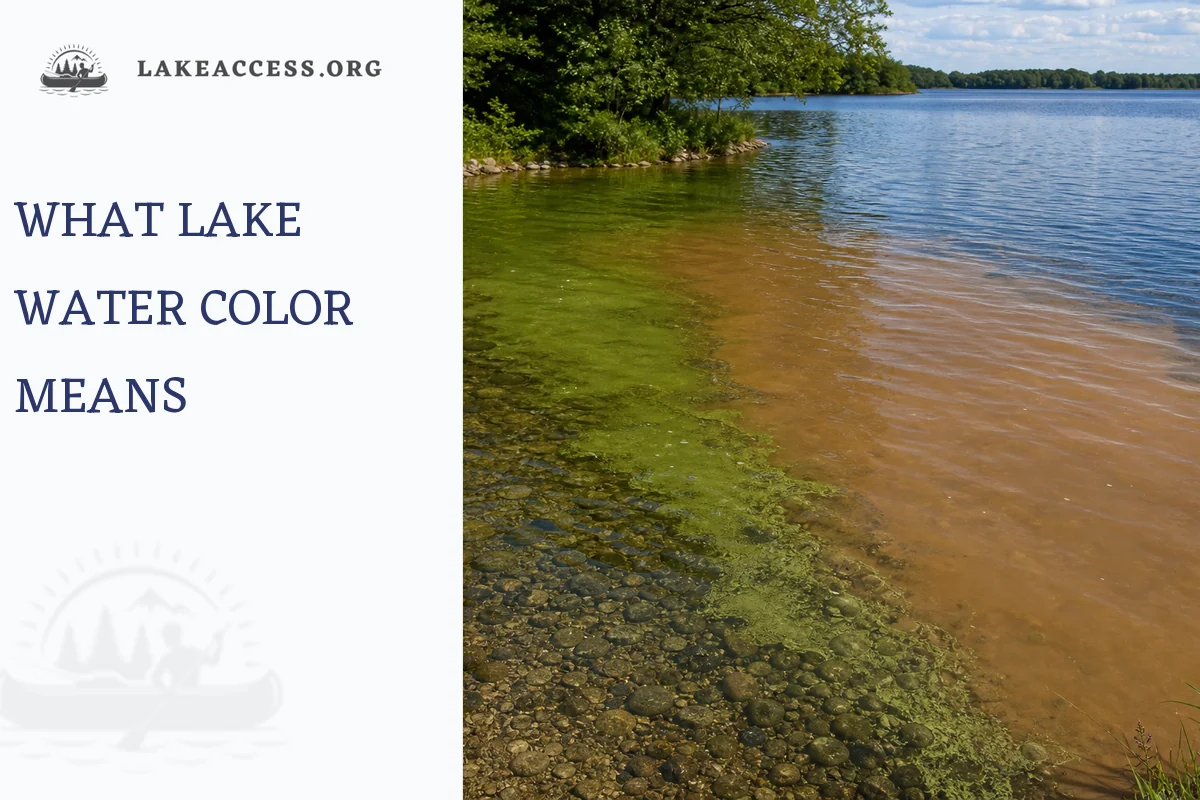
Lake water color is a clue, not a verdict. Clear water often means fewer suspended particles near the surface, green water can point to algae or cyanobacteria, brown water may come from sediment or natural tannins, and blue water is often a mix of depth, light, low suspended material, and sky reflection. None of those colors proves that a lake is safe. For swimming, boating, pets, or drinking-water questions, always check current advisories from the park, health department, lake authority, or state environmental agency.
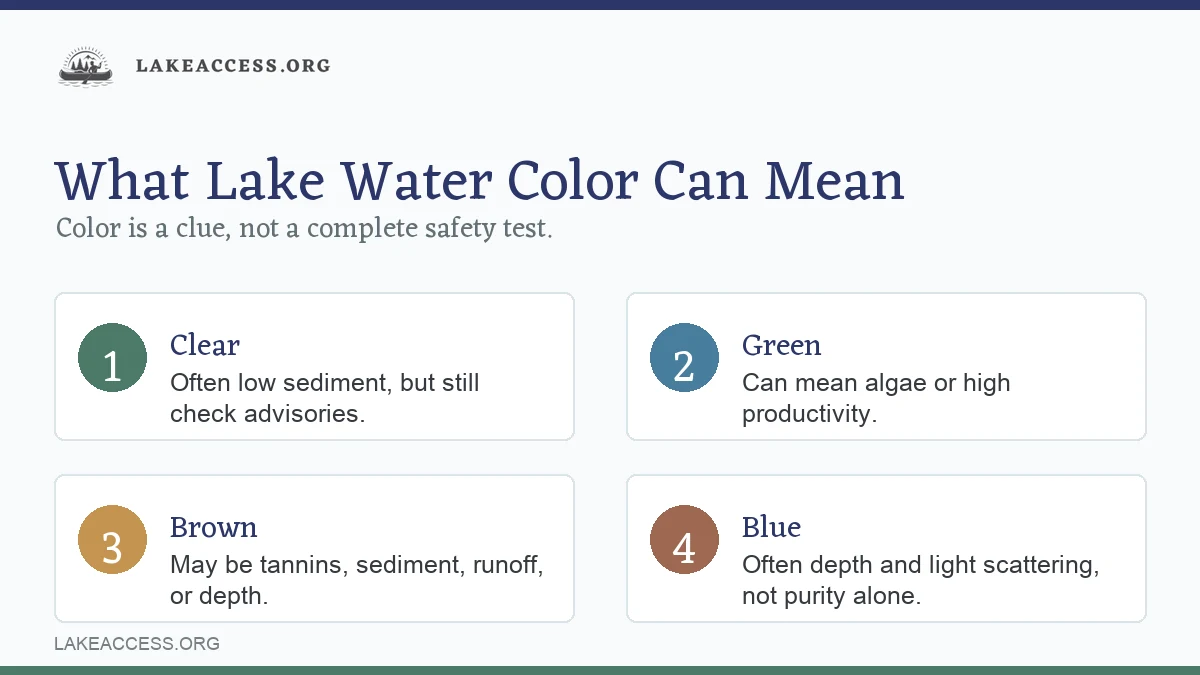
Use color as the first observation, then ask better questions: Is this normal for this lake? Did it rain recently? Is there scum, foam, odor, or dead fish? Is the beach officially open? If the water looks unusual or local officials have posted a warning, choose another access point or wait.
For broader planning, start with the LakeAccess lakes hub and outdoor guides. If your main question is whether to swim today, pair this article with how to know if a lake is safe to swim in and the dedicated guide to blue-green algae in lakes.
Quick guide to lake water colors
| What you see | Common explanation | What it does not prove | Best next step |
|---|---|---|---|
| Clear water | Low visible suspended sediment or algae near the surface | That the water is germ-free or safe to drink | Check official swim status and look for hidden hazards |
| Green water | Algae, cyanobacteria, aquatic plant material, or nutrient-rich conditions | That every green tint is toxic | Avoid scum or paint-like water and check HAB advisories |
| Brown or tea-colored water | Natural tannins, decaying plant matter, sediment, runoff, or stirred-up bottom material | That the lake is polluted or safe | Compare with normal color and avoid muddy post-storm water |
| Blue water | Deeper water, low suspended material, light absorption, and sky reflection | That the lake has no bacteria, cold shock risk, or currents | Treat it as scenic, not certified safe |
| Cloudy or milky water | Fine sediment, algae, air bubbles, or disturbed bottom material | A single cause by sight alone | Wait if conditions changed suddenly, especially after rain |
| Scummy, streaked, or paint-like water | Possible harmful algal bloom | Whether toxins are present or absent | Stay out, keep pets away, and check/report to officials |
Color is a clue, not a safety test
The biggest mistake is treating clear or blue water as “clean” and green or brown water as automatically “bad.” Real lakes are more complicated. USGS explains that natural water contains dissolved minerals and often suspended materials. Those dissolved and suspended materials can change both color and transparency.
A lake can look clear and still have bacteria, cold water, drop-offs, currents, or submerged debris. A lake can look brown because it drains through wetlands rich in natural organic matter. A lake can look green because normal algae are present, or because a bloom is forming. The same lake can look different from one cove to another, or from morning to afternoon, as wind moves surface material around.
Use this simple field sequence:
- Look at color and clarity.
- Compare it with what is normal for that lake.
- Check for scum, floating mats, unusual odor, dead fish, or recent runoff.
- Read posted signs and current online advisories.
- Make the conservative choice for the activity you are planning.
Lake Color Decision Card
- Clear or blue? Still check beach status, weather, depth, and currents before swimming.
- Green? Look for scum, paint-like streaks, pea-soup water, or bad odor. If present, stay out.
- Brown? Ask whether it is normal tannin color or fresh mud from rain, waves, or runoff.
- Changed suddenly? Treat sudden color or clarity changes as a reason to pause and verify.
- Pets or kids? Use a lower risk tolerance, especially around scum, mats, foam, or shoreline buildup.
- Still unsure? Choose another access point and contact the park, lake manager, or health department.
What clear lake water usually means
Clear water usually means light can travel farther through the water before being blocked or scattered by algae, sediment, or other suspended material. That can make swimming, snorkeling, paddling, and hazard spotting easier.
Clear water may be common in:
- Deep lakes with low suspended sediment
- Spring-fed lakes
- Rocky or sandy lakeshores with little mud
- Lakes with lower nutrient levels
- Calm conditions after particles have settled
- Cold-season periods when algae growth is lower
But clear water has limits as a signal. It does not show bacteria levels. It does not show whether a beach was affected by yesterday’s stormwater. It does not make untreated lake water safe to drink. It also does not remove physical hazards such as cold shock, sudden drop-offs, broken glass, fishing line, or boat traffic.
If you can see the bottom near shore, use that visibility well. Check for depth changes, rocks, vegetation, hooks, and soft mud before entering. For swim decisions, follow current local status first, not the postcard look of the water.
What green lake water can mean
Green lake water often points to algae or cyanobacteria suspended in the water. EPA notes that nitrogen and phosphorus influence algae and cyanobacteria concentrations in lakes, and those same nutrient conditions can affect water clarity. Some algae are a normal part of lake ecosystems. The concern rises when growth becomes dense, unusual, smelly, scummy, or bloom-like.
Green water may look like:
- A light green tint in otherwise normal water
- Pea-soup water
- Bright green streaks or swirls
- Floating dots, clumps, or mats
- Paint-like scum on the surface
- Green material collecting along the downwind shore
Not every green lake is under a harmful algal bloom advisory. The problem is that toxin risk cannot be confirmed by appearance alone. EPA explains that some cyanobacteria can produce cyanotoxins, and NYSDEC advises people and pets to avoid heavily discolored water, surface scums, and floating mats.
| Green-water sign | Risk level for casual visitors | Practical move |
|---|---|---|
| Light green tint, no odor, no scum, beach open | Use normal caution | Check current status and rinse after swimming |
| Water suddenly greener than usual | Caution | Check advisories before contact |
| Pea soup, paint-like streaks, or surface scum | High caution | Stay out and keep pets away |
| Green mats or scum at shoreline | High caution | Do not touch; report if local agency requests bloom reports |
| Green water plus dead fish or strong odor | High caution | Leave the area and notify the lake manager or agency |
Dogs deserve extra caution. They may drink lake water or lick bloom material from fur. If a dog enters suspicious green water, rinse it with clean water and contact a veterinarian quickly if it shows vomiting, weakness, drooling, stumbling, seizures, breathing trouble, or unusual behavior.
What brown lake water can mean
Brown water has two common explanations: dissolved natural color or suspended sediment. They can look similar from the dock, but they behave differently.
Tea-colored brown water often comes from tannins and other dissolved organic compounds released as leaves, roots, and wetland plants break down. USGS uses tannin-stained water as an example of dissolved color. In many wetland-influenced lakes, this is normal and long-lasting. The water may look like tea even when particles are not visibly muddy.
Muddy brown water often comes from suspended sediment. That can happen after heavy rain, shoreline erosion, boat wake, wind on shallow flats, construction runoff, stream inflow, or bottom disturbance. Sediment can reduce visibility and may carry attached nutrients or other pollutants depending on the watershed.
| Brown-water type | Clues | What to do |
|---|---|---|
| Tea-brown tannin color | Common in wetland or forested watersheds; color may be consistent through the season | Treat as normal for that lake if official status is clear |
| Muddy brown runoff | Appears after rain, flooding, or stream inflow; visibility drops suddenly | Avoid swimming until conditions clear and advisories are checked |
| Wind-stirred shallows | Brown plume over soft bottom on windy days or near boat traffic | Move to clearer water if boating; avoid contact if visibility is poor |
| Brown scum or mats | Surface material, odor, or streaks | Treat as possible bloom material and stay out |
Brown water is not automatically unsafe, but sudden brown water deserves attention. If a normally clear swim beach turns muddy after a storm, wait and check local guidance. Heavy rain and runoff can change water quality faster than routine monitoring can capture.
What blue lake water can mean
Blue lake water is often associated with depth, low suspended material, and the way light travels through water. USGS explains that even pure water has a slight blue tint when viewed through a long enough column because water absorbs more of the red end of visible light. In real lakes, blue appearance can also be influenced by sky reflection, lake depth, bottom color, viewing angle, and low algae or sediment levels.
Blue water may be common in:
- Deep open-water areas
- Clear, low-sediment lakes
- Sunny conditions with blue sky reflection
- Lakes with rocky or sandy basins
- Mountain or glacial-influenced lakes, depending on local geology
Do not turn “blue” into a safety promise. Some blue lakes are very cold. Some have steep drop-offs close to shore. Large blue lakes can have waves, currents, and offshore winds. For boating or paddling, use the LakeAccess boating hub and local marine weather. For swimming, check whether the access point is managed, monitored, and open.
How lake clarity is measured
The common field tool for lake clarity is a Secchi disk: a flat disk lowered into the water until it disappears from view, then raised until it reappears. The depth where it disappears or reappears gives a practical measure of transparency. Minnesota Pollution Control Agency volunteers use Secchi disks or tubes to measure clarity and record lake or stream observations during the monitoring season.
Secchi depth is useful because it turns “looks clear” into a repeatable observation. It can help show whether a lake is getting clearer, murkier, or changing seasonally. Still, Secchi depth is not a complete water-quality test. It does not directly identify bacteria, cyanotoxins, pesticides, metals, or every pollutant. It mainly tells you how far light can penetrate under those conditions.
Factors that can reduce clarity include:
- Algae and cyanobacteria
- Suspended clay, silt, or organic particles
- Runoff after rain
- Boat wake and wind resuspending bottom sediment
- Dissolved organic color from wetlands and decaying vegetation
- Seasonal turnover or mixing
For anglers, clarity can affect light penetration, plant growth, lure visibility, and where fish may hold. Use the LakeAccess fishing hub for trip planning, then check local fish-consumption advisories and current conditions when they matter.
When color changes should make you pause
Some lakes are naturally clear, greenish, brown, or blue. The red flag is often not the color by itself, but a change from normal.
Pause before swimming, paddling, or letting pets near the water if you notice:
- Water that turned green, brown, cloudy, or scummy suddenly
- Paint-like surface streaks
- Foam, mats, or thick shoreline buildup
- Strong musty, rotten, sewage-like, chemical, or fuel odor
- Dead fish, dead animals, or unusual wildlife behavior
- Heavy rain, flooding, or runoff entering the beach
- Posted signs that differ from what you saw online
- People leaving the water because of itching, coughing, odor, or irritation
If the issue is ordinary weeds or muck, see how to get rid of lake weeds and muck. If the issue looks like a possible bloom, do not treat it as a landscaping problem. Follow official harmful algal bloom guidance and avoid contact.
Is clear water always healthier than green or brown water?
Not always. Clear water can be a sign of low algae and sediment, but “healthy” depends on the lake type, region, season, habitat, and designated uses. Some naturally brown lakes support healthy ecosystems. Some very clear lakes may have invasive mussels filtering the water and changing the food web. Some green water reflects high productivity that may be normal in moderation but problematic when nutrients drive excessive blooms.
The better question is: healthy for what?
| Goal | What clarity can tell you | What else you need |
|---|---|---|
| Swimming | Whether you can see hazards and whether water looks normal | Beach status, bacteria/HAB advisories, weather, lifeguards |
| Boating | Visibility near ramps, shoals, and floating material | Charts, depth, wind, access rules, debris warnings |
| Fishing | Light penetration and possible fish behavior clues | Regulations, seasons, oxygen patterns, local reports |
| Wildlife viewing | Habitat conditions near shore | Disturbance rules, seasonal closures, agency guidance |
| Drinking water | Almost nothing by sight alone | Treatment, testing, and official drinking-water guidance |
The lazy rule is the useful one: color helps you decide what to check next. It does not replace the check.
What to do before you enter the water
Before swimming or wading, run a short shoreline check:
- Read posted beach, park, and advisory signs.
- Check the official website or alert page for that beach or lake.
- Look at the water from several angles, especially the downwind shore.
- Avoid scum, mats, foul odors, heavy discoloration, and fresh runoff.
- Make sure you can see near-shore hazards well enough for your group.
- Keep pets out of suspicious water.
- Recheck if wind shifts, storms arrive, or the water changes during the day.
For large lakes, remember that color and clarity do not describe current risk. Waves, structural currents, outlet currents, and rip currents can matter even when the water looks beautiful. Keep how lakes can have rip currents handy if you swim or paddle on the Great Lakes or other large open-water lakes.
Simple takeaway
Clear, green, brown, and blue lake water each tell part of the story. Clear water suggests lower visible turbidity. Green water often points to algae or cyanobacteria. Brown water may be natural tannins or sediment. Blue water usually reflects depth, light, and low suspended material. None of those colors is a safety certificate.
If the water looks normal for that lake and official advisories are clear, enjoy it with ordinary lake safety. If the color has changed suddenly, the surface looks scummy, the water smells bad, heavy rain just passed, or a posted advisory is active, stay out and choose another plan.
Sources
- USGS Water Science School, Water Color — Used for explaining why water can look blue and how dissolved and suspended materials affect natural water color.
- USGS Water Science School, Turbidity and Water — Used for turbidity, suspended sediment, and why natural surface water is rarely perfectly clear.
- EPA National Lakes Assessment Report — Used for cautious nutrient, algae, cyanobacteria, and water-clarity context in lakes.
- EPA, Learn about Harmful Algae, Cyanobacteria and Cyanotoxins — Used for harmful algal bloom, cyanobacteria, toxin, odor, recreation, and dissolved-oxygen context.
- Minnesota Pollution Control Agency, Volunteer water monitoring — Used for Secchi disk monitoring and how clarity observations are collected.
- Wisconsin DNR, Interpretive Guide to CLMN Water Quality Reports — Used for practical color categories and cautious interpretation of blue, green, brown, and clear lake appearance.
- New York State Department of Environmental Conservation, Harmful Algal Blooms — Used for advice to avoid heavily discolored water, surface scums, floating mats, and bloom material.