
Quick answer: The right pontoon horsepower begins with the exact boat’s current capacity information and manufacturer limits, then considers the expected load, intended use, altitude, configuration, and dealer-supported propeller and setup. Do not select power from a speed anecdote or use a higher output than the boat is documented to accept.
Horsepower comparison: make the boat record the first filter
A useful comparison starts by eliminating options outside the boat’s documented limits. Remaining choices still require a dealer review of the configuration and normal load.
| Question | Record to use | Do not substitute |
|---|---|---|
| What is permitted? | Exact capacity information and the boat maker’s documentation. | A similar model, year, or online listing. |
| How is it used? | Expected people, gear, water, and planned activity. | A speed claim from another boat. |
| What is installed? | Motor, rigging, tube configuration, and propeller documentation. | A generic propeller or setup chart. |
| Who confirms the fit? | Authorized dealer or qualified technician. | A forum post or a single anecdote. |
Read the boat documentation before shopping engines
A motor decision cannot begin with a target speed. Start with the capacity information and current manufacturer documentation for the exact boat. A similar length, a newer package, or a social-media example may have different construction, rigging, intended load, or permitted configuration.
If the label is missing, unreadable, or inconsistent with the boat history, pause before repowering. Ask the boat manufacturer or qualified dealer for model-specific guidance rather than attempting to reconstruct a maximum from a photograph or a generic length chart.
Describe the normal load honestly
Passenger count, gear, batteries, fuel, shade systems, electronics, towing plans, elevation, and tube configuration can change how a boat performs. Describe the common day on the water, not only the lightest possible configuration.
Use this description to ask a dealer which options are compatible with the boat and use case. It is not a promise about speed, fuel consumption, or handling; those outcomes depend on a completed setup, conditions, and operator decisions.
Treat propeller and rigging as part of the system
An outboard is installed with controls, rigging, mounting, and a propeller choice that must be appropriate to the boat and the maker’s instructions. Changing one component without reviewing the system can create performance, handling, warranty, or safety problems.
Ask a qualified marine technician to document the recommended configuration and any testing required by the relevant manufacturer. Keep the final paperwork with the boat rather than relying on an article after a later owner or accessory change.
Separate power selection from safe operation
An engine choice does not override weather, load, boating rules, passenger readiness, wake restrictions, or the operator’s responsibility. Even a documented configuration can be unsuitable for a particular outing.
Check current local rules and conditions close to departure. The conservative option is valid when wind, waves, visibility, water temperature, mechanical condition, or group comfort reduces the margin for the plan.
Start with the exact record, not a rule of thumb
Pontoon motor-horsepower selection is a decision about a particular boat, piece of equipment, trip, or site. A model-year brochure, owner manual, manufacturer label, dealer specification, trailer plate, or agency rule can be useful only when it describes the item in front of you. A broad online range is planning context; it is not permission to substitute an estimate for the record that applies to your setup.
Collect the boat manufacturer’s capacity information and any maximum-horsepower limitation before comparing options. Preserve the unit, model year, and any conditions printed with the rating. If two sources conflict, stop treating the larger number as a benefit. Ask the manufacturer, dealer, installer, or managing authority to identify the controlling document for the particular configuration.
Keep separate ratings separate
A boat capacity plate, an engine recommendation, a lift capacity, a trailer GVWR, tire-load information, and a tow-vehicle rating do not measure the same thing. They cannot safely be added together or used in place of one another. Each is tied to a purpose, a design condition, and often a specified configuration.
Write down the outboard maker’s current installation, operating, and propeller documentation in a separate line of the worksheet. This simple separation makes it easier to notice when a proposed decision relies on a rating that was never intended to answer the question. It also gives a dealer or technician a clearer starting point when a fit, loading, or installation question needs professional confirmation.
Count installed equipment and normal-use loads
Factory dry weight can omit equipment that is present when the boat is actually used. Depending on the decision, that can include an engine, batteries, fuel, anchors, safety gear, fishing gear, electronics, water, a trailer, a cover, or accessories added after delivery. Do not invent a universal allowance: use a scale, manufacturer specification, or itemized estimate suitable for the exact item.
The purpose is not to create the heaviest imaginable number. It is to avoid a reassuring number that silently leaves out equipment the boat carries every time. Mark what was measured, what was specified, and what remains an estimate so the next reviewer can see the uncertainty instead of inheriting it.
Check fit as well as capacity
A rating alone does not establish a safe fit. Length, beam, tube configuration, support geometry, trailer bunks, axle placement, water depth, dock structure, electrical service, ramp grade, and local operating conditions can affect whether the equipment is appropriate. A product can have enough nominal capacity yet still be wrong for the hull, site, or intended use.
Use manufacturer fit charts and installation instructions for the equipment type, then have a qualified dealer or installer check the physical setup when a site or support system is involved. A photo cannot show every clearance, connection, corrosion issue, or structural condition. Treat a missing detail as a reason to verify, not an invitation to assume it is favorable.
Do not turn an article into an installation instruction
This guide explains how to frame the decision; it does not certify a lift, trailer, propeller, capacity plate, vehicle, dock, or route. Electrical, structural, towing, and lifting work can have consequences beyond visible damage. Follow the current manufacturer instructions and use a qualified professional when the work exceeds ordinary owner checks.
Local shoreline, marina, HOA, state, and launch rules may impose additional limits. Verify them with the current manager or jurisdiction before buying, installing, modifying, or operating equipment. A nationwide article cannot determine the permit, inspection, setback, registration, or enforcement requirements at a particular lake.
Use a written stop rule
Set the condition that ends the decision before money changes hands or a trip begins: unreadable label, missing manual, unclear weight, incompatible fit, a condition outside the manufacturer instructions, an unresolved rule, weather beyond the plan, or a disagreement about the setup. A stop rule is not a failure to decide. It prevents urgency from being mistaken for evidence.
When the information is incomplete, choose a conservative alternative, postpone the installation or trip, or obtain a professional inspection. That response is more useful than a generic safety margin because it ties the next action to the uncertainty that actually remains.
Recheck after a meaningful change
Revisit the worksheet after adding a motor, battery bank, tower, canopy, electronics, trailer equipment, passenger plan, or shoreline structure. Repeat the check when ownership changes or when the boat is moved to a different ramp, dock, lake, or climate. The old answer may have been reasonable for the old configuration without applying to the new one.
Keep a dated copy of the sources and measurements used. That record makes it easier to diagnose a mismatch later and to ask precise questions of a dealer, insurer, installer, or marina. It also keeps an evergreen article from becoming a frozen claim about equipment or conditions that can change.
Match the source to the question
Use a federal boating source for the scope of a federal safety label, a vehicle or trailer manufacturer for its ratings, an equipment manufacturer for its model specification, and a local manager for site rules. A retailer or forum may identify a question worth checking, but it should not replace the maker or authority whose requirement applies.
Read the date and scope of every source. Product pages and manuals can change, state rules can be updated, and local operating conditions can shift rapidly. The visible Sources section is a starting point for that verification, not a promise that an article can make the final call for a reader’s boat or location.
Document the final confirmation
Before proceeding, record the exact model, serial or identification information when relevant, the document version, the person or organization consulted, and the date. For a purchase, retain the quote and configuration sheet. For a site installation, retain the approved plan and any required permits. For a trip, retain the current weather and facility check close to departure.
Clear documentation makes it easier to reverse a decision when facts change. It also reduces the chance that a future owner, operator, or family member will mistake a generic recommendation for an equipment-specific approval.
Before you buy, tow, install, or launch
Use this checklist to organize questions for the manufacturer, dealer, installer, trailer specialist, marina, or managing agency. It does not replace the current manual, label, posted rule, inspection, or professional assessment required for the specific equipment and location.
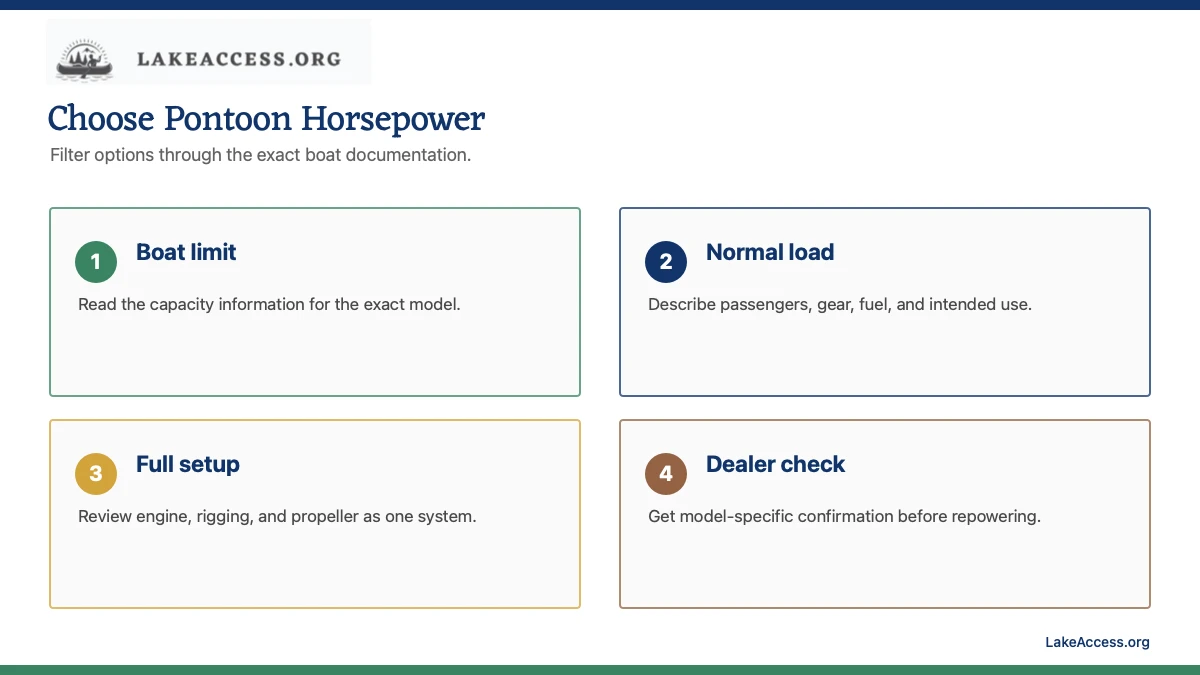
- Confirm the exact boat model, year, and capacity information.
- Describe normal people, gear, fuel, and use before comparing options.
- Use the motor maker’s current owner and installation resources.
- Obtain a dealer or qualified technician review of the complete configuration.
Related LakeAccess guides
- How fast a 150 HP pontoon boat can go
- Understanding pontoon boat dimensions
- Pontoon capacity plate explained
- Best lake boats for different uses
Sources
- US Coast Guard BoatBuilder’s Handbook: safe loading (checked July 14, 2026).
- US Coast Guard recreational boating safety (checked July 14, 2026).
- Yamaha outboard owner resources (checked July 14, 2026).
- Mercury Marine owner resources (checked July 14, 2026).
- BoatUS boat safety resources (checked July 14, 2026).