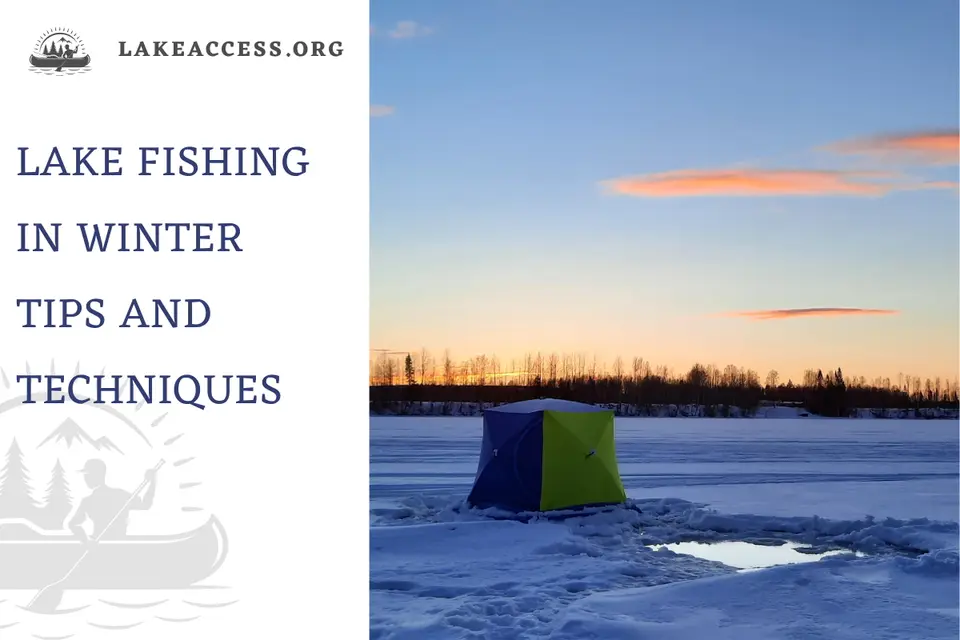
Lake Fishing in Winter: Tips and Techniques
Winter lake fishing is mostly ice fishing, and the ice comes first. Here is what state wildlife agencies, the Army Corps of Engineers and the Weather Service say about ice, cold water, fish location and bait.
On this page
Quick answer: Check the ice before you think about fish. Minnesota and Iowa both say to wait for at least 4 inches of new, clear ice before walking out to fish, and to keep measuring as you go. Never go alone, carry ice picks, a life jacket and a rope, and expect fish to be slower, to want small baits, and to bite best early and late in the day.
Ice comes first#
No agency will tell you a lake is safe. The Minnesota DNR says it does not measure ice thickness on lakes and that your safety is your responsibility. The Wisconsin DNR says there is no such thing as 100 percent safe ice, and that you cannot judge strength by one factor such as appearance, age, thickness, temperature or snow cover.
What the agencies do give is a minimum:
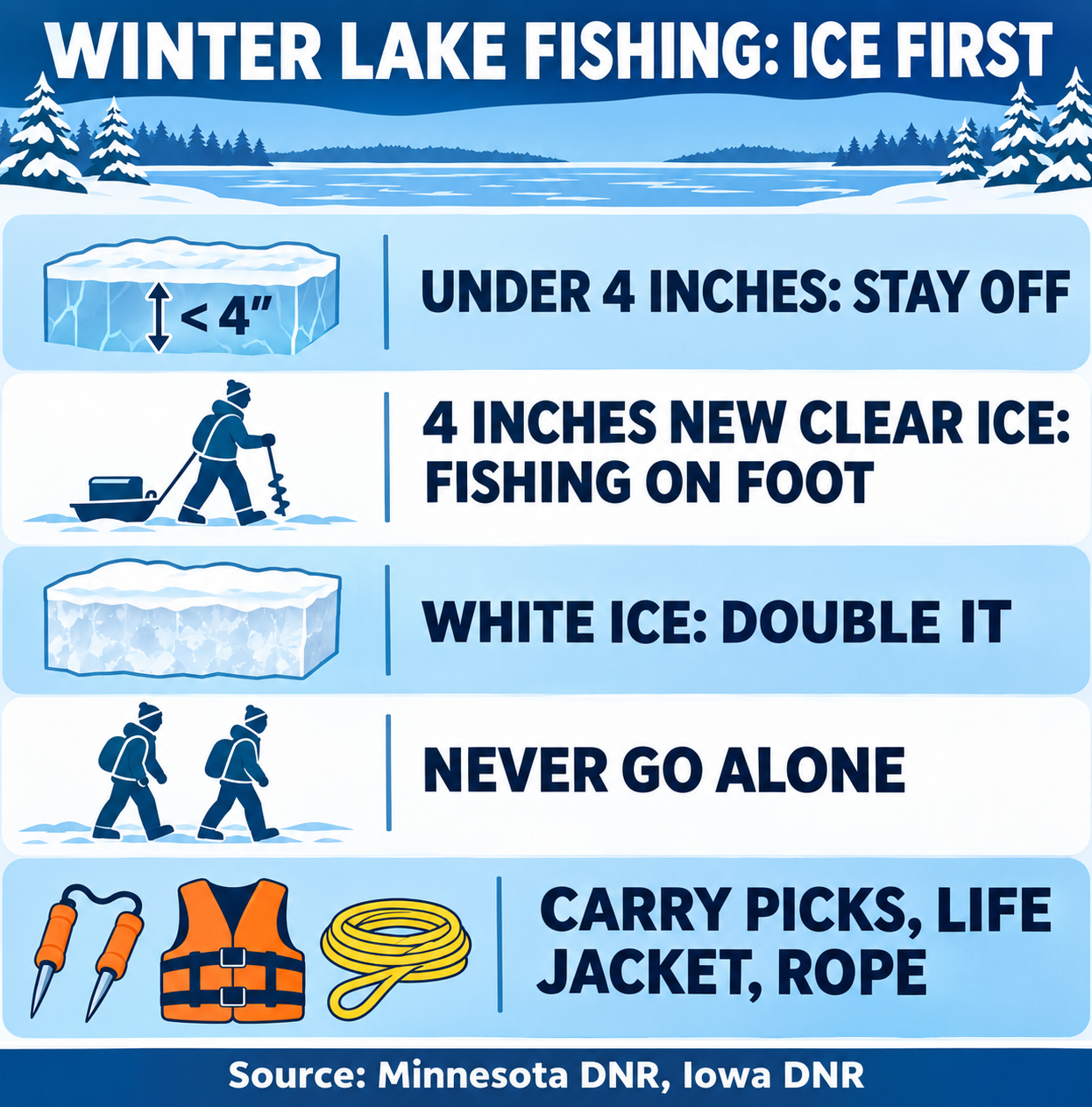
- 4 inches of new, clear ice for ice fishing or other activities on foot, and stay off anything thinner. That is Minnesota’s general guideline, and its table assumes solid, clear ice and average equipment weight. The Iowa DNR gives the same number for clear blue ice.
- Double it on white ice. Minnesota says snow that melts and refreezes on top of lake ice creates white ice that is only about half as strong as new, clear ice.
- Standing still needs more. Minnesota prints a separate table for stationary loads, and lists 6 inches of effective thickness for a person standing. If you plan to sit over one hole for hours, that is the figure to keep in mind.
You may see smaller numbers elsewhere. The U.S. Army Corps of Engineers table lists 2 inches for one person on foot, but it says the table is valid only for clear, sound ice with no flowing water underneath and is not reliable for stationary loads. For fishing, the 4-inch state guideline is the one to use.
Thickness changes across one lake#
Minnesota says ice can be two feet thick in one place and one inch thick a few yards away, and that temperature, snow cover, currents, springs and rough fish all affect it. Places to treat with suspicion, according to the agencies:
- Inlets, outlets and narrows with current (Wisconsin).
- Springs. The Corps says warm inflows from springs may create thinner ice on rivers and lakes.
- Submerged trees and emergent vegetation, where Iowa says ice tends to be weaker.
- Dark spots, discolored snow, and ice near dock bubblers or de-icers (Michigan DNR).
Weather matters too. The Corps says a rapid, large drop in air temperature can make ice brittle and possibly unsafe for 24 hours, and that once air stays above freezing for 24 hours or more, ice begins to lose strength and its table no longer applies.
How to check it#
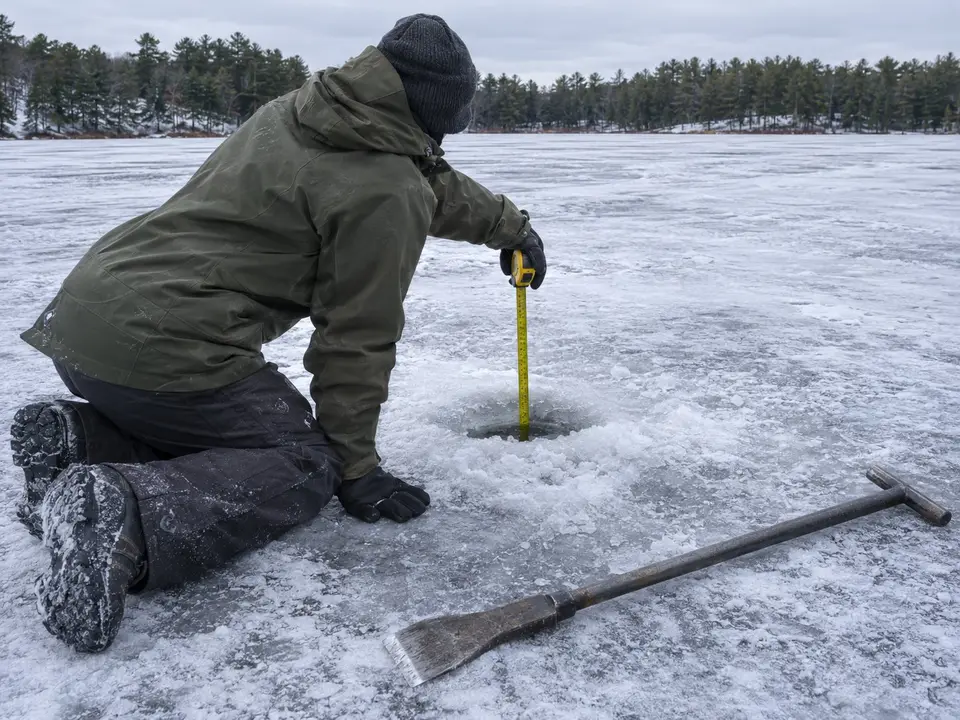
Minnesota’s ice-checking page recommends a tape measure plus an ice chisel, auger or cordless drill. Its points:
- Start near shore and stop to measure often as you go.
- With a chisel (spud bar), stab the ice in front of you with each step. If you are walking on 4 to 6 inches of ice, you will likely find spots under 4 inches on the same lake.
- Chisel checks do not replace measuring with a tape.
- Do not judge thickness by how easily the tool breaks through. It is easy to overestimate.
The Corps adds: never go out on an unknown ice sheet alone, always probe ahead with a heavy chisel, and consider wearing a personal flotation device and roping yourself to a partner.
Wisconsin also says the DNR does not monitor local ice, and that bait shops, fishing clubs and resorts often have the most current information. Michigan says the same about checking with bait shops before you go.
What to carry and wear#
Iowa’s list of safety items: hand warmers, ice cleats, ice picks worn around your neck, a life jacket, a floating safety rope, a whistle, a basic first aid kit and extra dry clothes including gloves. Wisconsin adds a cellphone in a waterproof bag and says to tell someone where you are going and when you expect to be back. Every agency we checked says not to go alone.
For clothing, Iowa recommends many thin, loose layers, a windproof and waterproof outer layer, wool socks and insulated waterproof boots. Michigan says to bring a spare pair of gloves.
An earlier version of this page suggested waterproof shoes could help keep you afloat. None of the sources say that. Flotation comes from a life jacket, and getting out comes from ice picks and a rope.
If you go through#
Wisconsin’s self-rescue steps, in short: stay calm, keep your winter clothes on because they trap air, turn back the way you came, put your arms on the unbroken ice, kick and dig in with your picks, then lie flat and roll away from the hole before standing. Get warm and dry right away, and get medical care for moderate or severe hypothermia.
Open water in winter is cold water#
If your lake does not freeze and you fish from a boat, kayak or dock, the risk changes but does not go away. The National Weather Service says cold shock causes a sudden gasp and rapid breathing that raise the risk of drowning even for confident swimmers, and that a life jacket buys time once cold shock and hypothermia set in. It lists lake boating and falls from watercraft and docks among the common ways people end up in cold water.
Its advice: always wear a life jacket, dress for the water temperature rather than the air, and file a float plan with someone you trust. Our page on lake boating in winter covers the boat side, and essential lake fishing safety tips covers the basics for any season.
Where fish hold in winter#
There is no single depth to aim for, and the sources do not agree on one:
- Many species stay low. Illinois Extension says fish metabolism slows in winter, so they feed less often but still need to eat, and most species spend the season near the bottom around points, humps, rocky outcrops or submerged trees.
- Oxygen can push them up. A separate Illinois Extension article on ponds says fish can sit deep early in winter where water is warmer, then move up the water column as oxygen in deep water drops.
- Crappie suspend. The Minnesota DNR crappie page says crappie leave colder shallow bays for deeper water after ice forms, and usually hold between surface and bottom near drop-offs, points, narrows or weedy flats, often slightly deeper than suspended bluegills. Walleye and perch, it says, typically feed within a foot or two of the bottom.
- Some stay shallow. Minnesota’s youth ice-fishing guide says bluegills and northerns like shallow water and walleyes deeper water.
A practical approach from Michigan: start near the bottom and work up until you find fish, then stay at that depth. Iowa suggests using lake maps to find creek channel edges, fish mounds, brush piles and rock piles. Our guide to reading a lake map for fishing explains the contour lines.
Bait and tackle: think small#
An earlier version of this page said artificial bait is usually best in winter because live bait is hard to keep alive, and that winter fish prefer large meals. The state guides say otherwise.
- Iowa: use small hooks, small bait and light line. Wax worms or wigglers on a small teardrop lure for bluegill and crappie; small minnows for crappie, perch, yellow bass or walleye. Keep wigglers in an insulated container next to your body so they do not freeze, and minnows in an insulated bucket.
- Minnesota: walleyes, northerns and bass eat minnows, crappies bite tiny minnows, and most panfish go for larvae and bugs in winter. Its crappie page says successful anglers often use 2- to 4-pound test line, and common crappie lures run from one-sixty-fourth to one-sixteenth of an ounce.
- Michigan: short, limber rods allow light line. Small teardrops or flies tipped with wax worms, spikes, wigglers or minnows are common, and tip-ups usually fish minnows.
Bites are light. Iowa and Michigan both recommend a spring bobber, a thin wire on the rod tip that shows a bite you may not feel. Iowa says ice rods are usually 18-24 inches long and the hole should be no larger than 10 inches; Michigan says 8 to 10 inches in diameter, and to mark holes when you leave.
For species detail, see bluegill and panfish fishing, crappie fishing in lakes and walleye fishing in lakes.
When they bite#
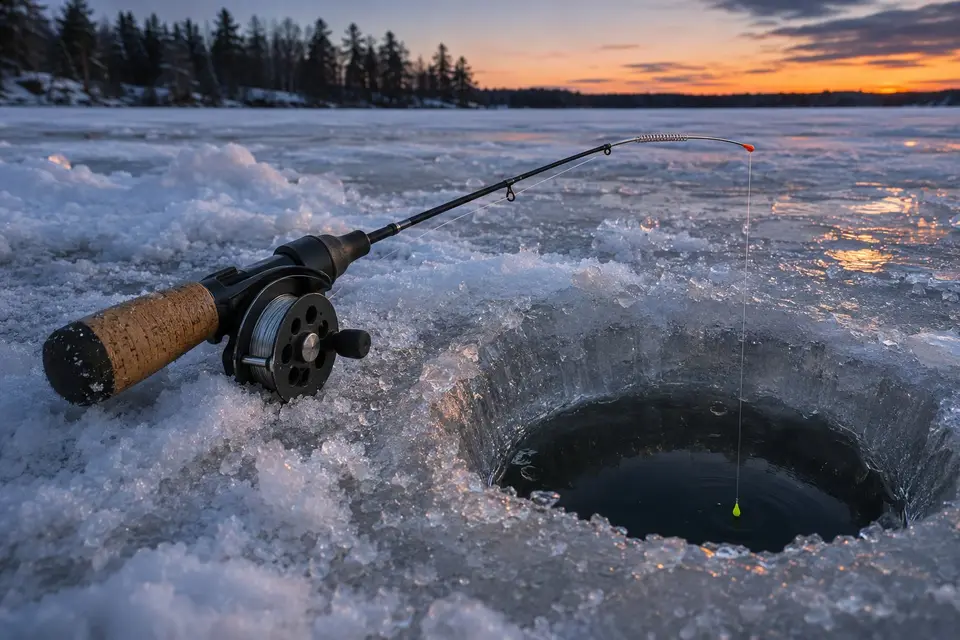
Iowa and Michigan both say fish are most active from dawn until mid-morning and from late afternoon until sundown, and Michigan says that is especially true for panfish and walleye. Minnesota’s guide says bluegills and sunfish school up and can be caught during the day, crappies and walleyes bite best just before sundown, and northerns and trout any time. Iowa says crappies often feed after sunset.
The old advice to fish only during the day does not match those sources. Night trips do bring their own risks: Wisconsin says not to travel on ice at night or in reduced visibility.
Rules and courtesy#
Check the regulations for your water. Iowa, for example, says unattended shelters must show the owner’s name or DNR number and be removed before ice melt or March 1, whichever comes first (checked November 2026 on the Iowa DNR ice fishing page). Michigan sets removal dates by zone. Minnesota’s crappie page suggests keeping crappie caught deeper than 20 feet, because fish pulled up from that depth are likely to die if released.
Pick up everything you bring: Minnesota’s guide points out that whatever is left on the ice goes into the water at thaw. More on this in lake fishing ethics and best practices. If you are planning a bigger trip, our Lake Winnipeg ice fishing guide is a worked example.
The sources we used do not cover fish-finder brands, open-water cold-weather lure choices for bass, or southern reservoirs that never freeze, so we have left those out.
Sources#
Checked November 2026: Minnesota DNR ice thickness, Minnesota DNR checking ice, Minnesota DNR crappie, Minnesota DNR ice fishing guide (2005), Wisconsin DNR ice safety, Iowa DNR ice fishing, Michigan DNR ice fishing, USACE ice loads, Illinois Extension hard water, Illinois Extension under the ice, National Weather Service cold water.
Frequently asked questions#
How thick should ice be for lake fishing in winter?
Minnesota DNR and Iowa DNR both recommend at least 4 inches of new, clear ice before you walk out to fish, and Minnesota says to stay off anything under 4 inches. Minnesota also says to double its guidelines on white ice, which is only about half as strong. No agency calls any ice 100 percent safe.
Does the DNR check ice conditions for me?
No. Minnesota DNR says it does not measure ice thickness on lakes, and Wisconsin DNR says it does not monitor local ice conditions. Wisconsin points anglers to local bait shops, fishing clubs and resorts for current information, and every agency says to measure the ice yourself as you go.
What safety gear should I bring ice fishing?
Iowa DNR lists ice cleats, ice picks worn around your neck, a life jacket, a floating safety rope, a whistle, a basic first aid kit, hand warmers and extra dry clothes. Wisconsin DNR adds a cellphone in a waterproof bag. Never go alone, and tell someone where you are going and when you will be back. See our lake fishing safety tips.
Where do fish go in a lake in winter?
It depends on the species and the lake. Illinois Extension says most species spend winter near the bottom around points, humps, rock and submerged trees, but fish may move up as oxygen in deep water drops. Minnesota DNR says crappie usually suspend between surface and bottom, while walleye and perch feed within a foot or two of the bottom.
What is the best bait for winter lake fishing?
Small live bait is the standard in state guides. Iowa DNR recommends wax worms or wigglers on a small teardrop jig for bluegill and crappie, and small minnows for crappie, perch and walleye. Minnesota DNR says most panfish go for larvae and bugs in winter. Both advise small hooks and light line.
What time of day is best for winter fishing?
Iowa DNR and Michigan DNR both say fish are most active from dawn until mid-morning and from late afternoon until sundown, especially panfish and walleye. Minnesota’s guide says bluegills can be caught during the day and crappies and walleyes bite best just before sundown. Wisconsin DNR advises against traveling on ice at night.
Written by
We started this blog as a place to go to when we had questions about buying our first home on the lake. There was a lot of information on the internet, but we always spent hours...