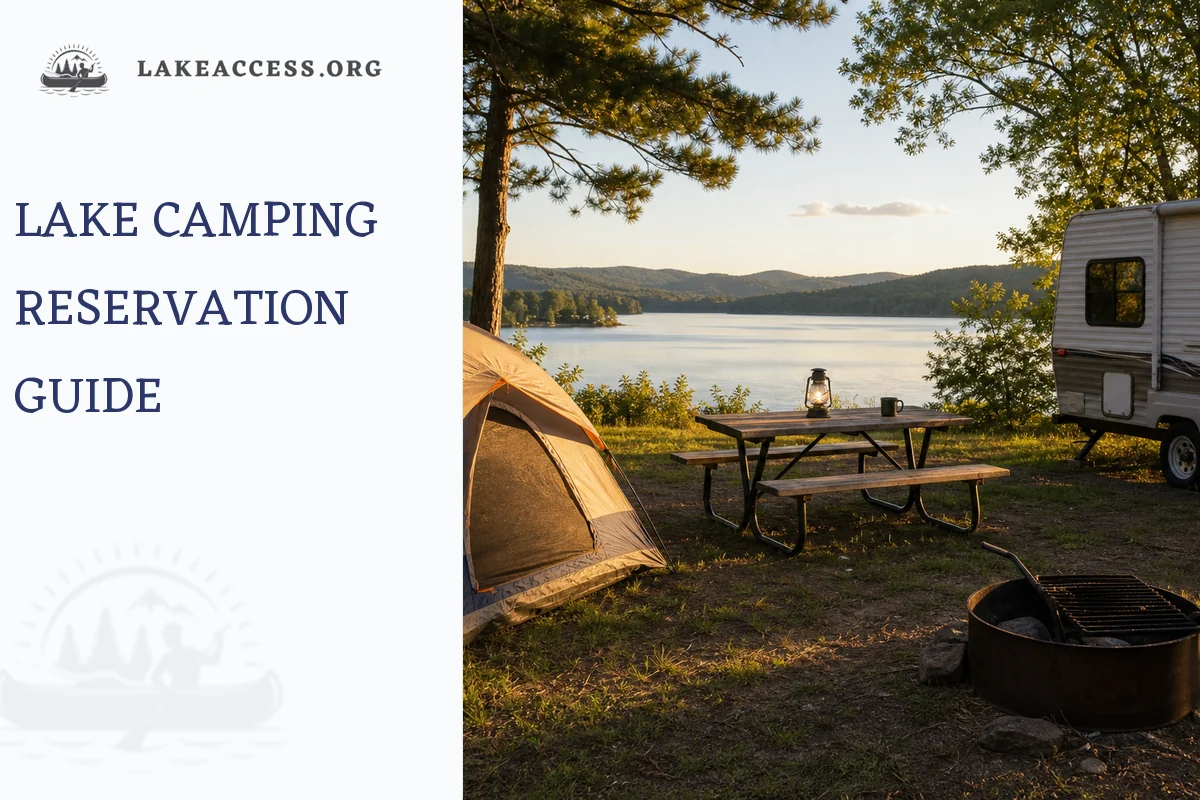
Lake camping reservations are easiest when you treat the campsite like a trip product with rules, not just a pretty spot by the water. Start on the official reservation system, check the booking window, compare the exact site details, review the total cost, read cancellation and no-show rules, and recheck alerts before arrival. Fees, seasons, release times, fire rules, lake levels, and campground policies change often, so the official park or reservation page should be the final word before you book.
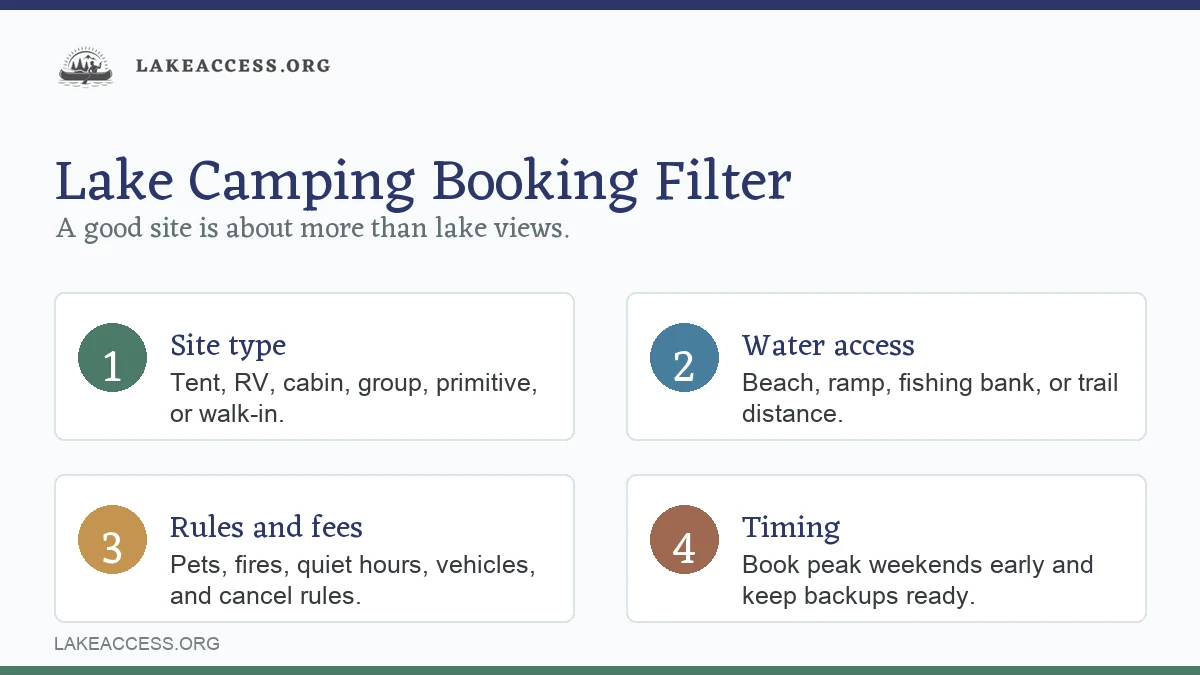
The goal is not only to get a site. It is to get the right site: one that fits your tent or RV, gives you the lake access you expect, allows your pets or boat if you are bringing them, and does not surprise you with a gate, fee, fire restriction, or minimum-stay rule at check-in.
Start with the official reservation system
Most public lake campgrounds are booked through one of a few paths:
| Campground type | Common official booking source | Best for | Watch for |
|---|---|---|---|
| Federal campground | Recreation.gov | National parks, national forests, USACE lakes, some federal recreation areas | Facility-specific booking windows, recreation fees, local alerts |
| State park campground | State park system, ReserveAmerica, ReserveCalifornia, or a state-run portal | Popular lakefront parks, cabins, yurts, RV sites, tent loops | State-specific release times, reservation fees, cancellation rules |
| County or city lake park | County/city parks department or authorized concessionaire | Local reservoirs, swim beaches, family campgrounds | Separate day-use, gate, boat launch, or vehicle fees |
| Private campground | Campground’s own website or booking engine | Resort-style lake camping, seasonal sites, marinas, rentals | Guest policies, deposits, pet rules, resort fees, cancellation terms |
| Boat-in or backcountry site | Park agency, Recreation.gov, or permit office | Quieter shoreline or island camping | Boat access, permits, weather exposure, food storage, emergency planning |
Use Google, Apple Maps, and campground directories to discover names. Use the official source to book and verify rules.
Choose the right kind of lake campsite
Before you chase availability, decide what kind of site you actually need. Lake campgrounds often mix very different site types in the same park.
| Site type | Good fit | Questions to answer before booking |
|---|---|---|
| Tent site | Simple car camping near the lake | Is the tent pad large enough? Is parking at the site or walk-in? Are hammocks allowed? |
| RV site | Travel trailers, motorhomes, camper vans | What is the max vehicle length? Are hookups 30 amp, 50 amp, water, sewer, or none? |
| Waterfront site | Sunrise views, paddling, fishing access | Is it truly waterfront or just near the lake? Is swimming allowed from the site? |
| Boat-in site | Paddlers and boaters who want shoreline solitude | Is there a dock, beach landing, or mooring? What happens in high wind or low water? |
| Cabin, yurt, or glamping unit | Less gear, shoulder-season trips | Are linens, heat, cooking, pets, and bathrooms included? |
| Group campsite | Families, clubs, scouts, reunions | What is the capacity? How many vehicles are included? Are quiet hours stricter? |
| Primitive or dispersed site | Flexible, low-service camping | Are reservations required? Are fires, toilets, potable water, and bear storage available? |
If the site map is unclear, call the campground office before paying. One phone call is easier than trying to fit a 32-foot trailer into a 24-foot spur.
The 15-minute reservation check
Use this quick sequence before you click “book.”
Lake Camping Reservation Flow
- Pick the lake and trip style. Tent, RV, cabin, group, boat-in, or primitive.
- Find the official booking page. Start with Recreation.gov, the state park system, ReserveAmerica, ReserveCalifornia, or the local park agency.
- Check the booking window. Note the release date, release time, same-day rules, and minimum-stay rules.
- Compare the actual site. Length, shade, slope, hookups, water access, restroom distance, pets, and parking.
- Review the full cost. Nightly rate, reservation fee, vehicle fee, entrance pass, boat launch fee, taxes, and cancellation fees.
- Read the rules. Arrival time, no-show cutoff, quiet hours, fire rules, food storage, pets, alcohol, and generators.
- Book and save proof. Download the confirmation, map, gate instructions, and campground phone number.
- Recheck before arrival. Look for closures, lake levels, fire restrictions, swim advisories, weather, and road alerts.
Booking windows: why timing matters
A booking window is the period before arrival when reservations become available. Recreation.gov explains that booking windows are set by individual facilities, so there is no single rule for every federal lake campground. State systems vary too. California State Parks, New York State Parks, and Oregon State Parks all publish their own reservation timing and release rules, and those rules can change.
For popular lake campgrounds, check:
- The first date your arrival night can be booked.
- The exact release time and time zone.
- Whether the site is released daily, monthly, or by season.
- Whether holidays, weekends, cabins, group sites, or boat-in sites use different rules.
- Whether a maximum booking-window reservation is locked from changes for a short period.
- Whether same-day or walk-up sites exist.
If you want a high-demand waterfront site for a holiday weekend, set the release date in your calendar and create your account ahead of time. Add your vehicle, payment method, and camper details before the release time if the system allows it.
Fees and cancellation rules are not all the same
Lake camping costs can include more than the nightly campsite rate. Fees are volatile, and even official sources revise them, so check the current checkout page before relying on any amount you saw in an old article.
| Cost or policy | Where it appears | Why it matters |
|---|---|---|
| Nightly campsite rate | Site listing or rate table | Usually varies by site type, hookups, season, and residency |
| Reservation or processing fee | Checkout or fee page | Often non-refundable, even if the campsite fee is refundable |
| Park entrance or vehicle fee | Park rules, pass page, kiosk | May be separate from camping and charged per vehicle |
| Extra vehicle fee | Campground rules | Important for group trips and families arriving separately |
| Boat launch or marina fee | Lake, ramp, or marina page | May be separate from camping reservation |
| Pet, cabin, or cleaning fee | Lodging rules | More common for cabins, yurts, and private campgrounds |
| Change/cancellation fee | Reservation policy page | Can depend on how close you are to arrival |
| No-show penalty | Reservation policy page | Can cancel the remaining nights and reduce or eliminate refunds |
Federal, state, local, and private systems handle refunds differently. Recreation.gov has its own rules and facility-specific policies. State systems such as ReserveCalifornia or ReserveAmerica-powered portals publish state-specific rules. Private lake campgrounds may use deposits, final-payment deadlines, or stricter holiday policies. Read the policy for the actual campground, not just the platform homepage.
What to check on the campsite detail page
Do not book from the calendar alone. Open the individual site page and scan the details.
Site fit
- Maximum RV or trailer length.
- Driveway surface and slope.
- Tent pad size.
- Shade and exposure.
- Number of tents, people, and vehicles allowed.
- Parking position: back-in, pull-through, parallel, or walk-in.
Utilities and facilities
- Electric amperage, water, sewer, dump station, or no hookups.
- Potable water availability.
- Restroom, shower, and trash distance.
- Picnic table, fire ring, grill, lantern pole, or food locker.
- Cell service and emergency phone access.
Lake access
- Actual distance to the water.
- Whether the site is waterfront, lake-view, or simply in a lake campground.
- Swim beach location and whether swimming is allowed.
- Boat ramp, dock, marina, or hand-carry launch access.
- Trailer parking and overflow parking.
- Water-level or ramp-depth alerts.
Rules
- Check-in and checkout times.
- Quiet hours and generator hours.
- Pet rules and leash length.
- Fire restrictions and approved fuel types.
- Food storage rules in wildlife areas.
- Alcohol, glass, fireworks, and drone restrictions.
National parks and national forests often have local rules that matter more than the general reservation system. Glacier National Park, for example, distinguishes reservation-only and first-come campgrounds and highlights food-storage requirements. Great Smoky Mountains National Park requires advance reservations for its campgrounds and publishes stay limits. Forest Service pages commonly remind campers to check fire restrictions before departure.
Lake-specific issues that can change your trip
Lake campgrounds have a few reservation problems that are less common at inland campgrounds.
| Issue | Why it matters | Best check |
|---|---|---|
| Low water | Boat ramps, beaches, docks, and shoreline sites may be less usable | Park alerts, marina page, reservoir/lake authority |
| High water or flooding | Sites, roads, and beaches can close | Park alerts, weather service, managing agency |
| Fire restrictions | Campfires may be limited to developed rings or banned | Forest, park, county, or state fire page |
| Harmful algal blooms | Swimming and pet safety can change quickly | Park page, health department, lake authority |
| Storms and wind | Boat-in sites and paddling plans may become unsafe | Local forecast and marine/lake forecast where available |
| Invasive species rules | Boats may need inspection, cleaning, or permits | State boating agency or lake authority |
| Seasonal gates | Campground may be booked but roads or amenities may be limited | Campground alerts and confirmation email |
This is why the final check should happen close to arrival, not only when you reserve.
How to book popular lake campgrounds without losing your mind
High-demand sites often disappear quickly. Keep the plan simple:
- Create your account early.
- Save two or three acceptable campgrounds, not just one perfect site.
- Know the booking window and release time.
- Filter by the essentials only: site type, RV length, hookups, pets, and accessibility.
- Take a good site before hunting for the perfect one.
- Check cancellation openings later, especially midweek.
- Avoid booking a site you cannot use; no-show penalties and late cancellations can be expensive.
If you are flexible, look beyond holiday weekends. Sunday-through-Thursday stays, shoulder-season dates, non-waterfront loops, and nearby public campgrounds can be much easier to reserve.
Reservation mistakes to avoid
| Mistake | Better move |
|---|---|
| Booking a “lake campground” without checking shoreline distance | Open the site map and photo gallery; verify waterfront versus lake-area language |
| Assuming camping includes boat launch access | Check ramp fees, launch hours, parking, and invasive species rules separately |
| Ignoring RV length | Match total vehicle/trailer length to the site’s stated maximum |
| Forgetting the second vehicle | Check included vehicle count and overflow parking rules |
| Bringing a dog without checking rules | Verify pets at campsites, beaches, trails, cabins, and swim areas |
| Counting on a campfire | Check current restrictions and allowed fuels before packing firewood |
| Arriving late without calling | Read the no-show cutoff and late-arrival instructions |
| Trusting an old fee table | Use the current official checkout page |
What to save after you reserve
Download or screenshot:
- Reservation confirmation number.
- Campground address and GPS directions.
- Site number and campground map.
- Gate code or late-arrival instructions.
- Check-in/check-out times.
- Cancellation deadline.
- Campground phone number.
- Vehicle/pass requirements.
- Fire, pet, food-storage, and generator rules.
- Boat ramp or marina rules if relevant.
Do not assume you will have service at the entrance station. Save the confirmation offline.
Related LakeAccess guides
Plan the rest of the trip with these LakeAccess resources:
- Camping guides
- Outdoor planning guides
- Lake guides
- Boating guides
- Fishing guides
- How to Find Public Lake Access Near You
- Advantages of Lake Camping
- Lake Taghkanic State Park Camping
Quick answer: how to reserve a lake campsite
Find the campground on the official booking system, check the booking window, choose a site that fits your tent, RV, group, pets, and lake-access needs, then review the full cost and cancellation rules before paying. Save the confirmation and recheck campground alerts, fire restrictions, lake conditions, weather, and arrival instructions shortly before you leave.
For the smoothest trip, book from the official page, keep one backup campground in mind, and treat all fees, seasons, release times, and policies as current-only details that need one last verification before arrival.
Sources
- Recreation.gov — used for federal camping reservation context and official booking tools.
- Recreation.gov FAQ — used for booking-window guidance and the reminder that windows vary by facility.
- Recreation.gov Rules and Reservation Policies — used for change, cancellation, no-show, and refund-policy context.
- ReserveAmerica — used for state-park and campground reservation platform context.
- California State Parks Reservations and Fees — used as a state-park example for rolling reservation windows and official ReserveCalifornia booking.
- California State Parks Booking and Fees — used for current-state examples of reservation timing, processing fees, and same-day availability cautions.
- New York State Parks camping reservations — used as a state example showing that booking windows and release times differ by system.
- Oregon State Parks reservation rules — used as a state example for booking windows, reservation fees, and same-day reservation rules.
- National Park Service Great Smoky Mountains campground regulations — used for official examples of required reservations, stay limits, and campground rules.
- National Park Service Glacier camping information — used for reservation-only versus first-come campsite context and food-storage cautions.
- USDA Forest Service Inyo National Forest camping and cabins — used for fire restriction, fire ring, and local firewood guidance.
- U.S. Coast Guard life jacket wear — used for lake boating and paddling safety language.