
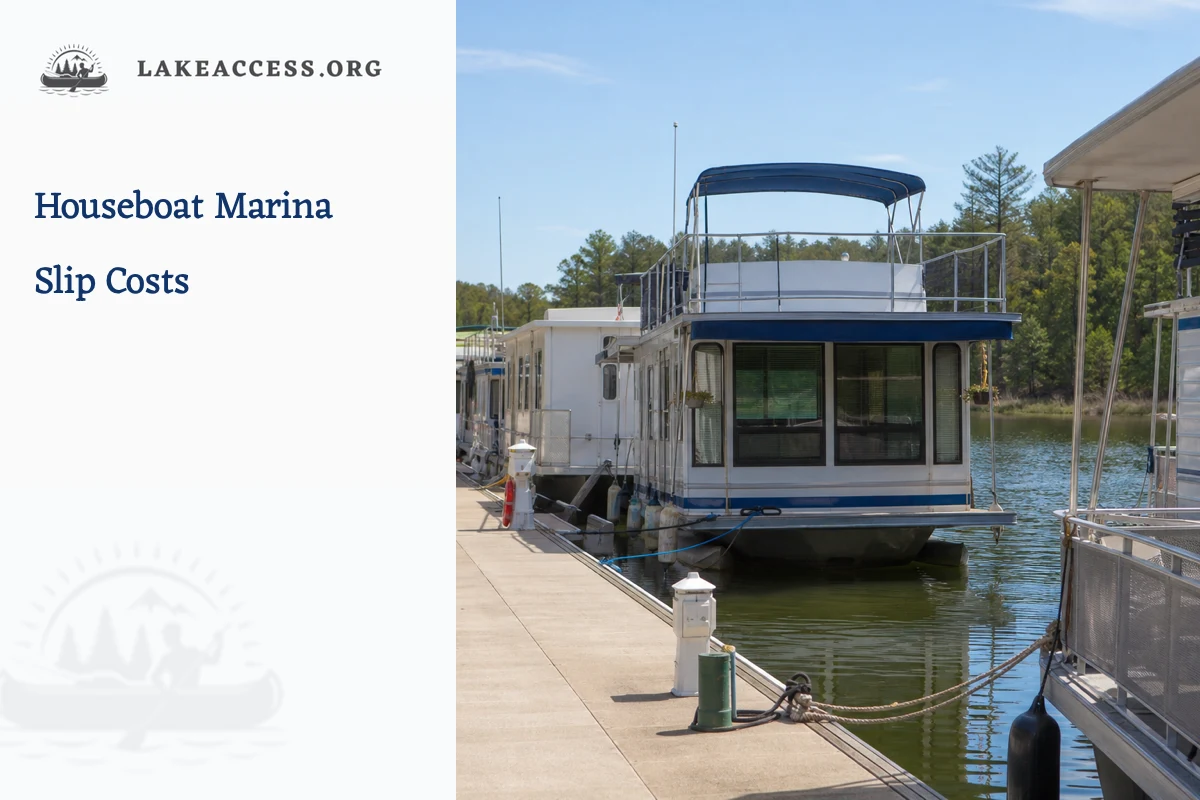
Quick answer: Houseboat slip cost depends on the specific marina’s charge basis, boat and slip dimensions, liveaboard permission, utilities, pump-out, parking, deposits, contract length, taxes, and availability. A published berth rate is not proof that the berth can be occupied as a residence.
Houseboat slip comparison: calculate the written total
Use this table for each marina. Ask the manager to confirm the current written terms; do not fill a missing line with an online average or a rule from another harbor.
| Check | What to record | Why it matters |
|---|---|---|
| Charge basis | Boat length, slip length, beam, minimum, season, or contract period | The charged measurement may be different from the boat’s advertised length. |
| Liveaboard approval | Written occupancy policy, fees, cap, wait list, and approval process | A recreational berth may prohibit or limit residence. |
| Services | Metered power, water, pump-out, parking, storage, Wi-Fi, trash, laundry | Included and optional services vary and can change the total. |
| Contract conditions | Deposit, insurance, survey, rules, cancellation, move-out, and renewal terms | The lowest rate may carry conditions that make it unavailable or unsuitable. |
Ask what measurement the marina bills
Marinas may price a berth from boat length, slip length, beam, a stated minimum, or a seasonal and contract formula. A houseboat with platforms, rails, a tender, a roof feature, or a different actual measurement can need a different fit than its advertised model length suggests. Ask what the marina measures, how it handles a boat that is shorter than the berth, and whether a minimum charge applies.
Record the answer with the unit and billing period. Do not multiply an internet rate by a guessed boat length and call it a quote. The applicable berth can be sized or priced differently, and the marina may need to inspect the boat, confirm its condition, or place it in a particular location. A written quote for the exact dimensions is the useful starting point.
Treat liveaboard permission as its own decision
A marina can allow boats while restricting residence, overnight occupancy, guests, number of occupants, pets, mail, parking, generators, storage, access hours, or waiting-list priority. It can also apply a separate liveaboard fee or cap. Ask whether the exact boat and occupants can live aboard, whether approval is current, whether there is a waiting list, and what rules are incorporated into the agreement.
Get that answer in writing before treating a berth as housing. A dock conversation, a past tenant’s experience, or a listing for a slip is not a substitute for the current policy. Local and state rules can also affect residency, vessel registration, taxes, or waste handling. Contact the relevant authority where a requirement applies instead of assuming that another waterfront community uses the same rule.
List separate service charges line by line
Electricity, water, pump-out, Wi-Fi, parking, storage, showers, laundry, trash, key access, and maintenance charges may be included, metered, seasonal, optional, or unavailable. Ask how each is billed, who provides it, and when rates or usage rules change. A rate sheet that lists only moorage is incomplete for a resident budget unless it clearly states what else is included.
Use current local figures from the marina rather than presenting a national cost. The useful comparison is not which advertises the lowest base rate; it is which written total fits the boat, occupants, use, and contract. Keep separate rows for deposits, connection charges, and required recurring services so that a one-time item does not disappear inside a monthly total.
Check pump-out and sanitation access before moving aboard
Federal and local rules govern vessel sewage differently from ordinary household wastewater, and no-discharge zones can impose additional limits. Ask the marina how its pump-out arrangement works, whether it serves the berth, what scheduling or fee applies, what holding-tank or marine sanitation requirements it expects, and what local rules apply. Do not assume a dock water connection answers a wastewater question.
EPA resources explain that recreational-vessel sewage is subject to a federal framework and that local conditions, including no-discharge zones, matter. The operational answer remains specific to the vessel, the waterbody, the marina, and current law. Follow the marina, equipment, and agency requirements and seek qualified help rather than improvising a discharge or a plumbing connection.
Compare contract terms and availability honestly
A berth can be attractive on paper yet unavailable, seasonal, short-term, subject to a deposit, or conditioned on insurance, survey, maintenance, or a minimum lease. Ask for the contract, cancellation and renewal terms, rate-change notice, storm and evacuation rules, move-out expectations, and documentation requirements. A wait list should be recorded as a wait list, not converted into assumed housing availability.
Place a clear status next to each marina: written quote received, application pending, wait-listed, unavailable, approved for liveaboard, or not approved. This protects the budget from treating a research lead as a confirmed home. It also gives the buyer or current owner a concise list of the remaining facts that must be resolved before a move or long-term commitment.
Review the fit and condition as well as the price
A liveaboard decision includes access, dock fit, water depth, mooring, weather exposure, shore power, emergency access, parking, local services, and the condition of the boat. A berth with a low rate is not automatically suitable for the specific houseboat or the systems it needs. Ask the marina what it requires and use qualified help for conditions that cannot be safely determined from a listing or photo.
Document the inspection date, manager contact, and questions that remain. When a local condition changes, such as water level, dock work, storm season, construction, or a revised rule, revisit the plan. A current, well-documented fit is more useful than an old rate sheet or an answer borrowed from a different marina.
Use this guide as a planning worksheet, not a promise
This houseboat marina-slip comparison guide explains a repeatable way to collect facts. It cannot determine the terms at a particular marina, the wording of a particular insurance contract, the condition of a particular boat, or a local legal requirement. Those details change by location, season, boat model, operator, and written agreement. Treat any number you find online as a question to verify against a current document rather than a number to copy into a final decision.
Start an evidence sheet with the current marina rate sheet, the written liveaboard policy, the exact boat dimensions, and a direct availability confirmation. Add the date, the source, the person or office that supplied it, the period it covers, and the conditions that apply. Keep quotes and rate sheets in the same folder as the worksheet. This makes it much easier to compare like with like and to spot when a monthly price hides a utility charge, a rule, a deductible, a deposit, a condition, or a required inspection.
Separate estimates from obligations
A budget estimate, a vendor description, a manufacturer recommendation, a marina rule, a state requirement, and an insurance contract do different jobs. Put each in its own line instead of treating the most convenient statement as controlling. A planning range can help identify which questions to ask, but it does not authorize occupancy, prove coverage, establish compliance, or certify a system as safe.
When two records disagree, do not solve the conflict by choosing the lower cost or the more favorable interpretation. Ask the organization that owns the rule, service, product, or policy to identify the current controlling document. For electrical, fuel, sanitation, structural, propulsion, or safety-device questions, pause the work and use the marina manager, harbor authority, and a qualified professional for any boat-condition or installation question when the manufacturer instructions or an inspection point to a condition beyond routine owner observation.
Review after a meaningful change
Revisit this worksheet when the boat changes marinas, gains equipment, changes insurers, enters a different season, is used as a residence, or develops a condition that was not part of the original plan. A quote can expire, a dock can change its policies, a renewal can change exclusions, and a utility arrangement can move from included to metered. The old answer may have been sensible for the old situation without applying to the current one.
Keep the source links and a dated summary of the decision. A useful record does not need to predict every cost or failure. It should show what was verified, what was estimated, what remains unknown, and what would cause you to stop and ask a qualified person. That approach is safer and more useful than a generic nationwide answer for a decision that is local and boat-specific.
Compare documents on the same basis
When two quotes or instructions seem to disagree, first check whether they describe the same boat, the same period, the same location, and the same service. A monthly marina price can exclude a resident fee, a policy quote can use a different deductible, and a service recommendation can apply only to a different engine or configuration. Put the assumptions next to each record before deciding that one source is cheaper, broader, or more restrictive.
Use plain labels for each answer: confirmed in a current written document, confirmed verbally and awaiting a document, estimated from a stated method, or unknown. This prevents an estimate from quietly becoming a fact as the plan moves from research to a purchase, a move, a renewal, a repair, or a seasonal change. It also gives the next person an efficient way to check the decisions that are most likely to drift.
Make the next question specific
A useful question names the boat, the use, the location, and the document needed. For example, ask a marina whether this boat can be a full-time liveaboard in this berth under the current agreement, ask an insurer which endorsement applies to this exact use, or ask a service provider which manual section controls this system. Broad questions tend to produce broad answers that cannot safely be carried into a binding decision.
Write down the answer, the person or office, and the date. If the answer changes a cost, safety measure, eligibility, or service plan, update the worksheet immediately. A documented question is also a clean handoff for a surveyor, lender, insurer, marina manager, technician, or family member who needs to understand why a choice was made and what still needs confirmation.
Keep a conservative stop rule
Pause the decision when a required document is missing, a condition is unclear, a quote does not state the intended use, an alarm or visible problem appears, a local rule is uncertain, or a professional identifies work that needs attention. Stopping at that point is not an administrative delay; it is how the plan avoids turning an unresolved assumption into an avoidable cost, claim dispute, compliance problem, or safety incident.
Choose a documented alternative, postpone the step, or obtain the correct inspection or written answer before proceeding. The practical value of a worksheet is not the number of boxes it fills. It is the discipline of showing which answers are dependable, which are provisional, and which decision has to wait for qualified evidence.
Preserve the record for the next review
Save the current documents, not just a summary. Rate sheets, policy forms, manuals, inspection reports, emails, photos, and receipts provide the wording and dates that a later review needs. At the next renewal, move, repair, or seasonal check, compare the new record to the saved one and flag every assumption that has changed before acting on it.
Before you commit
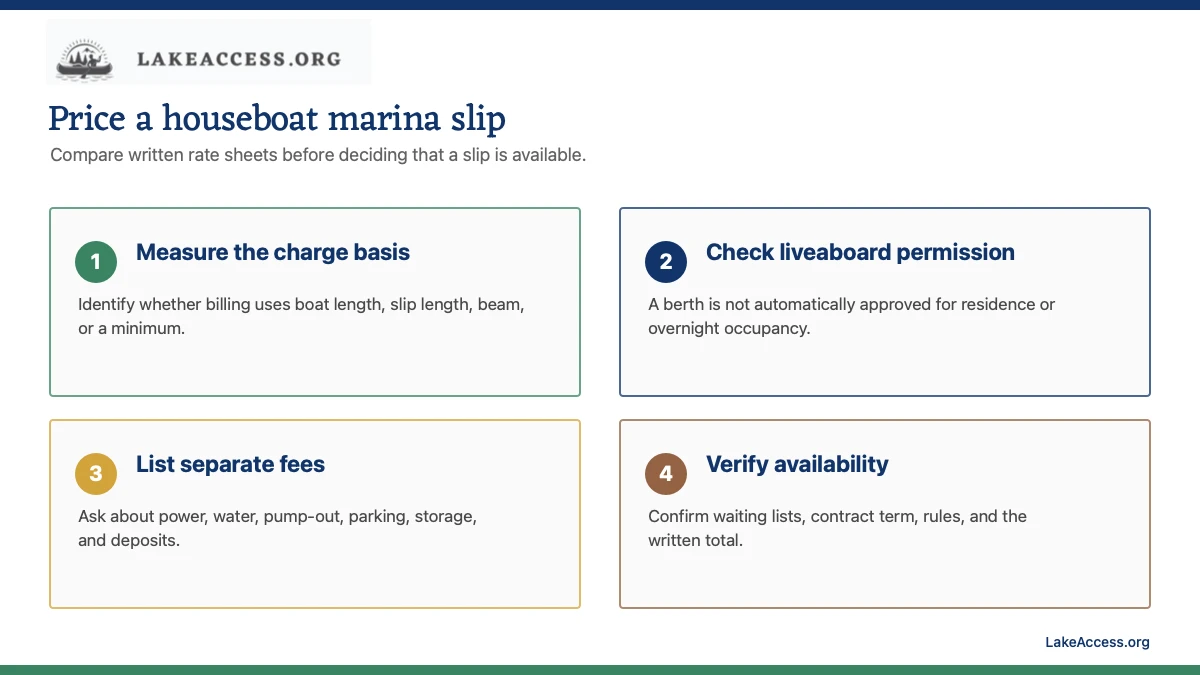
- Confirm whether charges use boat length, slip length, beam, a minimum, or another formula.
- Obtain written approval for the exact liveaboard use, occupants, and any waiting-list status.
- List each service, meter, pump-out, parking, storage, deposit, tax, and renewal charge separately.
- Read contract, insurance, survey, storm, cancellation, and move-out conditions.
- Recheck marina rules and local obligations before signing or relocating the houseboat.
Related LakeAccess guides
- Monthly houseboat living budget
- Houseboat insurance guide
- Best places to houseboat
- Living on a houseboat year-round
Sources
These sources support the verification questions in this guide. Check the current local rule, rate sheet, manual, and policy before acting.
- Maple Bay Marina 2026 moorage rate sheet (checked July 15, 2026).
- EPA: vessel sewage discharges (checked July 15, 2026).
- EPA: safe wastewater disposal for boat owners (checked July 15, 2026).
- USCG: A Boater’s Guide to Federal Requirements (checked July 15, 2026).
- USCG: Vessel Safety Check FAQ (checked July 15, 2026).