
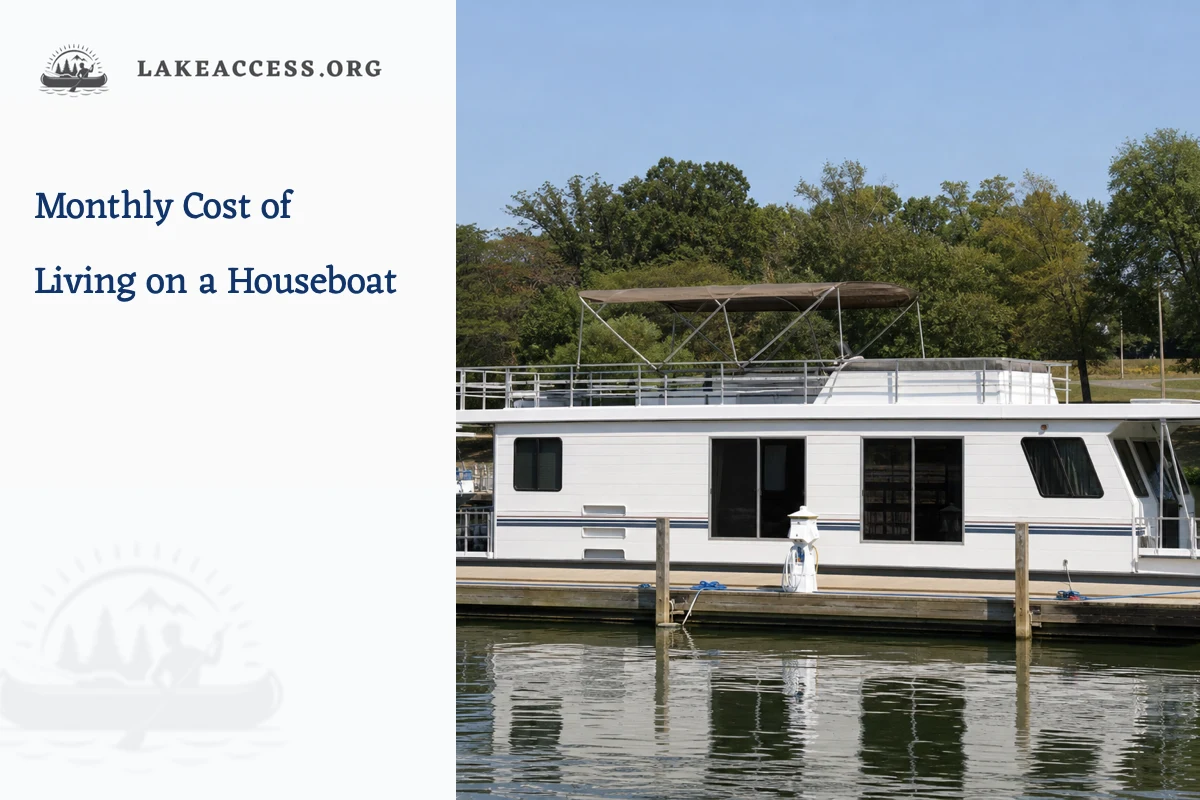
Quick answer: There is no reliable single monthly cost for living on a houseboat. Build the total from a written slip and liveaboard quote, utilities, pump-out, insurance, financing, maintenance reserve, registration or tax obligations, and internet. Use local documents and the exact boat rather than an online national average.
Houseboat monthly budget worksheet: keep every charge visible
Record the payment timing and conditions as well as the amount. A low monthly berth price can omit a liveaboard fee, metered power, a minimum length, insurance requirement, deposit, or seasonal storage.
| Check | What to record | Why it matters |
|---|---|---|
| Slip and occupancy | Rate sheet, boat/slip length, liveaboard approval, contract period, deposit | The marina may bill by a different length or restrict residence. |
| Utilities and waste | Meter terms, water, pump-out, internet, trash, and service fees | Included services and billing cycles vary by marina. |
| Insurance and finance | Coverage quote, deductible, loan payment, rate, and term | Policy terms and lender conditions must match the exact boat and use. |
| Maintenance reserve | Inspection, service history, haul-out, parts, and seasonal work | Routine and unplanned work should not be hidden inside an optimistic average. |
Start with the berth, not a national average
The place where the boat lives usually controls the first group of recurring costs. Ask for the current rate sheet and an occupancy-specific quote that names the charge basis: boat length, slip length, beam, minimum size, season, or another measure. A berth that is available for daytime use is not automatically approved for liveaboard use, and a marina can have a separate fee, a cap on resident vessels, a waiting list, or a different contract for residence.
Put the quote into the worksheet exactly as written. Note whether the price includes water, electricity, pump-out access, parking, storage, laundry, trash, Wi-Fi, taxes, or a deposit. If a rate is annual, seasonal, daily, or tied to a minimum term, record that instead of converting it into a reassuring monthly number. The goal is not a universal average; it is a local total that can survive a conversation with the dock office.
Price utilities by the actual service arrangement
A houseboat can use shore power, water, sanitation services, connectivity, fuel, and sometimes propane or other equipment. Each arrangement depends on the boat, the marina, the climate, and the way the boat is used. Ask whether power is metered, whether there is a service fee, how often pump-out is needed or provided, what water connection rules apply, and whether the marina limits heaters, extension cords, generators, storage, or residential equipment.
Keep these items as separate rows even when a manager quotes a bundled package. A bundle can change at renewal, and a meter bill can respond sharply to seasonal heating or cooling. Do not use this worksheet to design electrical or sanitation systems. Follow boat and equipment manuals, marina rules, and qualified advice for connections, waste handling, and anything that affects safety or compliance.
Treat insurance and finance as quotes, not placeholders
Insurance premiums, deductibles, navigation territory, liveaboard use, survey requirements, and exclusions are policy-specific. A lender may also require proof of coverage, a survey, an appraisal, a down payment, or a particular payment schedule. Obtain written quotes before assuming that the purchase payment plus a generic insurance line will represent the monthly cost of the exact boat and the way it will be used.
Record the effective date and what the quote assumes about location, primary residence, use, storage, age, and equipment. Compare the deductible and the terms that affect a claim rather than sorting only by premium. If financing is involved, keep interest rate, term, payment schedule, fees, and insurance conditions in separate fields. That prevents a low advertised payment from hiding a different term, an omitted fee, or a condition that changes the real monthly cash requirement.
Make maintenance a scheduled reserve
A houseboat combines hull, deck, propulsion, plumbing, electrical, safety, sanitation, and dock-related needs. The cost of keeping those systems reliable is not a stable percentage that applies to every boat. Start with the known service history, manuals, survey findings, age of systems, local climate, marina requirements, and quotes from qualified providers. Then set aside a documented reserve instead of treating maintenance as an occasional surprise.
Separate routine observation from work that needs a technician or yard. A monthly walk-around may identify a leak, worn line, alarm issue, or unfamiliar odor, but it does not diagnose a structural, electrical, fuel, propulsion, sanitation, or carbon-monoxide problem. When a condition is unclear, pause use and obtain qualified help. A budget that includes inspection and repair planning is more credible than one that assumes the boat will have no needs.
Include government and local obligations separately
Registration, documentation, property tax, sales or use tax, local licensing, and occupancy requirements are not interchangeable. The applicable rule depends on the boat, owner, state, waterbody, marina, and use. Contact the relevant state agency and marina or local authority for current obligations. Do not infer that one state’s registration practice, no-discharge zone, shoreline rule, or residence policy applies at another lake.
Add each item with the agency, due date, payment period, and reason it applies. This creates a calendar rather than a vague annual allowance. It also makes it clear when a cost belongs to the purchase, renewal, move, or ongoing operation. The worksheet can then distinguish an upfront expense from a recurring monthly charge without pretending that either is universal.
Stress-test the plan before relying on it
Build three versions of the budget using the exact same categories: a current minimum documented total, an expected total based on written quotes, and a higher scenario that preserves room for utility variation, required service, and a delayed repair. The point is not to predict the highest possible expense. It is to identify whether the decision still works when a clearly stated assumption changes.
Keep the scenario notes beside the source documents. If the plan only works when the berth is immediately available, the policy has no liveaboard limitation, utilities are fully included, and no maintenance is needed, the assumptions are doing more work than the budget. Resolve those questions before signing, moving, or treating a recreational berth as a residence.
Use this guide as a planning worksheet, not a promise
This houseboat living budget guide explains a repeatable way to collect facts. It cannot determine the terms at a particular marina, the wording of a particular insurance contract, the condition of a particular boat, or a local legal requirement. Those details change by location, season, boat model, operator, and written agreement. Treat any number you find online as a question to verify against a current document rather than a number to copy into a final decision.
Start an evidence sheet with a written marina quote, the exact boat details, current insurance quotes, and the terms of any loan. Add the date, the source, the person or office that supplied it, the period it covers, and the conditions that apply. Keep quotes and rate sheets in the same folder as the worksheet. This makes it much easier to compare like with like and to spot when a monthly price hides a utility charge, a rule, a deductible, a deposit, a condition, or a required inspection.
Separate estimates from obligations
A budget estimate, a vendor description, a manufacturer recommendation, a marina rule, a state requirement, and an insurance contract do different jobs. Put each in its own line instead of treating the most convenient statement as controlling. A planning range can help identify which questions to ask, but it does not authorize occupancy, prove coverage, establish compliance, or certify a system as safe.
When two records disagree, do not solve the conflict by choosing the lower cost or the more favorable interpretation. Ask the organization that owns the rule, service, product, or policy to identify the current controlling document. For electrical, fuel, sanitation, structural, propulsion, or safety-device questions, pause the work and use a marina manager, insurance professional, lender, or qualified marine service provider when the manufacturer instructions or an inspection point to a condition beyond routine owner observation.
Review after a meaningful change
Revisit this worksheet when the boat changes marinas, gains equipment, changes insurers, enters a different season, is used as a residence, or develops a condition that was not part of the original plan. A quote can expire, a dock can change its policies, a renewal can change exclusions, and a utility arrangement can move from included to metered. The old answer may have been sensible for the old situation without applying to the current one.
Keep the source links and a dated summary of the decision. A useful record does not need to predict every cost or failure. It should show what was verified, what was estimated, what remains unknown, and what would cause you to stop and ask a qualified person. That approach is safer and more useful than a generic nationwide answer for a decision that is local and boat-specific.
Compare documents on the same basis
When two quotes or instructions seem to disagree, first check whether they describe the same boat, the same period, the same location, and the same service. A monthly marina price can exclude a resident fee, a policy quote can use a different deductible, and a service recommendation can apply only to a different engine or configuration. Put the assumptions next to each record before deciding that one source is cheaper, broader, or more restrictive.
Use plain labels for each answer: confirmed in a current written document, confirmed verbally and awaiting a document, estimated from a stated method, or unknown. This prevents an estimate from quietly becoming a fact as the plan moves from research to a purchase, a move, a renewal, a repair, or a seasonal change. It also gives the next person an efficient way to check the decisions that are most likely to drift.
Make the next question specific
A useful question names the boat, the use, the location, and the document needed. For example, ask a marina whether this boat can be a full-time liveaboard in this berth under the current agreement, ask an insurer which endorsement applies to this exact use, or ask a service provider which manual section controls this system. Broad questions tend to produce broad answers that cannot safely be carried into a binding decision.
Write down the answer, the person or office, and the date. If the answer changes a cost, safety measure, eligibility, or service plan, update the worksheet immediately. A documented question is also a clean handoff for a surveyor, lender, insurer, marina manager, technician, or family member who needs to understand why a choice was made and what still needs confirmation.
Keep a conservative stop rule
Pause the decision when a required document is missing, a condition is unclear, a quote does not state the intended use, an alarm or visible problem appears, a local rule is uncertain, or a professional identifies work that needs attention. Stopping at that point is not an administrative delay; it is how the plan avoids turning an unresolved assumption into an avoidable cost, claim dispute, compliance problem, or safety incident.
Choose a documented alternative, postpone the step, or obtain the correct inspection or written answer before proceeding. The practical value of a worksheet is not the number of boxes it fills. It is the discipline of showing which answers are dependable, which are provisional, and which decision has to wait for qualified evidence.
Preserve the record for the next review
Save the current documents, not just a summary. Rate sheets, policy forms, manuals, inspection reports, emails, photos, and receipts provide the wording and dates that a later review needs. At the next renewal, move, repair, or seasonal check, compare the new record to the saved one and flag every assumption that has changed before acting on it.
Before you commit
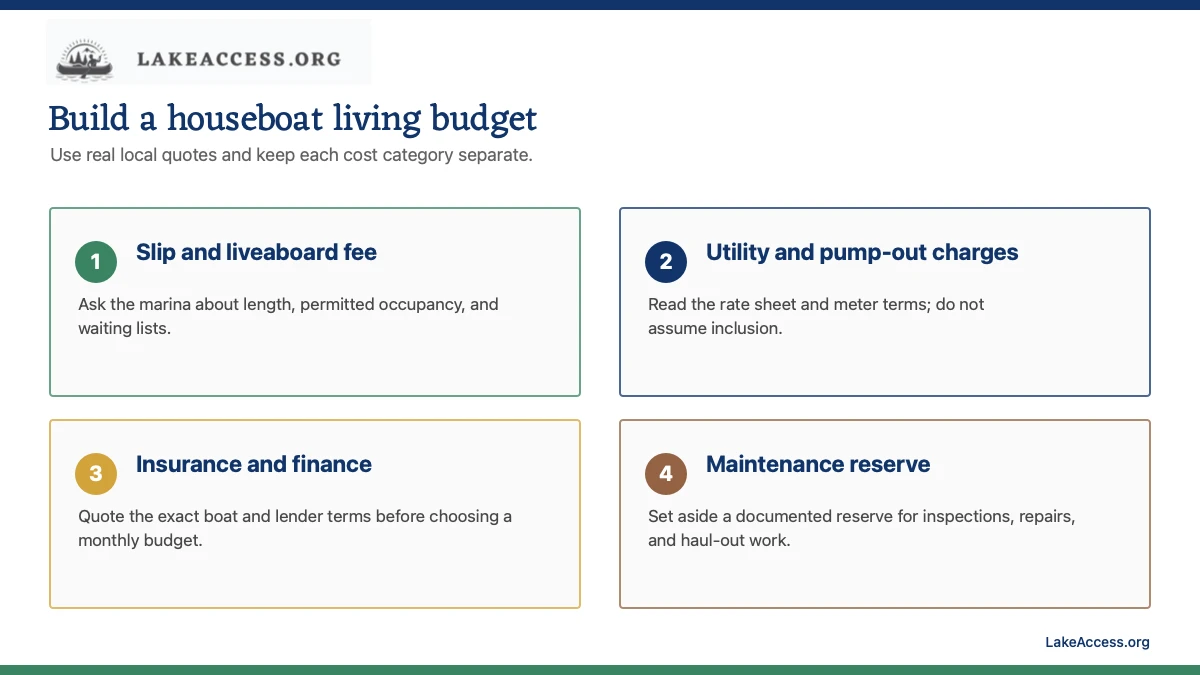
- Get a written quote for the slip and any liveaboard permission before treating a berth as available.
- List metered and separate utility, pump-out, internet, deposit, parking, and storage charges.
- Obtain insurance and finance terms for the exact boat and intended use.
- Create a dated maintenance reserve from manuals, service history, inspections, and local quotes.
- Recheck every line when the marina, boat, season, insurer, or use changes.
Related LakeAccess guides
- How much a houseboat costs to buy
- Whether you can legally live on a houseboat
- Places to live on a houseboat year-round
- Houseboat marina slip costs and liveaboard fees
Sources
These sources support the verification questions in this guide. Check the current local rule, rate sheet, manual, and policy before acting.
- BoatUS: line up insurance and financing before an offer (checked July 15, 2026).
- NAIC: consumer property-insurance guidance (checked July 15, 2026).
- Maple Bay Marina 2026 moorage rate sheet (checked July 15, 2026).
- USCG: A Boater’s Guide to Federal Requirements (checked July 15, 2026).
- USCG: Vessel Safety Check FAQ (checked July 15, 2026).