
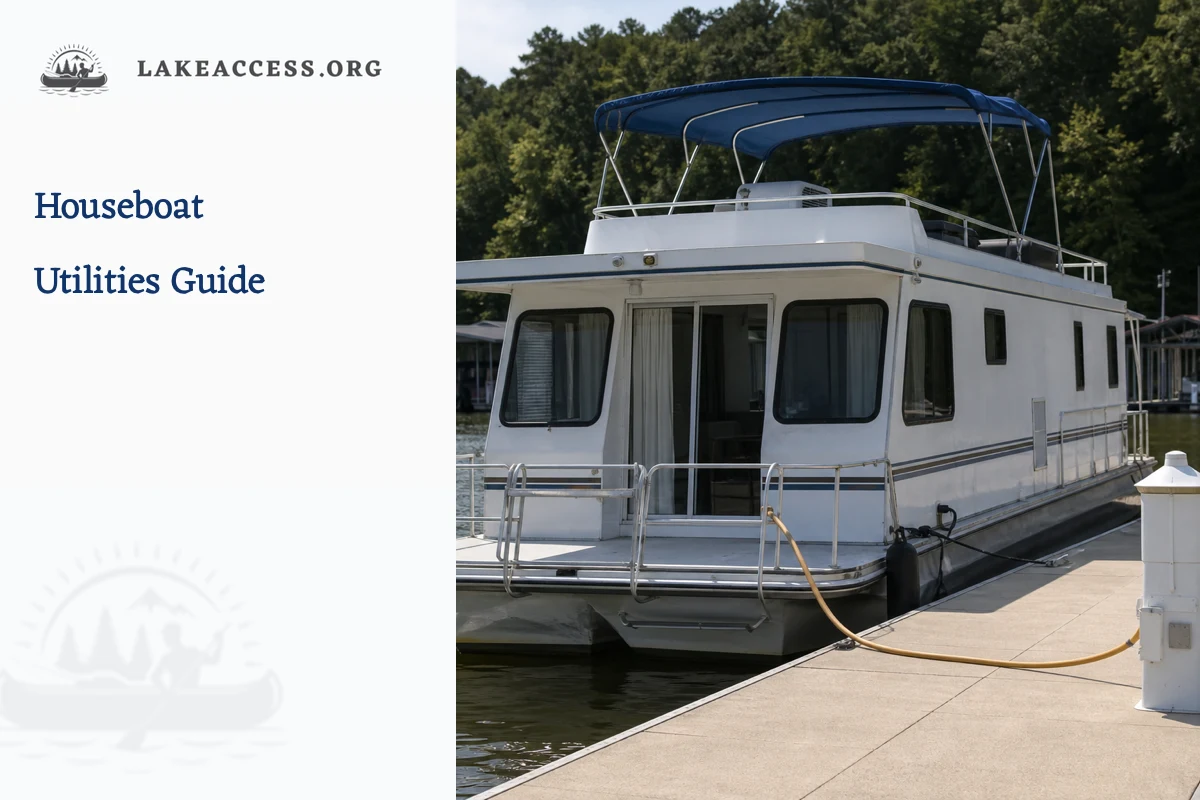
Quick answer: Houseboat utilities should be planned from the specific boat and equipment manuals, current marina rules, and local sewage requirements. Verify shore-power configuration, potable-water procedures, holding-tank and pump-out arrangements, carbon-monoxide risks, internet availability, and backup plans with qualified help where needed.
Houseboat utility worksheet: verify each connection and responsibility
Use the current manuals and local rules for the actual boat. This article is not a wiring, plumbing, fuel, sanitation, generator, or installation instruction.
| Check | What to record | Why it matters |
|---|---|---|
| Shore power | Boat inlet, pedestal type, cord, protection, inspection and marina rules | Electrical compatibility and condition must be confirmed for the exact system. |
| Fresh water | Source, hose hygiene, storage, tank condition and restrictions | Potable-water handling is local and equipment-specific. |
| Toilets and waste | Marine sanitation device, holding tank, pump-out access and local limits | Federal, state, waterbody, and marina requirements can apply. |
| Internet and backup | Available service, coverage test, power needs and outage plan | Connectivity and backup capacity depend on the location and installed equipment. |
Identify the installed shore-power system before using it
A shore-power plan begins with the actual boat inlet, cord, pedestal, breaker, protection equipment, labels, condition, and manufacturer instructions. Do not assume that a nearby outlet, an adapter, a cord, or a familiar amperage label makes a connection appropriate. Marina policies may limit how connections are made, what equipment is allowed, and who may inspect or repair a system.
If the inlet, cord, pedestal, breaker, corrosion protection, wiring history, heat, damage, or compatibility is unclear, stop and use a qualified marine electrician or other appropriate professional. Do not use this guide as an installation procedure. An electrical issue can create shock, fire, corrosion, or equipment damage risks that cannot be safely resolved from a generic online description.
Plan potable water as a source-to-tank workflow
Ask the marina which water source is intended for potable use, what hose and connection practices it requires, how seasonal shutdowns work, and whether a water connection is available at the berth. The boat’s tank, plumbing, filters, heaters, and storage conditions also matter. A dock connection is not proof that every onboard component is clean, compatible, or ready for a particular season.
Keep potable-water equipment separate from equipment used for waste, fuel, or cleaning. Follow the current boat and equipment instructions for tank care, filters, winterization, and sanitation. When water quality, a connection, a tank, or a component is uncertain, seek guidance from the marina, manufacturer, or qualified technician rather than assuming that clear water or a working faucet resolves the question.
Use the sanitation system and pump-out rules that apply locally
EPA explains that vessel sewage is regulated under a federal framework and that no-discharge zones can impose additional restrictions. The exact houseboat may use a marine sanitation device, holding tank, portable system, or other equipment with specific instructions. The local marina may add pump-out scheduling, access, fee, and operational rules. Verify the current requirements with the appropriate agency and marina before relying on a disposal arrangement.
Never turn an article into permission to discharge waste. Confirm the equipment condition, valves, labels, capacity, pump-out process, and local rules for the actual waterbody. If a system is damaged, unfamiliar, leaking, or inconsistent with the boat manual, pause use and obtain qualified service. Proper waste handling protects water quality and avoids treating a local compliance question as a generic lifestyle tip.
Manage carbon monoxide as a boating safety issue
Carbon monoxide can accumulate in and around a boat from engines, generators, neighboring vessels, and other sources. Coast Guard resources emphasize knowing exhaust outlets and maintaining equipment. Houseboats can also present enclosed-space, sleeping-area, docked-neighbor, and generator-use considerations that deserve attention from the actual boat manuals and qualified service providers.
Follow manufacturer instructions for detectors and safety equipment, keep safety systems maintained, and obtain a Vessel Safety Check or other qualified review when appropriate. Do not diagnose exhaust, ventilation, fuel, or electrical issues from an odor, a detector silence, or an online checklist. If there is an alarm, suspected exhaust intrusion, or unexplained symptom, follow emergency guidance and seek qualified help before resuming use.
Treat internet and backup power as separate availability checks
Marina Wi-Fi, cellular coverage, satellite options, local internet providers, and backup power arrangements differ by location. Test the service where the boat will actually be moored and record the provider, plan, signal, data limits, equipment power needs, and outage conditions. A coverage map, a neighboring boat’s experience, or a provider’s broad claim is not a guarantee of usable service at a particular berth.
Do not use an internet plan as a reason to improvise electrical work or generator use. Keep the backup plan within the limits of the installed equipment, manuals, marina policy, and applicable rules. For any battery, charger, inverter, generator, shore-power, or wiring modification, use qualified help and correct documentation rather than relying on a generalized how-to guide.
Build a seasonal utility checklist
Before a heat wave, freezing period, storm season, move, or extended absence, review the boat manuals and marina notices for water, shore power, sanitation, fuel, ventilation, lines, access, and communications. Ask what the marina expects during a closure, outage, evacuation, or water-level change. A plan should name the person responsible for each task and the condition that triggers a call to a professional.
Keep a dated log of inspections, service, alarms, outages, meter readings if applicable, and changes in marina policy. This record helps identify whether a recurring issue needs professional diagnosis and prevents an old answer from being reused after the boat or berth changes. The best utility plan is current, documented, and conservative about what should not be done without qualified help.
Use this guide as a planning worksheet, not a promise
This houseboat utilities planning guide explains a repeatable way to collect facts. It cannot determine the terms at a particular marina, the wording of a particular insurance contract, the condition of a particular boat, or a local legal requirement. Those details change by location, season, boat model, operator, and written agreement. Treat any number you find online as a question to verify against a current document rather than a number to copy into a final decision.
Start an evidence sheet with the boat and equipment manuals, the marina’s written utility rules, and current agency guidance for the waterbody. Add the date, the source, the person or office that supplied it, the period it covers, and the conditions that apply. Keep quotes and rate sheets in the same folder as the worksheet. This makes it much easier to compare like with like and to spot when a monthly price hides a utility charge, a rule, a deductible, a deposit, a condition, or a required inspection.
Separate estimates from obligations
A budget estimate, a vendor description, a manufacturer recommendation, a marina rule, a state requirement, and an insurance contract do different jobs. Put each in its own line instead of treating the most convenient statement as controlling. A planning range can help identify which questions to ask, but it does not authorize occupancy, prove coverage, establish compliance, or certify a system as safe.
When two records disagree, do not solve the conflict by choosing the lower cost or the more favorable interpretation. Ask the organization that owns the rule, service, product, or policy to identify the current controlling document. For electrical, fuel, sanitation, structural, propulsion, or safety-device questions, pause the work and use a qualified marine electrician, plumber, engine technician, sanitation professional, marina manager, or other appropriate specialist when the manufacturer instructions or an inspection point to a condition beyond routine owner observation.
Review after a meaningful change
Revisit this worksheet when the boat changes marinas, gains equipment, changes insurers, enters a different season, is used as a residence, or develops a condition that was not part of the original plan. A quote can expire, a dock can change its policies, a renewal can change exclusions, and a utility arrangement can move from included to metered. The old answer may have been sensible for the old situation without applying to the current one.
Keep the source links and a dated summary of the decision. A useful record does not need to predict every cost or failure. It should show what was verified, what was estimated, what remains unknown, and what would cause you to stop and ask a qualified person. That approach is safer and more useful than a generic nationwide answer for a decision that is local and boat-specific.
Compare documents on the same basis
When two quotes or instructions seem to disagree, first check whether they describe the same boat, the same period, the same location, and the same service. A monthly marina price can exclude a resident fee, a policy quote can use a different deductible, and a service recommendation can apply only to a different engine or configuration. Put the assumptions next to each record before deciding that one source is cheaper, broader, or more restrictive.
Use plain labels for each answer: confirmed in a current written document, confirmed verbally and awaiting a document, estimated from a stated method, or unknown. This prevents an estimate from quietly becoming a fact as the plan moves from research to a purchase, a move, a renewal, a repair, or a seasonal change. It also gives the next person an efficient way to check the decisions that are most likely to drift.
Make the next question specific
A useful question names the boat, the use, the location, and the document needed. For example, ask a marina whether this boat can be a full-time liveaboard in this berth under the current agreement, ask an insurer which endorsement applies to this exact use, or ask a service provider which manual section controls this system. Broad questions tend to produce broad answers that cannot safely be carried into a binding decision.
Write down the answer, the person or office, and the date. If the answer changes a cost, safety measure, eligibility, or service plan, update the worksheet immediately. A documented question is also a clean handoff for a surveyor, lender, insurer, marina manager, technician, or family member who needs to understand why a choice was made and what still needs confirmation.
Keep a conservative stop rule
Pause the decision when a required document is missing, a condition is unclear, a quote does not state the intended use, an alarm or visible problem appears, a local rule is uncertain, or a professional identifies work that needs attention. Stopping at that point is not an administrative delay; it is how the plan avoids turning an unresolved assumption into an avoidable cost, claim dispute, compliance problem, or safety incident.
Choose a documented alternative, postpone the step, or obtain the correct inspection or written answer before proceeding. The practical value of a worksheet is not the number of boxes it fills. It is the discipline of showing which answers are dependable, which are provisional, and which decision has to wait for qualified evidence.
Preserve the record for the next review
Save the current documents, not just a summary. Rate sheets, policy forms, manuals, inspection reports, emails, photos, and receipts provide the wording and dates that a later review needs. At the next renewal, move, repair, or seasonal check, compare the new record to the saved one and flag every assumption that has changed before acting on it.
Before you commit
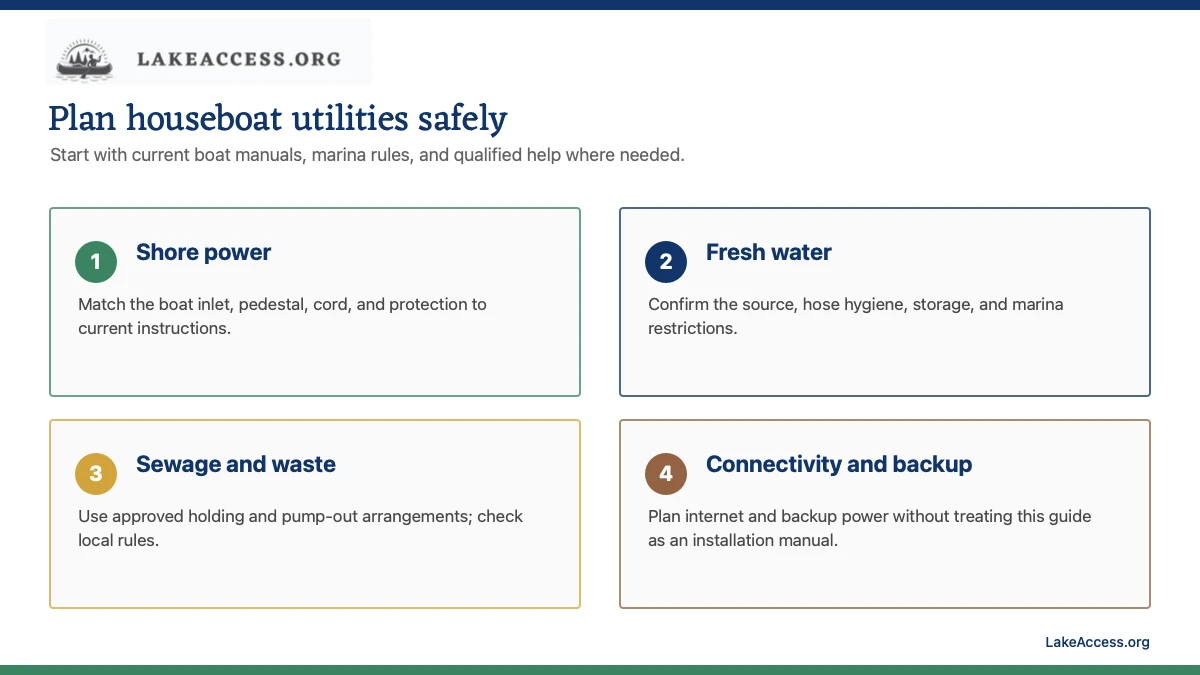
- Confirm shore-power compatibility and condition from the actual boat, pedestal, cord, manuals, and marina rules.
- Verify potable-water source, hose practice, storage, seasonal plan, and equipment guidance.
- Confirm the local pump-out and no-discharge requirements for the houseboat sanitation system.
- Maintain carbon-monoxide safety equipment and obtain qualified help for any alarm or system concern.
- Test connectivity at the berth and keep any backup plan inside documented equipment and marina limits.
Related LakeAccess guides
- How to use shore power on a boat
- How to empty a boat toilet
- Whether you can legally live on a houseboat
- Houseboat maintenance schedule
Sources
These sources support the verification questions in this guide. Check the current local rule, rate sheet, manual, and policy before acting.
- EPA: vessel sewage discharges (checked July 15, 2026).
- EPA: recreational boater guide to vessel sewage (checked July 15, 2026).
- USCG: carbon monoxide protection (checked July 15, 2026).
- USCG: carbon monoxide checklist (checked July 15, 2026).
- USCG: A Boater’s Guide to Federal Requirements (checked July 15, 2026).