
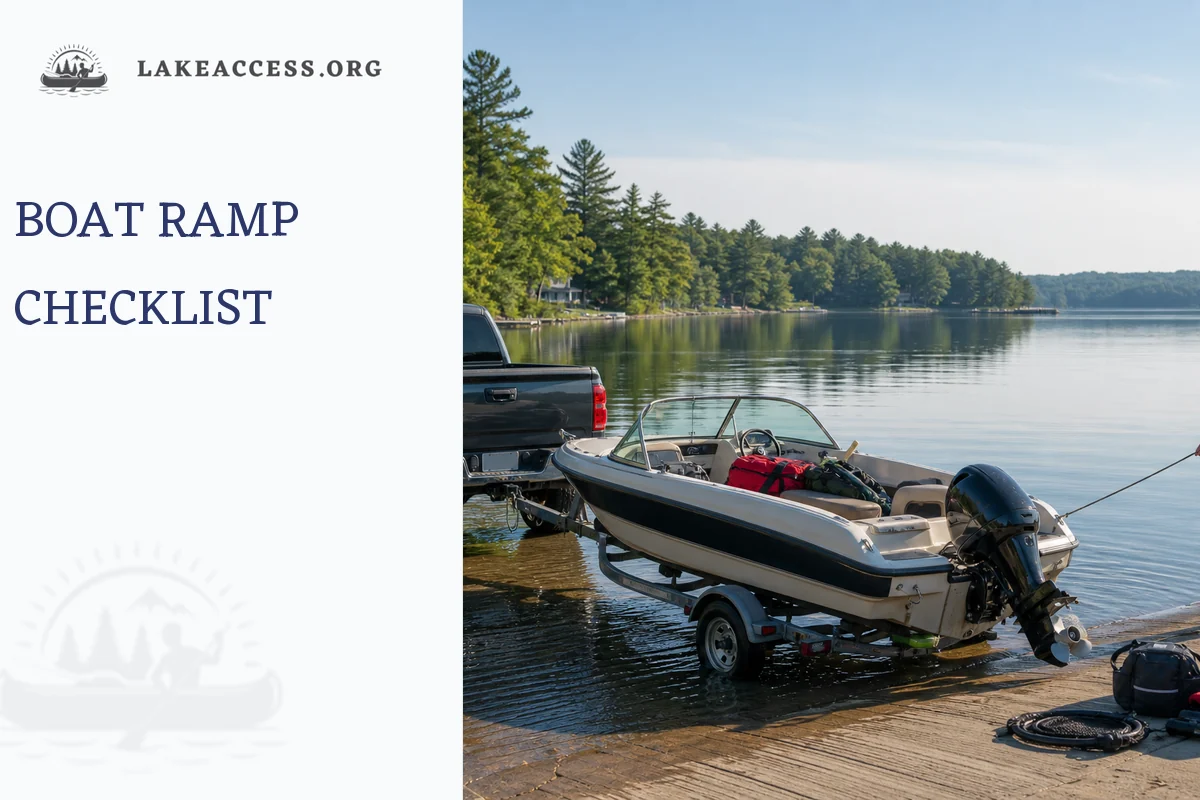
If this is your first time using a boat ramp, the best rule is simple: do every task you can in the staging area, not on the ramp. Load gear, check safety equipment, install the drain plug, attach dock lines, remove tie-downs, and brief passengers before you back down. At the ramp, launch, move the boat away, park, and clear the lane for the next boater.
This checklist is written for new trailer-boaters using a public lake ramp with a small powerboat, fishing boat, pontoon, or similar recreational boat. It does not replace your state boating laws, local ramp signs, marina rules, or the owner’s manual for your boat and trailer. Before your first launch, check your state boating agency through NASBLA’s state boating contacts, review U.S. Coast Guard safety equipment guidance, and take a boating safety course if you have not already.
For more LakeAccess planning help, start with the Boating hub, the broader Guides hub, and lake-specific planning from the Lakes hub.
Quick boat ramp checklist
Use this as the short version before you leave home and again when you reach the staging lane.
| Phase | Do this before moving on | Why it matters |
|---|---|---|
| At home | Charge batteries, check fuel, keys, registration, plug, straps, PFDs, and weather | Problems are easier to fix in the driveway than on the ramp |
| Staging area | Load gear, install drain plug, remove transom straps, attach bow and stern lines, brief passengers | Keeps the ramp lane open and reduces rushed mistakes |
| Backing down | Windows down, spotter visible, trailer straight, no passengers behind vehicle or trailer | Prevents blind-spot accidents and awkward resets |
| Launch | Float the boat, control it with lines, move it to the courtesy dock or away from the ramp | Clears the lane quickly |
| Parking | Driver parks tow vehicle and trailer while boat waits clear of the ramp | Avoids blocking other launches |
| On the water | Wear PFDs, connect the engine cut-off switch link when required, idle near the ramp | Keeps the first few minutes calm and legal |
| Retrieval | Prep away from the ramp, back in when ready, winch boat on, pull out, secure in tie-down area | Keeps loading quick and orderly |
| After use | Clean, drain, dry, remove plants/mud, pull plug where required, secure boat for towing | Helps prevent invasive species spread and protects your rig |
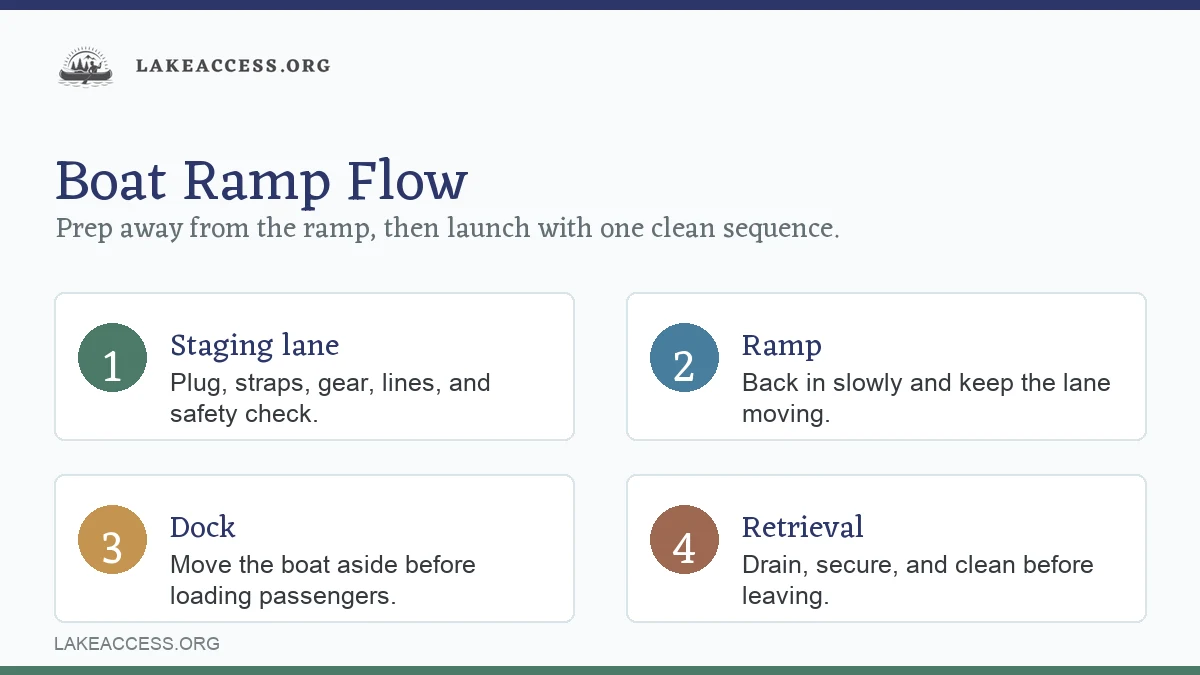
First-Time Boat Ramp Flow
- Stage: gear in, plug in, lines on, straps off.
- Launch: back straight, float boat, keep control with lines.
- Clear: move boat to courtesy dock or holding area.
- Park: tow vehicle and trailer leave the ramp lane.
- Retrieve: trailer in only when the boat is ready.
- Clean: clean, drain, and dry before leaving or before the next lake.
Before you leave home
A smooth ramp visit starts before the tow vehicle moves. First-time boaters often focus on backing the trailer, but the most avoidable delays are usually basic checks: a missing key, a dead battery, no drain plug, expired registration, empty fuel tank, or life jackets buried under gear.
Safety and legal checks
The U.S. Coast Guard’s federal guide explains that federal equipment requirements are minimum requirements and that state rules may add more. That matters at the ramp because local officers, lake patrols, and marina staff may check more than one thing: registration, boater education, PFDs, throwable devices, fire extinguishers, lights, sound signals, visual distress signals where required, and local operating rules.
At minimum, confirm:
| Item | First-time boater check | Source-backed note |
|---|---|---|
| Life jackets | One properly sized, U.S. Coast Guard-approved wearable PFD for each person | The Coast Guard emphasizes fit, serviceable condition, and accessibility |
| Child PFD rules | Check both federal and state age rules before the trip | Federal law covers children under 13 while underway, with exceptions; state rules may vary |
| Throwable device | Check whether your boat length and water type require one | Requirements vary by vessel and operating area |
| Fire extinguisher | Confirm type, charge, accessibility, and whether your boat configuration requires it | Do not wait until inspection day to find an expired or discharged unit |
| Sound signal | Whistle, horn, or other approved sound-producing device | Essential for warning and signaling |
| Navigation lights | Test before leaving if there is any chance of low-light operation | Ramp delays get worse after sunset |
| Engine cut-off switch link | Use it when required and practice clipping it on | Federal rules apply to covered recreational vessels under 26 feet with 3+ hp when operating on plane or above displacement speed |
| Registration and education card | Bring current paperwork and any required boater education proof | Use your state agency for current rules |
If you are brand new, schedule a free Vessel Safety Check through the U.S. Coast Guard Auxiliary or America’s Boating Club before the season. It is easier to learn your missing items in the driveway than in a launch line.
Check weather, water, and ramp conditions
For coastal waters and the Great Lakes, use NOAA National Weather Service marine forecasts before you tow to the ramp. Inland lakes may also have local forecasts, wind forecasts, reservoir notices, launch pages, park alerts, or water-level updates from state, county, or managing agencies.
Do not treat a sunny driveway as proof of safe boating weather. Wind across an open lake, afternoon thunderstorms, cold water, fog, current near dams, and low-water ramps can all change your launch plan.
Before you go, check:
- Official weather forecast and watches or warnings
- Wind speed and direction at the lake
- Local ramp closures, fees, hours, and parking rules
- Water level, low-water hazards, or steep-ramp warnings
- Required permits, inspections, reservations, or invasive-species stickers
- State life jacket, boater education, speed, towing, and alcohol rules
For lake-trip planning beyond the ramp, the Lakes hub and Guides hub are good next stops.
The 10-minute staging-lane checklist
When you arrive, do not pull straight onto the ramp unless your boat is already ready to launch. Use the parking lot, staging lane, or rigging area. Georgia DNR’s ramp guidance makes the same point: prepare before getting in line, observe local ramp conditions, and use bow and stern lines to control the boat after launch.
Staging steps
- Park in the staging area, away from the ramp lane.
- Walk down and look at the ramp before backing. Notice slope, algae, drop-offs, wind, current, dock position, and traffic flow.
- Load coolers, fishing gear, towels, water toys, and safety gear into the boat.
- Put the drain plug in.
- Remove transom tie-downs, but keep the bow winch strap and safety chain connected until the boat is at the water.
- Attach a bow line and stern line.
- Raise or secure the outboard or sterndrive for backing down, following the owner’s manual.
- Disconnect trailer lights if your trailer or vehicle manual calls for it.
- Put passengers, children, and pets in a safe waiting spot away from moving vehicles and trailers.
- Brief your crew: who holds lines, who parks, where everyone waits, and what happens if the boat will not start.
Ramp courtesy callout: Anything that can be done away from the ramp should be done away from the ramp. That includes loading gear, removing covers, finding life jackets, applying sunscreen, arranging fishing rods, and discussing the plan.
Launch without blocking the ramp
When it is your turn, move with purpose but do not rush. Most first-time ramp mistakes happen when the driver feels watched and hurries. A clean, slow launch is better than a fast reset.
Simple launch sequence
- Back down with the trailer straight. Use a spotter if you have one.
- Stop before the tow vehicle’s rear wheels are unnecessarily deep in the water.
- Set the parking brake and keep firm control of the vehicle.
- Unhook the bow safety chain and winch strap only when the boat is ready to float and someone controls the lines.
- Float or gently power the boat off, depending on ramp rules and boat type.
- Move the boat to the courtesy dock, shoreline holding area, or another safe spot away from the launch lane.
- The vehicle driver parks the tow vehicle and trailer.
- Passengers board from a safe dock or approved boarding area, not from behind a moving trailer.
Power loading is restricted or discouraged at many ramps because prop wash can damage ramp ends and create holes. Follow posted local rules. If you are unsure, winch the boat on and off instead of blasting throttle at the ramp.
First minutes on the water
Once the boat is clear of the ramp, do not immediately accelerate. Use the first few minutes to settle the boat, check steering, confirm cooling-water flow where visible, stow lines, and make sure everyone knows where to sit.
New boaters should keep the plan boring:
- Idle away from the ramp, docks, swimmers, anglers, and no-wake zones.
- Have everyone wear a life jacket, especially children, weak swimmers, and anyone moving around a small boat.
- Clip on the engine cut-off switch link when it applies.
- Keep weight balanced and passengers seated while underway.
- Avoid towing sports, nighttime boating, rough weather, and crowded holiday ramps until basic handling feels routine.
If you are still learning boat setup, see LakeAccess guides such as Best Layout Boats for Duck Hunting and Best Aluminum Jet Boats for Shallow Water for examples of how hull type, load, and water conditions affect handling.
Retrieval checklist
Retrieval is the same courtesy problem in reverse: get ready away from the ramp, enter the lane only when the boat and trailer are ready, then pull out and finish securing the boat somewhere else.
| Step | Do it where? | What to check |
|---|---|---|
| Drop off vehicle driver | Courtesy dock or safe shoreline | Boat stays clear of ramp lane |
| Prepare boat | Away from ramp | Lines ready, passengers briefed, loose gear stowed |
| Back trailer | Ramp lane | Trailer straight and deep enough for your boat, not excessive |
| Load boat | Ramp | Idle or guide boat on gently; follow local power-loading rules |
| Winch and safety chain | Ramp | Bow snug to roller, winch locked, safety chain attached |
| Pull out | Ramp to tie-down area | Clear the lane before unloading coolers or wiping down |
| Road secure | Tie-down area | Transom straps, plug removed if required, lights connected, motor supported, gear secured |
Do not stop at the top of the ramp to unload the boat, wipe the hull, rearrange coolers, or debate dinner. Pull forward to the tie-down area first.
Clean, drain, dry before the next waterbody
Aquatic invasive species can move on boats, trailers, anchors, motors, livewells, bilges, bait buckets, and wet gear. The U.S. Fish & Wildlife Service’s plain-language guidance is easy to remember: clean off visible plants, animals, and mud; drain water-containing areas; and dry equipment before another launch.
At the ramp or cleaning station:
- Remove plants, mud, and debris from the hull, trailer, prop, anchor, bunks, rollers, and fishing gear.
- Drain bilge, livewell, motor, ballast, and other water-holding compartments where legal and appropriate.
- Pull the drain plug for transport when required by state law.
- Dispose of bait and debris according to local rules, not into the water.
- Use hot water, pressure wash, decontamination stations, or drying times where required by the waterbody.
Rules are especially important on lakes with zebra mussels, quagga mussels, hydrilla, giant salvinia, or other regulated species. Do not guess. Check the lake manager or state invasive-species page before moving between lakes.
Common first-time mistakes
Most ramp tension comes from the same avoidable habits.
| Mistake | Better move |
|---|---|
| Loading gear on the ramp | Load in the staging area |
| Forgetting the drain plug | Put it on a written checklist and verify before backing down |
| Removing the bow strap too early | Keep winch strap and safety chain attached until the boat is at the water |
| Letting passengers stand behind trailer | Keep everyone in a safe waiting area |
| Starting the engine for the first time on the ramp | Test and maintain at home according to the owner’s manual |
| Blocking the courtesy dock | Pick up or drop off, then move away |
| Power loading where it is restricted | Winch the boat on or follow posted ramp rules |
| Securing for road travel in the ramp lane | Pull to the tie-down area first |
If the boat will not start, the plug is missing, the battery is dead, or the wind is pushing you sideways, pause and clear the lane if you can. There is no shame in resetting. A slow reset is safer than a rushed mistake.
What to keep in the tow vehicle
The tow vehicle is part of the launch system. Keep a small ramp kit in it so small problems do not become lane-blocking problems.
| Ramp kit item | Why it helps |
|---|---|
| Spare drain plug | Cheap backup for the most common panic moment |
| Wheel chocks | Helpful on steep or wet ramps |
| Tow strap or recovery strap | Useful if a vehicle needs assistance; use safely and within ratings |
| Basic tools | Pliers, screwdriver, adjustable wrench, spare fuses |
| Trailer light adapter and spare bulbs | Helps solve legal road-travel issues before leaving |
| Towels and gloves | Better grip on wet lines, winch strap, and trailer parts |
| Printed checklist | Works when phones are wet, dead, or in poor signal |
| Trash bag | Keeps packaging, bait containers, and broken gear out of the lake |
For upkeep after the trip, Best Way to Remove Boat Oxidation is a useful maintenance companion. For bigger build or ownership projects, see How to Build a Pontoon Houseboat Safely.
Final first-launch plan
For a first-time boater, the best boat ramp plan is not heroic. Pick a quiet weekday morning, bring one calm helper, use a ramp with a courtesy dock, avoid high wind, and practice when the ramp is not crowded. Prepare in the staging area, launch without lingering, retrieve with the same courtesy, and clean, drain, and dry before leaving.
After one or two calm launches, the ramp feels much less mysterious. The checklist does not change; you just stop needing to think about every line.
Related LakeAccess links
- Boating
- Guides
- Lakes
- Best Aluminum Jet Boats for Shallow Water
- Best Layout Boats for Duck Hunting
- Best Way to Remove Boat Oxidation
- Boat Rentals on Lake Winnipesaukee
Sources
- U.S. Coast Guard, A Boater's Guide to the Federal Requirements for Recreational Boats — Used for federal safety equipment, operator responsibilities, vessel safety checks, and state-law caution.
- U.S. Coast Guard, Life Jacket Wear / Wearing your Life Jacket — Used for PFD carriage, fit, access, and child-life-jacket notes.
- U.S. Coast Guard, Engine/Propulsion Cut-Off Devices — Used for engine cut-off switch link guidance for covered recreational vessels.
- U.S. Coast Guard, Accident Statistics — Used to note that boaters should check the latest USCG safety data; 2024 is the latest posted annual report as of July 9, 2026, while 2025 is pending.
- U.S. Coast Guard, Boating Safety Courses — Used for the recommendation to take a basic boating safety course before a first launch.
- NASBLA State Boating Contacts — Used for state boating-law and education-rule lookup guidance.
- NOAA National Weather Service Marine Weather Services — Used for checking official marine forecasts and warnings before launching on coastal waters and the Great Lakes.
- Georgia Department of Natural Resources, Ramp Etiquette — Used for ramp-specific staging, launch prep, bow/stern line, and courtesy guidance.
- U.S. Fish & Wildlife Service, Clean, Drain, Dry — Used for invasive-species prevention steps after leaving the ramp.